Thursday, 15 October 2015

No, You Don't Need A Gun To Overthrow The Government

So this showed up in my news feed last month:

And I began to feel a chill wind on my neck that there are people in this country who look at the amazing results of the Firearms Act of 1996 and the gun buyback scheme that have made us the go-to example anytime the Americans raise the issue of gun control... and want to go back to the fucking bad old days.

I posted a reply, asking who this law was supposed to benefit, but nobody from the LDP answered. One of those on my friendslist did reply with something about "responsible gun owners," but I think we can dismiss that straight away, because I don't think I've ever met an irresponsible one. A majority of my immediate family are SSAA members who like their target shooting, and there have been multiple occasions where we've had to eat dinner in front of the TV because they've commandeered the dinner table reloading shells. They're enthusiasts who keep all their shit locked in a safe as per requirements, and they're not who the LDP are targetting. They made that clear when they posted a video revealing this is explicitly about self defence, so let the record show: nothing I am about to say applies to hunters and sportsmen.

Now, to be fair, all credit to the LDP for posting their policies like this so we can discuss them openly. Be nice if there was more of it. But for those who are less familiar with the mythology of the loony Right, let's be clear there's only one reason they want unregistered semi-automatics out there, and it's this scene from Red Dawn (1984).


No really, that's it. Because otherwise Patrick Swayze can't fight off the Russians Chinese North Koreans. Libertarians both here and in the States are perfectly happy to see mass shootings on a monthly basis so they can fight off an imagined invasion in the indeterminate future.

The fact that firearms won't actually help them do that doesn't seem to register.

In all seriousness, this isn't even a question anymore. In the hands of you, an untrained individual, a gun offers five-eights of fuck-all degrees of actual protection. No, it doesn't. No, it's not your opinion, you're just wrong. Whether through narcissism or human brain just sucking at statistics, everyone assumes they'll turn out to be the exception. Well, no you won't. Only 1 in 5 untrained people ever fire their weapons in combat, which means the odds are you – yes, you, personally – will not shoot back if someone comes at you with a gun. And that's damn sensible of you. As this fantastic video shows, having some cold steel on your hip won't make a damn bit of difference when the shit gets thick. Your best moves are ducking for cover or running for it.


Likewise, in an article on The Nation titled "Tactical Experts Destroy the NRA's Heroic Gunslinger Fantasy", some tactical experts destroy the NRA's heroic gunslinger fantasy (although it's more or a nut-and-bolt dismantling. Very satisfying). The FDchief has a way with words that gets the message across much more colourfully, though, because you'll notice he used to be in the fucking army.
Look, I may have been just a simple grunt medic, but I was smart enough to figure out that the way to stop a bad guy with a gun is a fucking battery six with HE-quick in effect. Except you can't fucking do that in a shopping mall or a theatre.

And short of that, you're pretty much just tossing the dice.

Teaching a human being to take effective deadly action is a damn difficult thing. We spend weeks and months training Joe and Molly to do that and the statistics show that we only succeed in about 30-50% of the time. Most people – even most trained soldiers – react to danger by getting their heads down and trying to stay in defilade.

But let's assume that the training works and our hero heads towards the sound of shooting. What does he or she encounter?

Fucking chaos, that's what. The nutter is the center of it, shooting left and right... but everyone else is amplifying the chaos; screaming, running, dying... it's total mayhem.

It takes an assload of training to even begin to sort this stuff out, and without experience the likelihood of sorting it wrong is damned likely; that's why we try and make veterans into our combat NCOs. Because they've had to sort through this gibbering chaos and hopefully – seeing as they're still alive – have gotten it right.

But there's another, even more complicating and difficult factor here.

This isn't a straightforward military red-on-blue. There's at least four factions; the "bad guy" shooter(s), the prospective "good guy" shooter(s) – if more than one made more fraught by having no connection or experience working together, meaning just as likely to mistake each other for the "bad guy" – the people being shot at... and the police.

The coppers have NO idea who the "bad guy" is. To them anyone with a weapon out is just as likely to be the murderer, which has, in previous massacres, nearly led to blue-on-blue gunfire.

I'm sorry. That's fucking nutzoid land. Makes the Battle of Ia Drang look like a sorority pillow-fight.
Paul Bibeau over at Goblinbooks paints a similar picture in a short story sardonically titled, "Okay, Which One Of Us Is The BAD Guy With The Gun?" If you strap on a gun, your odds of getting into a gunfight just went up a thousandfold. And if you get into a gunfight, you're pretty likely to get shot – by the police, if no-one else.

So it's demonstrably better not to have armed citizens out there, but what about the "criminals don't follow laws" approach, articulated so well by Terry Pratchett in Night Watch?
Vimes wondered if [Constable Swing] sat up in bed in the middle of the night and hugged himself when he'd dreamed that one up. Confiscate all weapons, and crime would go down. It made sense. It would have worked, too, if only there had been enough coppers – say, three per citizen.

Amazingly, quite a few weapons were handed in. The flaw, though, was one that had somehow managed to escape Swing, and it was this: criminals don't obey the law. It's more or less a requirement for the job. They had no particular interest in making the streets safer for anyone except themselves. And they couldn't believe what was happening. It was like [Christmas] every day.

Some citizens took the not unreasonable view that something had gone askew if only naughty people were carrying arms...
It's called the Lawbreaker's Paradox, and as this page says:
Without exception, every law could be refuted by the lawbreaker's paradox. Laws against rape, murder, and theft, for example, are rarely followed by rapists, murderers, and thieves, but the fact that such people exist in society is the reason behind such regulations in the first place...

Not only is this conservative sound-bite irrelevant to gun reform discussion, it’s also socially untenable and dangerously naïve. If we were to accept that a law is justified only if it has a 100% compliance rate, then we could systematically dismantle every existing law until nothing remains but the state of nature.
This page also has graphs showing how gun violence went down in both Australia and Brazil after gun controls were introduced, which I haven't reproduced because go read the whole thing you lazy bum. That observed and recorded objective reality runs counter to the ammosexual's argument, but it's actually because they got something right – criminals don't obey the law. That means you know what else criminals don't do? Buy their guns legally.
The vast majority of guns in America are purchased and owned – that is, introduced into society – by white people. Each year about 500,000 guns are stolen, mostly from these same white people. And the vast majority of those guns end up in the inner city, sold cheaply or traded for legal or illegal goods and services. – Michael Moore, Stupid White Men
So those criminals you're so scared of? They got their guns from you. Gun control works because when you take guns out of the hands of the law-abiding, they stop trickling down to the criminals. In other words, it doesn't matter that criminals don't obey the law, gun control laws DO take guns away from criminals. No, it doesn't matter if you disagree. No, it's not your opinion, you're just wrong.

So let's review: having a gun on your hip won't help you defend yourself, greatly multiplies the risk to yourself and others through accidental discharge, is likely to get you shot by police who mistake you for the bad guy, is even more likely to get you shot by your fellow armed citizenry who mistake you for the bad guy, and WON'T ACTUALLY HELP YOU DEFEND YOURSELF.

"Guns for self defense/overthrowing tyranny" isn't just a very expensive solution with a lot of collateral damage, it's no solution at all. So what will protect you from a tyrannical government? What does that sacred Second Amendment the Americans are so fond of look like today? Funnily enough, we've been in touch with people who've been showing us how for the last 15 years, and they've been on the news regularly, but we don't seem to've absorbed the lesson.

Can you guess? They're urban guerrillas, the freedom fighters of the modern age. And what is the preferred instrument of the urban guerrilla? Heh, this is gonna put me on a watch list somewhere, but so be it: it's the improvised explosive device. The infamous IED.


Are you serious about your Second Amendment rights? Do you genuinely want to prepare to overthrow your government in case it turns tyrannical? Then forget three-rounds-rapid at your weekend survival camp and learn to make a pipebomb. Dismantle your automatic garage door and learn to wire it to a detonator. As the Iraqi militias found out pretty quickly, sending untrained amateurs against government troops in a stand-up fight is a good way to get them all killed, especially once the drones and attack choppers home in. Since a guerrilla's first job is to stay alive, they soon found it's much better to bury an artillery shell under a crossroads and wait for an enemy patrol.
On the very first mission I ever flew, we saw what's called "The Eye of Sauron" – a spot where a fiery tire was used to soften asphalt in order to plant an IED. The cool metal against the hot asphalt created an eye effect. A convoy was heading straight for it, but we couldn't communicate with them. They were jamming all radio frequencies in a (useless) attempt to stop any bombs from detonating. I don't think I've ever felt more helpless than I did in that moment.

Five American soldiers died when that convoy hit the IED. – Cracked, 6 Myths About Drone Warfare You Probably Believe
By 2010 the U.S. Army's own newspaper was admitting that 75% of their casualties in Afghanistan were from IEDs. See, guys? This is what works. This is how you fight tyranny, staying alive and polishing up your alibi while they blunder into your latest trap. To learn this kind of thing you have to turn to the master, Gary Breacher, who despite his occasional lapses on military history is second-to-none when it comes to urban guerrillas. Here's his walkthrough on how to get your liberation started:
The way somebody usually asks this is like, “Which would you rather have, an RPG-7 or a Carl Gustav?” or “Which is better at stopping tanks/anti-personnel/penetrating bunkers?” Reminds me a lot of standing at the bus stop watching cars go by, waiting with other kids and somebody’d say, “Which would you rather have, a BMW or a Jag?” There are a lot of answers to that one, but I’d always say, “Either one – where’s the keys?” And they’d stop talking to me because I ruined the whole game.

You see where I’m going: back to the bus stop, no BMW, no Jag. Where you, the “you” that’s actually here, actually are. Imagine you’re on that same bus stop you were on at age 13 and you suddenly need an antitank weapon. Who knows, maybe you’re having in-law problems or you want to blast a hole in a bank wall or you’ve decided to start your own guerrilla movement. Where would you get your Carl Gustav? Or your RPG-7, or anything else?

Yeah, I like that, it’s a better way to think about this stuff: You’re standing at that same bus stop and you need an antitank weapon. Whucha gonna do?

First thing I’d do is lower my expectations, away from antitank weapons, because they’re hard to get in this country, and anybody who says he’s got one is probably getting a check from Uncle Sam and has a nice little family in the Witness Protection Program. Good way to end your guerrilla movement in one step, asking around for stuff like that.

You have to start with what’s easy to get. And in this country, that’s firearms and cars. You’d have to ask yourself, why’d I need this antitank shit? What can I do with cars and guns and careful planning instead?

America’s got its own rules about weapons, just like any other place. We think it’s weird they sell RPGs at the open market in Kandahar, but they probably think it’s weird how we can buy machine guns but not AT weapons. So you start with cheap, easy to find automatic weapons like Loughner’s 31-round Glock (and excuse me before you tell me it’s not technically automatic – 31 rounds in a few seconds is auto, and the fact that you have to pull the trigger 31 times doesn’t change that fact – in fact it’s a pleasure on its own, like a stick shift).

Lots of ways to get some of those. Gun shows in wacko states like Nevada. Show up and talk some Second-Amendment shit and you’ll walk out with serious mayhem in your shopping bag and no written record at all. If that’s too conspicuous for you, try burglary. Hit a rich neighborhood in someplace like Arizona and you’d probably get a good weapon every second house.

Or just buy the damn things. Take advantage of the local availability. If the local rules say you can buy a 31-round Glock and tell the man it’s for home defense, then do it, take advantage of the customs. Just make sure you get standard-caliber weapons. You don’t want some CSI Fed digging odd slugs out of your first kills.

Now you’ve got small arms – but they don’t look so small when someone’s pointing one at you, telling you to open a door. And that’s what small arms are good for: getting people to open doors. If you really, really gotta have your antitank weapon, you can use your small arms and some trickery to get it. There are a million ways, all involving having somebody in your group become a cop, date a cop, join the service, and so on. People, not hardware, that’s what it’s about. Think of all the ways you can work some metal fatigue on the bank, or armory, you want to get into: there’s sex – sex makes people do dumb shit, so you got any sexy volunteers in your groups willing to hang out in cop- or GI bars? Money works; use those small arms to take it and a whole lot of people will suddenly open doors for you. And if all that fails, small arms work as well as a Hellfire when you’re pointing one at somebody’s forehead.

But I’d say, why do you need that little rocket tube? They’re not going to come for you in tanks, and if they do you’re through anyway. You need to stay light and hard to find.

I was arguing this online with somebody and they said something like, “I just wanted to talk antitank weapons, I wasn’t serious about starting a war.” Well, that’s the whole problem, off in dreamland. – Gary Brecher, RPG vs BMW
Bear in mind "opening doors" can be done equally well with a knife, or  – since knives are restricted in Australia as well – a hammer or a screwdriver, with the added bonus that knives, hammers and screwdrivers have much lower rates of accidental discharge. Whatever, the point is, why aren't the ammosexuals talking like this? Because this is serious terrorist shit, obviously. Which is my real point – anyone actually thinking about overthrowing the government is going to be considered a terrorist, but the people who talk longest and loudest about the Second Amendment are the first ones to squeal like little bitch at the suggestion of terrism in their neighbourhood. They're not defending their constitution, they're off in dreamland, living their revolting little fantasy of walking around with a permanent hard-on and ejaculating it into anyone who looks at them funny. Blackwater thugs, basically.

This fantasy is where the NRA and firearms industry makes its money, which brings us full circle, back to the Liberal Democratic Party. Because in the end, this is what libertarianism boils down to. Doug Muder at The Weekly Sift has a pretty devastating character assassination of the typical libertarian footsoldier:
It’s also the perfect belief system for a young male (and maybe, by now, young females too). You don’t need knowledge or experience of any specific situations, you just need to understand the One Big Idea That Solves Everything: Other than a small and appropriately humbled military and judicial establishment, government is bad. Protect life, protect property, enforce contracts – and leave everything else to the market.
Yeah, you know who else wants to leave everything to the market? The people who've already beaten it. The 1%. These people play on our fear and ignorance to keep the government out of their business, because make no mistake, libertarianism is for the rich.


The only people who could possibly benefit from relaxing the ban on semi-automatic long arms in Australia are the owners of the Lithgow Small Arms Factory, and they don't mind in the slightest that the rest of us would pay for it in blood. I wouldn't try to ban the LDP from existing, but whatever policies they end up putting out are going to benefit Gina Rinehart, not the dupes who actually voted for them. Because as G.K. Chesterton warned us:
You've got that eternal idiotic idea that if anarchy came it would come from the poor. Why should it? The poor have been rebels, but they have never been anarchists; they have more interest than anyone in there being some decent government. The poor man really has a stake in the country. The rich man doesn't; he can go away to New Guinea in a yacht. The poor have sometimes objected to being governed badly; the rich have always objected to being governed at all.

Sunday, 4 October 2015

Farhad Jabar Khalil Mohammad Fought the Law, And We All Lost

So apparently some arsehole has shot police-employed IT worker Curtis Cheng in Parramatta.

Pictured: Some Arsehole
First of all, my sympathies to Cheng's family and friends and the fucking awful shit they're going through right now. That's priority one. Sadly, priority two is that this particular arsehole happened to've been of Middle Eastern extraction, and in the current climate that brings complications. Since both the right-wing Islamophobe freakout and the left-wing victim-narrative counter-freakout will be in full swing by now, it might be a good time to post some of what the War Nerd had to say when ISIS darling Jihadi John was revealed to be Mohammed Emwazi of jolly ol' London.
Why, oh why, would a rich boy from a nice home go on to make snuff movies? That’s the whine you hear from the press. As always, first thing to do is question the question; why wouldn’t he? He’s famous, isn’t he? The hero of his own movie, “and the papers want to know whose shirts he wears,” as the feller said. It’s a classic male fantasy, and gore is a classic feature of those fantasies. What astonishes me is that so few middle- and upper-class Muslim kids are succumbing to it.

True, Mr. Emwazi is unlikely to spend his thirtieth birthday aboveground, but that idea probably doesn’t register with him. It usually doesn’t, with young males... – The War Nerd, Why Did Mohammed Emwazi Become Jihadi John? 27 Feb 2015
If you want to know how far removed our officials are from this basic idea, check out what they had to say in the ABC coverage: Commissioner Andrew Scipione said, "We believe his actions were politically motivated and therefore linked to terrorism," while Prime Minister Malcolm Turnbull denounced it as "cold-blooded murder, targeting the NSW Police Service."

I don't pretend to know everything – or anything, come to think of it, when I don't know the dude or any of his family – but that sounds absurd to me. 15-year-olds don't have politics, and they do nothing cold-bloodedly. At that age we aren't really capable of anything beyond an emotional response. What passes for our minds is focused on exactly one thing – pussy – and when we can't get it (and we usually can't, especially growing up in a conservative religious community), we turn to the next best thing – blood and glory. Emphasis on the blood.

"What's really concerning police is there's no rhyme or reason to these current terror threats," said Pat Gooley, ignoring the tautology that if there's no rhyme or reason to it then it's not fucking terrorism. Terror is about gestures, about undermining the public's sense of safety until the whole world's paranoid and ready for war. 15-year-olds don't think as long-term as that, they just want their gore and want it now. Far from a terrorist, Fuckhead Jabar sounds like a simple loser, a young loser who found a gun after the strain of adjusting to the Western Suburbs, where the language is impenetrable and girls won't talk to him, broke his feeble little brain in half. Maybe, just maybe, he'll turn out to've been indoctrinated by some terror cell laying low in Parramatta, but personally I doubt it – our security people have turned out to be pretty good at tracking and busting actual terror cells. I'm guessing instead Jabar'll turn out to be a very ordinary kid, not that bright and with no obvious axe to grind. And just like Nicholas Teusant of Acampo, another wannabe splatter hero, that ordinariness will be the whole point.
You’ll notice that my friend’s comments keep coming back to how ordinary Nicholas the Jihadi really is: “Guy is playing by every single fucking rule we were taught growing up.” If there’s anything unusual about Nicholas the Wannabe Warrior, it’s that he’s a poor specimen. He needed to look all the way to Syria to find some way to make a “snowflake” of himself. Most find a sanity-saving fiction nearer home – but then most didn’t have to live in a trailer in Acampo. – The War Nerd, Who Exactly Are The Jihadis (And Why Aren't There More Of Them?), 28 Mar 2014
So, how do we deal with "domestic terrorists" like Fuckhead Jabar Khalil Mohammad?

A girlfriend who puts out and a copy of Modern Warfare.

Thursday, 10 September 2015

Gone In Sixty Seconds

To save his brother's life, Randall "Newcastle" Raines must pinch fifty cars between beer o'clock and sparrowfart and deliver them to the South Yarra pier, or else crime boss Raymond "The Chippie" Calitri will track down his family.

The List

'63 Ford Cortina GT................................................Sheila
'64 Holden EH S4 Special..........................................Matilda
'67 Holden HR 186S...................................................Shae
'67 Ford XR Falcon GT...............................................Alice
'68 Holden HK Monaro GTS 327........................................Kylie
'68 Ford XT Falcon GT...............................................Danni
'69 Holden HT Monaro GTS 350.........................................Isla
'69 Ford XW Falcon GT-HO............................................Coral
'70 Holden HG Monaro GTS 350........................................Beryl
'70 Holden LC Torana GTR XU-1........................................Opal
'70 Ford XW Falcon GT-HO Phase II....................................Ruby
'70 Chrysler VG Valiant Pacer 245................................Sapphire
'71 Holden LJ Torana GTR XU-1......................................Nellie
'71 Ford XY Falcon GT-HO Phase III................................Raelene
'71 Chrysler VH Valiant Charger R/T E38.............................Kelly
'72 Chrysler VH Valiant Pacer 265....................................Dawn
'72 Chrysler VH Valiant Charger R/T E49...............................Bec
'73 Ford XA Falcon GT Hardtop RPO83................................Brooke
'74 Holden LH Torana SL/R 5000 L34..................................Maddy
'77 Holden LX Torana SS 5000 A9X....................................Carly
'78 Ford XC Falcon Cobra............................................Betsy
'79 Holden VB Commodore SL/E.......................................Acacia
'79 Ford XD Falcon Fairmont Ghia “Phase 5”.........................Aurora
'81 HDT VC Commodore SL/E......................................Chardonnay
'82 Ford XE Falcon Fairmont Ghia ESP “Phase 6”......................Roper
'82 HDT VH Commodore SS Group Three..............................Breeanah
'84 HDT VK Commodore SS Group Three “White Pointer”...............Adeline
'85 HDT VK Commodore SS Group A “Blue Meanie”.....................Merinda
'86 HDT VL Commodore SS Group A......................................Roma
'87 Holden VL Commodore LE Calais Turbo..........................Bacardee
'88 HSV VL Commodore SS Group A “Walkinshaw”........................Bindi
'89 HSV VN Commodore SS Group A SV5000.............................Jarrah
'92 HSV VP Commodore GTS........................................Kimberley
'92 Ford EB Falcon GT 25th Anniversary..............................Kaiya
'94 Ford ED Falcon XR6............................................Karinya
'94 HSV VR Commodore GTS...........................................Kalina
'96 HSV VS Commodore GTS-R..........................................Kiara
'97 Ford EL Falcon GT 30th Anniversary..............................Ember
'97 Ford EL Falcon XR6...............................................Zara
'02 Ford BA Falcon XR6 Turbo.......................................Brylee
'03 FPV BA Falcon GT-P..........................................Mackenzie
'04 HSV V2 Monaro GTO LE..........................................Elanora
'05 Holden VZ Monaro CV8-Z........................................Amarina
'06 HSV VZ Maloo R8.................................................Tayla
'06 FPV BF Falcon Pursuit.........................................Jacinta
'07 HSV VE Commodore GTS...........................................Tahlia
'09 FPV FG Falcon F6 Typhoon........................................Casey
'12 FPV FG Falcon GT R-Spec...................................Abercrombie
'14 FPV FG Falcon GT-F..........................................Shirleigh
'16 HSV VF Commodore GTS.......................................Diamantina

In reality, the movie would be over in ten minutes after Randall and his crew realise they could just back a transporter up to David Bowden's place.

Monday, 31 August 2015

Meanwhile, in Judea...

And while the Greco-Persian Wars were going on, what's that sound we're not hearing? That's the sound of the Jews not rising up and revolting against their Persian overlords. Why not? After nigh-constant warring the Egyptians, Assyrians and Babylonians (and in coming centuries, their Greek rulers as well), you'd think they'd be all over it. But instead the Hebrews laid down tamely under a Persian satrap and purred like cats in a lake of cream.

Pictured: Israel and Persia

Why? Well, for two reasons that I can see. One, after seventy years in Babylon, plenty of Jewish captives couldn't think of an awful lot of reasons to return to a Jerusalem they had never even seen and their grandparents had never shut up about, so they elected to stay in Babylon instead. Although remaining devout Jews, these Exiles rose to high positions in the imperial bureaucracy, and some even managed high positions at court (see: Esther). That meant there were plenty of sympathetic ears for Jewish grievances.

Apparently she was a white girl from New Orleans

And two – and this is the biggie – Israel was a nation completely defined by its state religion, and the Persians took great care to be religiously tolerant. In fact, more than that, Cyrus the Great established a habit of making offerings to the gods of whatever people he had conquered this week, partly because he didn't need any more enemies (especially supernatural ones), and partly because it was just good statesmanship. I know nobody likes thinking about Iraq these days, but ten years ago we had a perfect demonstration of this sort of thing in Basra, which was kept very quiet thanks to some smart management by the British army. Compare and contrast Najaf and Karbala, left to the tender mercies of U.S. troops on a mission of cultural assimilation, which went off like a double-bunger on Cracker Night. So of course, the first thing the Americans did was complain the British were a bunch of Arab-loving weaklings.
Some Basra residents complain that Britain, whose troops occupy Basra, is turning a blind eye while the religious establishment usurps the running of the city through intimidation and threats against secular residents. Explaining why the British are loath to intervene, Maj. David King, a British spokesman, says: “We are not here to dictate our way of life,” but merely “to provide a basic foundation to get Iraqis back on their feet.” 
America, watch and learn: this is how you run an empire, as the British well knew and so did the Persians. When 537 came around, Cyrus sent the Exiles home and one of his underlings even provided 1,000 darics to rebuild what became the Second Temple, which was consecrated in 516 on the express permission of Darius the Great. Many of the original golden vessels of the first temple, which had been plundered by the Babylonians, were likewise restored on the orders of Cyrus (see: Ezra).


Israel was no longer an independent kingdom, but they were free to gank animals in the Temple, and that was what really mattered. With their cosy relationship with the Persians blossoming, their influence on Persian religion was enormous, changing everything in their cosmology from... oh wait, sorry, I got that backwards. How embarrassing.

It was the Persians that had a profound effect on Judaism.

As I've mentioned, the Persians were followers of the prophet Zoroaster, who intriguingly may have been a contemporary of (though completely unconnected to) Moses. His Persian followers introduced such minor revisions as...

"Cosmic Dualism." Any good Christian today is at pains to point out that Satan is not the "god of evil," a being equal-but-opposite to God, but in Zoroastrianism that's almost exactly how it works. Ahura Mazda, the supreme, ethereal god of wisdom, harmony, order and general all-round goodness, is opposed by a chaotic counterpart called Ahriman, who is, in effect, God of Evil.

Yep, the very idea that the universe is locked in an epic battle between Good And Evil owes everything to Zoroaster, so without him we wouldn't have Star Wars. This separation of Good and Evil had a profound effect on how the Jews viewed YHWH. Before, he was more or less a tribal protector, a Jewish version of Marduk, a source of both light and dark as likely to hand out a dollop of plague as a good harvest. After, he was seen more as a Jewish version of Mazda, dishing out only blessings. This meant there was a lot of leftover evil that needed a driver, so the job ended up falling to Ha-Satan, the Accuser – Satan, who graduated from the supporting cast to become a powerful figure in his own right. You can see glimpses of the old view in the book of Job, a strong contender for the oldest story we have, where Job mutters weird lines like, "Shall we accept good from God, and not trouble?" and Satan behaves more like God's prosecuting attorney.

The Afterlife. Before, the Jews believed the dead – all the dead – went to a dreary Hades-like realm called Sheol, "the grave" (Ecclesiastes will seem less like an exercise in clinical depression if you keep this in mind). Under the influence of the Zoroastrians, the idea of a moralised afterlife with heavenly rewards for the good and eternal punishment for the wicked began to gain traction. The sheep were supposedly separated from the goats by means of crossing a bridge, which would be wider or narrower depending on how much good you'd done in life (so, Cracked concluded, "if you wind up in Zoroastrian heaven, avoid the tightrope walkers").

One of the sects of Jesus's day, the Sadducees, refused to believe in the afterlife, mainly because they were hardcore conservatives who stuck by the Torah and firmly rejected all this Persian claptrap (also because they were nobles and temple elites, not grubby commoners. As John Dolan said, "Nihilism’s one great weakness was that it had always been an elite cult, not considered transmissible to the masses... Nirvana was too cold a doctrine for peasants who equated fecundity with happiness").

Their Pharisaic rivals however – and Jesus – took this Persian stuff and ran with it. When on the cross Jesus told the two thieves, "Today you will be in Paradise with me," his word was the Persian pairi daeza, a walled or enclosed garden. It's a word that's trickled down to English through Greek, Latin and French, and one of the few definite Persian loanwords in the Bible – necessary because the Jews didn't have any such word of their own. In the Septuagint, the Greek translation of the Old Testament that would've been most familiar to the people of Jesus's day, it's also the word used for the Garden of Eden. Jesus's choice of words probably weren't an accident.

Other innovations include apocalyptic literature – the genre of the book of Daniel itself, incidentally – angels & demons and, depending on who you believe, maybe even monotheism itself. That's a fairly unsubstantiated claim, banished to the lunatic fringe of George Tsoukalos types, but it's something to keep in mind when poring over some of the older books of the Bible. Sometimes the editor's pen was a bit rough and bits of the older text get through.


I can already imagine some of my friends arcing up about this, as if my revealing where these ideas came from is the same as saying they're not true. Well, all I can say to that is that what's true is way, way above my paygrade... but Jesus certainly believed it, which ought to be enough for believers, while still containing enough objective truth enough to placate atheists. Personally I just think some people had an encounter with the divine, and like the blind men debating the nature of an elephant, were left fumbling for ways to get the message across, so they borrowed local cultural ideas of what a god is. Like El, the early version of YHWH worshipped by the Patriarchs, who was virtually indistinguishable from any other Canaanite tribal gods: was El the last and complete revelation of YHWH? No, but he was a lie they could understand. Was the YHWH of Moses the last and complete revelation of God's nature? No, but he was a lie the Israelites could understand. Is Paradise really the "walled garden" of a Persian king? No, but it's a lie we can understand. Was Jesus the absolute last and complete revelation of God's nature?

...We shall see. I can tell you, however, that there is a miracle here. A real one. The Jewish people captured by Nebuchadnezzar spent 70 years in Babylon, died of old age, and then their grandchildren and great-grandchildren returned to Jerusalem – all without losing their cultural identity as a people apart, a nation through whom all others would be blessed. Maybe someone knows something I don't and can correct me, but as far as I know, that's unique in all of human history. Conquered people don't keep their previous cultural identity, especially in the ancient Near East where military victory was granted by patron gods. Except this once.

Miracle. And it would be needed again soon, when the next beast of Daniel's vision came on the prowl.

What Really Happened At Thermopylae?

Three posts about the Persians, because they lasted just over two centuries, and because it gives me a chance to tell you about the Greco-Persian Wars, which were full of badassery and awesome. At the same time it'll give some insight into the Persian way of doing things, which will tie back into my exploration of Daniel in a later post. So let's get cracking.


Ionian Revolt
It began in the year 494 BCE. Darius the Great, King of Persia, was looking to expand into Europe and led armies across the Bosphorus and even across the Danube, where he fought a little war with the Skythians, which would have ended in disaster if not for his Ionian Greek contingent from the coast of modern Turkey, who held the Danube bridgehead.

Both Darius and the Ionians drew the wrong conclusions from this little escapade: Darius came to believe he could rely completely on the loyalty of his Ionian friends; the Ionians concluded that Darius was weak and the time was right to rebel. The city of Miletus, the richest and most brilliant of the Ionian cities with sixty colonies of its own, sent emissaries to Greece asking for help in overthrowing their Persian overlords. The Spartans, cautious as ever, refused; the Athenians, impulsive as ever, sent 20 ships complete with marines.

At first the Ionian revolt was a success, the Greeks marching inland and burning Sardis, the capital of Croesus that was now the seat of the local satrap. But retribution followed. A Greek fleet of 353 ships was destroyed by a Persian fleet of over 600 (maybe – Herodotus often exaggerates) in the Battle of Lade in 494; Miletus was captured and razed, and the inhabitants carried off to the mouth of the Tigris 1,600km away to be slaves. When the Athenian poet Phrynichus dramatised the event in The Capture of Miletus, the Athenians wept so bitterly he was fined 1,000 drachmas for depressing them.

Marathon
Knowing the Athenians had been cheerleaders to the Ionian Revolt, Darius got busy planning a punitive expedition into Greece itself. A massive army was sent to invade from the north along the Aegean coast, supported by a grand armada under his son-in-law Mardonius, which sailed parallel to the army. One thing they don't tell you in the movies is that as Mardonius passed through Ionia on the way to mainland Greece, he used his army to depose the Greek tyrants and install democratic governments instead (yes, really. It was probably just a way of damping down the flame of rebellion, but nevertheless...). With the invasion going well, Darius then sent ambassadors to all the other cities of Greece demanding symbolic offerings of ge kai hydor – Earth and Water. Having seen the size of his army, most of them gave it – all, says Herodotus, except Athens and Sparta. The Athenians allegedly put the ambassadors on trial and executed them by throwing them into a pit, suggesting they dig out their own earth; the Spartans threw theirs down a well, suggesting they collect their own water. I'm not sure why we're supposed to cheer for people who murder ambassadors visiting under a flag of truce, but there you are.

Unfortunately, before the Persians could avenge this insult, their fleet was wrecked by a storm while rounding the Mount Athos peninsula. This was a major bummer because that vast army needed the fleet for supplies. To give you an idea how good ships are for ferrying in cargo, consider that before the advent of railways in America, it cost as much to move a tonne of goods 50km inland as it had to move it across the entire Atlantic. Donkeys and camels were never going to match that kind of load-bearing capacity, and horses weren't used for transport in those days (in fact, they were part of the cargo on board the ships. Nobody in that era had horseshoes and it would've done them no good if their cavalry went to the trouble of riding all the way to Greece only to arrive with lame mounts). So the army abort and fall back to billets elsewhere.

Displeased, Darius removed Mardonius from command and sent another, smaller army from Kilikia by ship, under the generals Datis and Artaphernes. They landed on the coast of Attika, in the bay of Marathon, where there was a road leading all the way to the polis of Athens itself.

Athens had an ace to play, however: a colourful character by the name of Miltiades. His uncle of the same name had made himself king of a barbarian tribe living on what we now call the Gallipoli peninsula, but the advent of the Persians had put the nephew out of a job. He'd found refuge in Athens, where he became an archon, one of the city's ten elected generals and statesmen; it was he who prevailed on the polemarch Callimarchus to use his casting vote  to take Athens to war.

With that vote, Miltiades was effectively in charge of the Athenian military, and took a force of Athenian hoplites (including Callimarchus) up to Marathon and blocked all exits from the plain. A Mexican standoff ensued, but after five days the Persians got bored and decided to sail elsewhere, and started loading their cavalry (their best soldiers) back onto the ships. Seeing his chance, Miltiades attacked, the Athenians weighting their wings and advancing at the quick-step "a little over a mile," according to Herodotus, and cannoned into the milling Persian infantry. The Persians were enveloped and slaughtered: Herodotus claims 6,400 Persian dead for just 192 Athenians.


The Persians who had survived were then transported by fleet around Cape Sunium, to approach Athens from the Saronic Gulf. Seeing this, the Athenians about-faced and ran 33km back towards Athens to oppose them. When they arrived the Persians found the Athenians holding such commanding ground that it was impossible to attempt a landing, so they gave up and sailed home. A messenger subsequently ran all the way back to Athens to gasp, "We have been victorious!" – then fell dead from exhaustion. The slain were buried in a huge mound which still marks the site of the battle, and its veterans were held in high honour for the rest of their lives. But Callimachus had been killed, and without his restraint Miltiades went too far towards trying to reclaim his home at Gallipoli; he ended up dying in prison while awaiting prosecution by the Athenians.

Thermopylae
Not a man to give up easily, Darius planned another, even bigger army to invade Greece again, but before he could get it done the Egyptians revolted, requiring his attention there. Darius died in 486 while organising the Egyptian campaign, and the task of punishing Greece passed to his son Xerxes. The matter was not forgotten: every night, a slave stood by Xerxes's side at dinner and whispered, "Master, remember the Athenians."

So by 480, ten years after his father's expedition, Xerxes had an expedition of his own ready. This host deliberately included warriors from every corner of the Empire, because war wasn't just a way of conquering territory for the Great King. It was, as jerk-off middle-management types would say, a "team-building exercise." Guys under 25 are dangerous, especially when they don't have wives, jobs or children to tie them down. Too much free time gives them ideas; organising them into an army where your company commanders can beat the cheek out of them and put their natural bloodlust to work in a place far, far away from the heartland is just good management. Even better, a lot of them will be killed, and those who survive will return to their villages quietly traumatised and full of stories about what a fine fellow the Great King is, and how those people from Somewhere-stan our tribe's been fighting for the last thousand years aren't so bad either. See? Team-building!

Herodotus says Xerxes assembled 1,207 ships and 2.5 million men: that would've been way, way beyond the logistics of the time, and today the accepted figure is about 200,000 soldiers and 700 ships. This still easily left Athens outnumbered ten to one. In fact, his army was so vast he decided to bridge the Hellespont rather than ferry them across in ships. To this end he lined up scores of ships and laid a road down upon them, whereupon a storm arose and demolished the bridge. At this, Herodotus says, Xerxes was, "...full of wrath and straightaway gave orders that the Hellespont should receive 300 lashes, and that a pair of fetters should be cast into it."  This mightn't have been the bout of childishness it sounds like: among his multinational host were many thousands of tribesmen who knew nothing of the enlightened Zoroastrian religion the Great King ascribed to, so to restore morale it was necessary to demonstrate that even the winds and waves were subject to the will of Xerxes. This time the wind and waves obeyed, and the bridges were completed: 314 ships in one, 360 in the second, spanning some 2.2km, with screens were erected on either side so that horses wouldn't take fright. The Persian army crossed into Europe in April, 480 BCE.

It's at this point Bold King Leonidas enters the story. The real Leonidas was almost exactly nothing like Gerard Butler: for one thing, he was already 60 years old, having been born some time in the 540s BCE – much more Badass Grandpa than Young, Hot and Shirtless. For another, he had a home life worthy of Jerry Springer. His father had been King Anaxandridas, whose wife was also his niece, and barren for so long the ephors had tried to convince Anaxandridas to divorce her and breed sons with someone else. But it seems Anaxandridas was fond of his first niece, because although he recognised the ephors' concerns, he wouldn't divorce her. Eventually they came to a compromise whereby he married his second while keeping his first, Big Love style.

This second wife immediately bore a healthy son, Kleomenes, and all seemed well and good – until, in a twist to make Hagar giggle, the first wife also gave birth to a son, this one named Doreius – then later had another, our Leonidas. Normally princes were the only Spartan boys exempt from a brutal childhood in the agoge, but Leonidas was so far from the throne he became one of the few to go through it. When Anaxandridas died in 520, Kleomenes succeeded him as Agiad king, offending Doreius so badly he quit Sparta forever and eventually died trying to rebuild his fortunes in Sicily. Then Kleomenes went stark raving mad, so the kingship passed to Leonidas, the boy who'd started out as Plan C. Just to be on the safe side, Leonidas legitimised his rule with a marriage to Kleomenes's daughter Gorgo – so like his father, Leonidas married his niece. Yeah, that hot sex scene from the movie? Incest.

Anyway, the timing of Xerxes's invasion coincided with the Karneia, and the Greeks considered warfare at this time sacrilegious, so they hatched a plan to delay the Persians. Leonidas and his personal guard of three-hundred hippeis (the usual very young men replaced with older veterans who had sons to replace them) formed a virtual suicide squad and marched north, gathering volunteers as they went. Leonidas's last words to Gorgo were, "Marry a good man and bear fine children," because Spartans were romantic like that.

The original plan was to fight at the Vale of Tempe on the northern border of Thessaly. King Alexander of Macedonia, however, warned that this narrow pass was easily flanked by several of the others, and that Xerxes's army was astoundingly large and could easily attack from the rear while still engaging at the front. They retreated instead to the Gates of Fire – Thermopylae – the strategic bottleneck where Greek lives could be sold most dearly.


Joining the Spartans were volunteers from several other Greek cities, including 400 of my boys the Thebans, making a total of 7,000 or so Greeks holding the narrow pass. The Spercheios River has been silting up the bay for the last 2,500 years, so unlike the modern Thermopylae it was then a narrow pass less than 16 metres wide, with a steep mountain on one side and the beach on the other. Xerxes waited four days for all his forces to get into camp, and in the meantime sent spies to observe the Greeks. He burst out laughing when the report came in that the Spartans were passing the time doing gymnastic exercises and combing their long hair, but one of his advisors corrected the impression, telling him that the Spartans, "when they are about to hazard their lives, adorn their heads with care," and warned him he was about to face the attack dogs of Greece, the "finest kingdom and town in Greece, with the bravest men."

Thermopylae today: in 480 the coast lay more or less where the road does now.

On the fifth day after arriving Xerxes sent emissaries demanding the Spartans surrender their weapons. We all know what they said to that: Molon labe (Μολὼν Λαβέ), i.e. "Come and get them" – the original "come at me bro," and still the official motto of the Greek 1st Army Corps. Xerxes decided he'd had enough, and attacked. And got nowhere. Before the day was out he'd "leaped three times from his throne in agony for his army": pressing forward against this densely packed phalanx, the lightly-armoured Persian soldiers died like flies and made zero headway. Determined to break the Greeks, Xerxes committed his elites, the Immortals, so named because men in other regiments had been preselected as BCRs (battle casualty replacements). Against other forces they must've been a brilliant piece of psychological warfare - you throw everything you have against the 10,000 Immortals, manage to kill a good number of them, and the next day there's 10,000 of them again? Despite that, there was nothing particularly special about them – they had the same felt hat, same armour of fishlike scales, same wicker shield, and same short spear and bow as any other Persian soldier. So they died like flies too.


After three days the traitor Ephialtes revealed to Xerxes the Anopoea, the path by which the Greek flank could be turned. Leonidas saw he could retreat to a hopeless position further south or die where he stood: an easy choice for a Spartan. Leonidas sent most of the allies home, but his 300-strong bodyguard (along with 1,100 Boeotians, whose homelands would be first to suffer the tender mercies of Xerxes's army if Thermopylae fell) continued their delaying action until they were forced back to a small hillock. Wrote Herodotus: "They defended themselves to the last, such as still had swords using them, and the others resisting with their hands and teeth; til the barbarians... overwhelmed and buried the remnant left beneath showers of missile weapons." Leonidas, 300 Spartans and a thousand Boeotians died to the last man, an object lesson in Spartan military ideals.

The other half of the engagement, which rarely gets mentioned, was the naval Battle of Artemisium. A fleet of 271 Athenian ships had sailed to the northern tip of the island of Euboea, which sat like a gargantuan barrier reef off the Greek coast, and held the narrow channel between the island and the mainland against the 700-odd Phoenician warships of the Persian fleet. Like Thermopylae, the Persians could make no use of their overwhelming numbers and suffered colossal losses. Like Thermopylae, they could've sailed all the way around Euboea to take the Athenians from the rear, but for the third time summer storms came to the aid of the Greeks. The fleet was far too large to find safety in any of the local harbours, so in rough weather many had to ride it out: as a result many were wrecked. The squadron tasked with rounding Euboea was destroyed without completing its mission. But when news of the Greek defeat at Thermopylae filtered through the Athenians broke off the engagement: the strategy needed both ends to hold to do any good.

Salamis
Victory at Thermopylae meant all Boeotia fell to Xerxes, and Attika was next. The people of Athens were withdrawn to the islands of Aegina, Salamis and Troezen for safety, and the city abandoned to Xerxes, who burned it to the ground. His revenge for the Ionian Revolt was now complete, but that was no longer what this was about: Xerxes was here to conquer Greece. Knowing this, the Spartans and their Peloponnese cousins prepared to build a wall across the Corinthian Isthmus and hold it to the last man; the Athenians, however, were now led by a man worthy of Miltiades, a certain Themistokles. He'd been something of a rake in his youth, and turned to politics as his natural dishonesty was placed at the service of the state: "I shall enter politics and persuade my way to the top," he said in his 20s, and later added: "I cannot tune a harp, but I know how to take a modest city in hand and raise it to greatness." Accordingly he became an archon at the age of just 30.  It had been Themistokles who suggested building the famous Long Walls that connected the city of Athens to the port of Piraeus; after the attack at Marathon, he was able to persuade the Assembly to finish it. When a rich silver vein had been found in the southern part of Attika, he also managed to persuade the Assembly to spend it on upgrading the navy, which grew to a full 200 triremes.

The conquest could not be completed as long as this fleet survived, so Themistokles argued for a sea battle fought in the cramped straights of Salamis. The rest of the Greeks, half-panicked and ready to disperse and defend their own cities, said hell no, they wanted the fleet moved to the western end of he Saronic Gulf, just offshore of the Corinthian Isthmus where the army was waiting. In the ensuing argument Themistokles won the admiration of the Spartans when one raised his staff to wallop him: "Strike," said Themistocles calmly, "but hear me."

They heard him. Themistokles sent his slave Sikinnus (pedagogue to his children) to the Persians with the message he was on their side, and by the way the Greek fleet was in a panic and planning to make their escape from Salamis before it was too late. Xerxes promptly dispatched his own fleet to block all exits from the straights, thus trapping the Greeks in a battle right where Themistokles wanted to fight it. The wind picked up, just as Themistokles had hoped, and it had a greater effect on the high-riding Phoenician ships of the Persians, who fell into disarray. Themistokles attacked and sent 200 of them to the bottom, then pursued and picked off stragglers as they retreated. For the Persians it had been a colossal rout, the waters were chocked with the wreckage of smashed ships and dead men, and the coast was piled with corpses.


(It was in this battle that we met Artemisia, the Greek princess who ruled Halicarnassus and was played by Eva Green and her boobs in 300: Rise of an Empire. She'd brought five ships of her own to the party, and watching from the shore, Xerxes saw some of the best fighting had been done by Artemisia, prompting him to lament: "My men have become women, and my women men." Despite that, she seemed to regard loyalty to either side as strictly optional. When pursued by an Athenian vessel, she deliberately rammed one and sank one of her own galleys; thinking she'd changed sides, the Athenians broke off and went after someone else.)

With his fleet out of action, Xerxes now had no way to defend the pontoon bridge he'd built across the Hellespont, and fearing the Athenians would destroy it he hot-footed it back to Persia. The remaining fleet was shadowed by the Greeks, still with some caution as even after such losses they were badly outnumbered. Xerxes's general Mardonius, a capable man who'd finally worked his way back into the Great King's favour, volunteered to stay behind and finish the job with the hard core of the Persian army, about 100,000 men; the rest went home with Xerxes. Wintering in Boeotia and Thessaly, Athens was free for its people to return for the winter.

Plataea
With the Spartans still refusing to send an army out of the Peloponnese and the Persians refusing to send an army into it, 479 seemed like it would be a year of  stalemate. Mardonius went through Alexander of Macedonia to offer a peace deal, but the Athenians made sure there were Spartans in the room to hear them refuse it. Athens was thus evacuated again, and Mardonius marched back south and re-occupied it. Mardonius repeated his peace offer to the refugees on Salamis, who now, along with the cities of Megara and Plataea sent messengers to the Spartans asking would they please get off the fucking couch already, or so help us Zeus we're going to sign this treaty. Finally goaded into action, the Spartans gathered an 80,000-strong army from among the Peloponnese, put Leonidas's nephew and successor Pausanias in command, and marched north to meet the Persians.

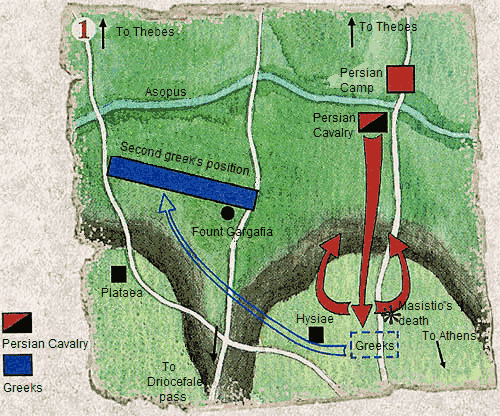
They found them near the Boeotian city of Plataea. The ending of 300 portrays it as another Hollywood zerg rush, but the real battle actually opened with the exact opposite manouevre – a retreat. Both Pausanias and Mardonius were wise commanders who tried to tempt the other into attacking his well-prepared position. Both were playing a waiting game, but neither could afford to wait forever. Camping on the foothills of Mount Kithaeron so they couldn't be ridden down by Mardonius's huge cavalry arm, Pausanias nevertheless saw off an attack by the Persian cavalry under Masistius, who unusually wore a breastplate of gold scales under his scarlet coat (when they couldn't bring him down with body blows, the Greeks guessed his secret and struck at his face). The fighting was bloody, so Pausanias moved to another position further down onto the plain, still with a cluster of small hills protecting him from frontal cavalry attack. But this meant there was no water to be had, and all of it had to be brought up by porters. Still Mardonius did not attack, although he went out of his way to make life hell for Greek forage parties: Mardonius was calculating that time and hardship would see the Greeks start bickering among themselves and fracture the alliance against him.


This was not a futile hope: Pausanias waited ten days, but after that he could wait no more, and by night he tried moving back to a position nearer his old one, where water would be available and foraging easier. In the confusing and demoralising night march, which must've seemed a retreat to the soldiers themselves, the units of he Greek forces became separated and lost contact.

The following morning, when he beheld the Greek disorganisation, Mardonius thought his strategy had come to fruition and the Persians surged forward. But he'd misjudged their mood completely: the Greeks were still in good spirits and, when the Persians came out of their camp, they about-faced and charged. The Spartan main body, although separated from the rest of the Greek army, was able to meet an infantry attack on ground that impeded the use of Persian cavalry. This was the moment for which Pausanias had worked so hard and risked so much: in savage fighting Mardonius himself was killed, the Persian infantry was routed and their camp sacked. Here they were joined by other Greeks who had just defeated some Boeotian collaborators; no mercy was given to the few defenders in the camp, and almost none got away. A huge amount of Persian treasure, with which  Mardonius had intended to buy provisions for his army, fell into Greek hands. The Battle of Plataea was won, and with it the Persian invasion of Greece was over.

The fighting went on – a Greek expedition dispatched to aid the Egyptians in their own revolt met with disaster, for example – but by 449 it was possible to sign a treaty by which Persia recognised the independence of Greece.

So in the wars with the Greeks we see the full glory and the fatal flaws of the Persian Empire. Their armies, though numerous, weren't especially good, and fought as disorganised mobs that relied on sheer weight of numbers to get the job done – not a foolish strategy when you're sitting on 44% of the world's population, but counterproductive in the cramped confines of Greece. Their leaders were formidable organisers and logistical masters - just imagine what it took to summon the warriors of a hundred nations and get them pointed in the same direction! - but they weren't especially good generals, and were stuck with the standard problems of alll absolutist monarchs: they relied on the Great King and his delegates (chosen by nepotism not merit) to make the right decisions 100% of the time. Despite that, a Great King was not a god-king, and every decision Darius and Xerxes made was made in the understanding that they'd one day have to answer for them. And as we've already seen, their bureaucracy was on a level unseen in the ancient world before – many think the Romans learned how to run an empire from them. I think it's fair to say that for all their territorial gluttony, they were better at peace than war. And that's about the highest compliment I can pay any society.

Wednesday, 26 August 2015

Meet the Persians

After my post on the Neo-Babylonians a friend asked me why I don't consider the events of Daniel as things that actually happened when I'd just spent a whole blog providing circumstantial evidence that they did. I have to admit that's a fair question: I kinda gave the wrong impression with the "not things that actually happened" line. It would be more accurate to say I believe things like that were probably happening on a daily basis. The Neo-Babylonian Empire lasted only 87 years, from 626 to 539 BCE – about as long as the Soviet Union – and had six kings, from the rebel Nabopolassar to the weirdo Nabonidus, but that's plenty of time for these kings to issue idolatrous decrees that the Jewish captives just couldn't comply with, and correspondingly plentiful opportunities to keep the lions fed. I'm even sure some of the Israelites stood firm rather than nodding furiously and saying, "Yeah, me and Marduk, we're tight!"

But here's the thing – how would we know any of this happened unless someone took the time to tell us? Stories like those in Daniel probably did happen, and plenty worse besides, and then were promptly forgotten. But someone wrote out an apocalypse and called it Daniel. Why? What point were they trying to make? And who were they trying to make that point to? Them's the real questions here; whether it all really happened isn't really relevant, nor, to my mind, particularly interesting.

Anyway, I'm going to keep going down through the four empires of Daniel, just because I enjoy it. Whether the four beasts of Daniel Ch.7 are the same four kingdoms as the four segments of the statue is a question for better minds than mine: I've read a convincing argument that the sections of the statue actually represent Neo-Babylonian kings, but whatever. The four beasts at least are much less subtle. The "lion with the wings of an eagle," for example, isn't hard to interpret: it's a cherub.


It's less obvious to me why the Persians are represented by a bear. It's true the Syrian bear roamed the wilds of the Fertile Crescent from ancient times right up until World War I, menacing travellers and farmers alike (which makes more sense when you realise back then the whole area was thickly forested; the last of the tall pines outside Petra were cut down by Ottoman soldiers during the First World War). The typical justifications for using the bear to represent the Persians strike me as post hoc i.e. they start already knowing that the bear is the Persian Empire and then looking for similarities (great strength, clumsiness, etc). But when I thought about the country symbolised by a bear in our modern, Western minds – Russia – it started to make more sense. The stereotype of a Russian guy is someone big, strong, burly and fairly clumsy, more often than not because they're drunk out of their skull: it seems Jewish rabbis had a similar image of the people of Persia themselves, "who eat and drink like the bear, are fat like the bear, are hairy like the bear, and are restless like the bear."


So I guess that makes sense then. In the early sixth century, the Persians occupied territory around Susa, just east of what we now call the Persian Gulf. At the time they were subject to a Mede king with the fantastic name of Astyages, who ruled another huge empire that stretched from the Lydian frontier in Turkey, wrapped around the Fertile Crescent, and stretched down through most of modern Iran. The Persians theoretically owed loyalty to this Astyages, but you can't keep a dynamic go-getter down: a Persian king history calls Cyrus the Great rebelled against his Mede overlords in 553 and fought them until 550, when he captured their capital Ecbatana. He'd effectively conquered the Median Empire from within. To ease the transition he married Astyages' daughter, and the realm became a sort of Medo-Persian coalition, though the ruling family was Persian and the Persians were the dominant partner, hence the bear being raised up on one side.

So why the three ribs in its mouth? Well, once he was fully in charge, Cyrus turned his attention to conquering the kingdom of Lydia. Lydia's interesting because we never hear anything about it, but it was semi-Greek in culture, and under King Gyges had become quite large by local standards, taking up roughly half of Asia Minor. Croesus, last of the Lydian kings, made himself proverbially rich by exploiting his country's gold deposits, becoming the first state to use standardised gold coins as currency, and also becoming very popular with the Greeks for his lavish temple gifts.


When Cyrus and his army came a-calling, Croesus consulted the Oracle at Delphi, who with typical ambiguity promised he would "destroy a great empire." Pleased with this report, Croesus opted for battle and was quickly and completely destroyed, his capital at Sardis sacked and burned. The "great empire" he was destined to destroy had turned out to be his own. Afterwards Croesus lamented: "No one is so foolish as to prefer to peace war, in which, instead of sons burying their fathers, fathers bury their sons. But the gods willed it so."

With Lydia now under the heel, Cyrus left the conquest of the Aegean coast to be completed by his general (and brother-in-law) Harpagus, while Cyrus himself returned east to capture Babylon, an event was recorded in sanitised form in Chapter 5 of Daniel, aka. The Writing on the Wall.
That very night Belshazzar, king of the Babylonians, was slain, and Darius the Mede took over the kingdom, at the age of sixty-two.
Belshazzar was in charge because their last Neo-Babylonian king, Nabonidus, had absented himself from Babylon. Instead he was squatting in a place called Tema, northern Arabia, where he'd been for the last ten years. Why? We have no idea. Tema was a trade outpost and there was plenty of money to be made for the king who held it, and Nabonidus also had a devotion to the moon-goddess Sin that didn't sit well with the city of Marduk, but really your guess is as good as mine. For whatever reason, he left the actual job of being king to his son Belshazzar, and only returned when Cyrus came looking for trouble.

Cyrus captured Babylon easily, that much we know; what's still a headscratcher is exactly how. The city was surrounded by walls so vast a four-horse chariot could turn on top of them; no army in the world at that time had the technology to besiege them, and starving the population wasn't likely to work because there was some acreage of farmland and the river itself within the walls. Cyrus's own proclamations say the people opened the gates and welcomed him with open arms, and even the Nabonidus Chronicle, the most reliable (though not informative) ancient document we have on the subject, says the people laid green twigs before him as he entered (which should also sound vaguely familiar). Herodotus denies this and says Cyrus defeated the Babylonians in the Battle of Opis, then took the city after a hard siege. Complicating the picture is a building inscription in Babylon itself that suggests Nabonidus sent an army up the Euphrates to meet Cyrus before he could make it too far south, then got the shock of his life when a smaller force came up the Tigris and captured Babylon – and Nabonidus himself – with their guard down.


Either way, the text in Daniel clearly depicts the end coming like a thief in the night, arriving suddenly and catching Belshazzar by surprise. So why does the text say the city fell to Darius the Mede and not Cyrus the Great? Again there are theories, but the one I like best is that it's a simple transcription error: in Hebrew "Darius" translates as DRYWS (דריוש) and "Cyrus" as KWRS (כורש); one lapse in concentration and you've copied it wrong. This hypothesis is seemingly supported by early copies of the Septuagint, where the names are reversed in Daniel 11:1 (others say they really meant Astyages, or that Darius was a sort of dynastic name and Cyrus's wife and mother were both Medes, so Darius the Mede it was).

So Babylon was now subject to the Great King, who was very popular with the exiled Jews, not least because he was the one at last let them go home (in Isaiah 45:1 he is even referred to as a messiah, an anointed one, the only non-Jew ever to receive the honour). He subsequently divided his empire into provinces under the rule of governors or "satraps," a Persian word we have inherited in its Greek form... then met his death in an obscure war against some northern tribes. His son Cambyses, despite some evidence of mental instability, went on to add Egypt to the empire and a third rib to the bear's trophies – Lydia, Babylon (meaning the whole of Mesopotamia, the Phoenician trade cities, Syria and Israel), and now Egypt. The Great King, King of Persia, King of Anshan, King of Media, King of Babylon, King of Sumer and Akkad, and King of the Four Corners of the World, now ruled a land that stretched from the Indus to the Hellespont, home to Assyrians, Babylonians, Egyptians, Jews, Phoenicians, Ionians, Persians and Medes. It covered 5 million square kilometres and had a population of 50 million, 44% of all the people in the world at that time (a record that still stands). Earth had never before seen its like.


After an interlude where a usurper took the throne, rule passed to Darius I, also called Darius the Great, another scion of Cyrus's family. He was a good ruler who consolidated what his predecessors had won, supporting his national economy with fixed yearly taxes, making Aramaic the official language, building a canal between the Nile and the Red Sea, and building a network of roads for his armies – although the trade industry of course took full advantage. One of them, the Royal Road, ran all the way from Susa to Sardis, a distance of 2,400km, and one of the most important positions in Darius's court was their supervisor, a position called the King's Eye.

But the bear had not yet had its fill of flesh. When a pretext arose that gave Darius a chance to add Greece to his empire, he jumped at it. And so began the Persian Wars.

Monday, 24 August 2015

Where Does It End?

It's been very nearly four years since I posted this, on another blog, in another time:
1994: Ayrton Senna & Roland Ratzenberger (Formula 1)
1995: Greg Hansford (ATCC)
1996: Scott Brayton (IRL) & Jeff Krosnoff (CART)
1997: Sebastian Enjolras (Le Mans)
1999: Greg Moore & Gonzalo Rodriguez (CART)
2000: Adam Petty, Kenny Irwin Jr. & Tony Roper (NASCAR)
2001: Dale Earnhardt Sr. (NASCAR)
2003: Tony Renna (IRL) & Mark Lovell (rally)
2006: Paul Dana (IRL), Mark Porter (V8 Supercars) & Peter Brock (sportscar)
2008: Ashley Cooper (V8 Supercars)
2009: Henry Surtees (Formula 2)
2011: Dan Wheldon (IndyCar) & Marco Simoncelli (MotoGP).

The only shocking thing, when you think about it, is that this still shocks us.

When I heard the news, almost my first thought was, "This is 2011. Surely we've seen the last of this?" But as the list shows, motorsport's post-Senna safety era has existed largely within our minds.

Motor racing is still dangerous. How dare we forget that.
For some reason, maybe it was subconscious, you'll notice I put a full stop after Marco Simoncelli as if the matter was closed. More fool me. If you'd told me then this was just beginning, I wouldn't've believed you. But it just keeps going. Since 2011 we can extend the list thus:

2012: Osamu Nakajima (Super GT)
2013: Allan Simonsen (Le Mans)
2014: Jules Bianchi (Formula 1)
2015: Justin Wilson (IndyCar)

And that's just the big, international series; I've deliberately left out names like Kevin Ward Jr, the kid Tony Stewart ran over in a sprintcar race in 2013, because that was only a minor event (which doesn't make him any less dead). If you want to see the full list you're welcome, but it's pretty grim reading. The Ascaris are on there, father and son; so is Jules Bianchi, now heartbreakingly listed right above his great-uncle Lucien, who hit a telegraph pole at Le Mans in 1969; there's also the fiery Frenchman Jean Behra, Indianapolis legend Tony Bettenhausen, NASCAR star Neil Bonnett (who won the first race at the newly-opened Thunderdome in 1988), Possum Bourne (the rally maestro who did such amazing things in our Aussie dust), and of course Peter Brock, who wasn't blessed with enough self-doubt to know it was time to quit for good - all without even getting to the letter C.

I think it's getting to me, all the more because I'm up to the mid-80s in my local touring car writing, which means at some point in the near future I'm going to have to broach the subject of Mike Burgmann (another B), who died on Conrod Straight in the early laps of the '86 James Hardie 1000. A gust of wind lifted the car and dropped it off the track, and he ran into a tyre barrier so hard it pushed the engine into the cockpit. Footage from the day shows the front guards of his VK crumpled like beer cans, right up to the firewall. I personally catch the barest gust from the reaper's wings on this one, because his co-driver that day was to be Mal Rose, the man who frightened the bejeezus out of me on the Thunderdome a couple of years back.

I dunno. I just dunno. I don't have any answers, or even coherent questions really, just a feeling that something's gone terribly wrong with the sport I love. Even Formula 1's luck is broken, that paragon of intensive (and expensive) safety preparation, Jules Bianchi becoming the first driver death since the god-of-F1 Ayrton Senna (I know Bianchi didn't die at the track, but officially neither did Senna. The only difference between them really is the amount of time they spent in hospital).

I was at Spa last year, you know, and got footage of a Marussia coming through Pouhon in the wet Saturday qualifying sessions: it got a back tyre on the slippery kerb and had a big wobble, which the driver caught and powered away like it was nothing. It might've been Bianchi; my camerawork is too blurry to be sure.

On race day my hand was steadier.

And now Justin Wilson as well, because of a freak of coincidence with a piece of flying debris.


That's not a component you can say, "Oh, we better tether it to the car, then," because it's already supposed to be tethered to the car (you'll notice the wheels stayed on like they're designed to). A fraction of a percent more or less throttle, on any given lap, and Wilson's head wouldn't've been trying to occupy the same space as that nosecone at that moment. A miniscule difference in the crash physics, and that nosecone would've ended up somewhere else completely - sliding along the track maybe, or flying over the fence. But instead the twain did meet, and Justin is gone, and there's no lesson or a way of convincing ourselves that we can make sure it never happens again. Maybe that's what makes it so hard to take. No mantra but the passive, hopeless one I posited back in 2011 that still bears repeating.

Motor racing is dangerous. How dare we forget that.