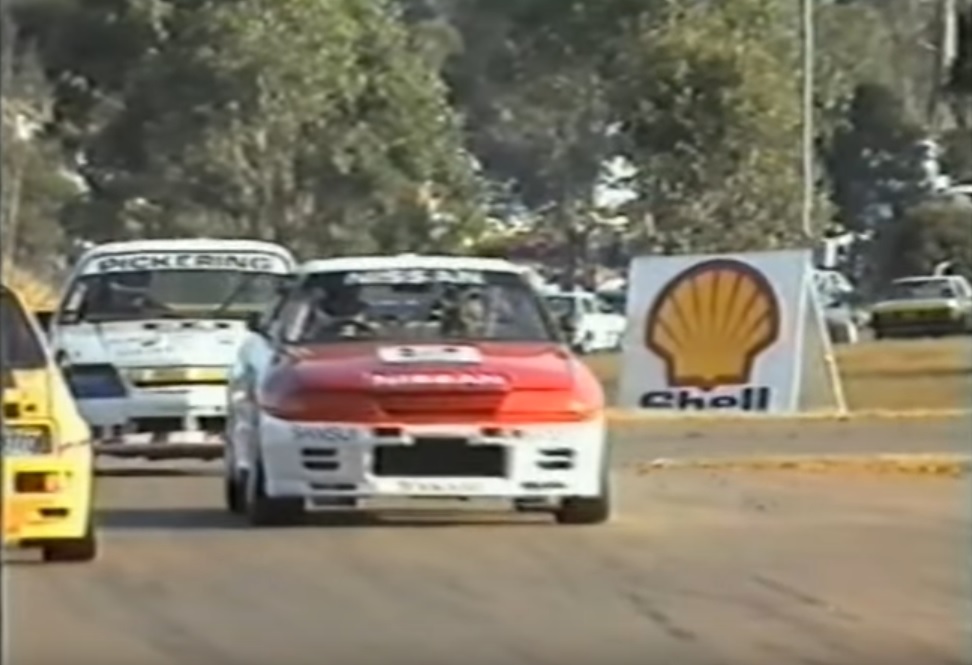
August in 1990 was the deep breath before the plunge, a time when everyone was back at the workshop busy building their new cars for Bathurst. That left almost no-one venturing out on track...
Almost. Here, to tide us over, are three things I couldn't think to put anywhere else. Enjoy.
5 August – Amaroo Super Cars
Here in Godzone, there was Round 3 of the AMSCAR series.
By 1990, it was clear AMSCAR was running out of puff. Shell signing on as sponsor for a fully-televised ATCC had made the national series more practical than ever, and several of the smaller teams around Sydney had given up the Amaroo races to focus all their resources on the ATCC. That reduced the once-proud AMSCAR calendar to just three rounds that year, including the shared ATCC round.
Round 1, the shared ATCC meeting, we've already covered (-ish, YouTube limitations remain a factor). Rounds 2 and 3, the standalone AMSCAR meetings, were each run as a simple pair of 10-lap heats. Heat 1 of Round 2 was won by Alan Jones in the #20 B&H Sierra, with his boss Tony Longhurst 2nd in the #25, making it a Benson & Hedges 1-2 – and it was much the same story in Heat 2. When Jones stayed home for Round 3, however, Longhurst was able to sweep both heats and clinch yet another AMSCAR title (his fourth) by a huge margin, with Bond and Skaife sharing 2nd place.
12 August – Budweiser at the Glen
Over in the asylum, meanwhile, Dick Johnson was making his last-ever NASCAR start, on the very track Marcos Ambrose would later make his own – Watkins Glen.
What with stock cars being V8s and the Glen being a road course, he was arguably on more familiar ground than on America's speedways, but as was now a bit of theme with these trips Stateside, he barely featured in the race at all. According to Racing Reference, he qualified 15th and was eventually classified 27th with "handling", whatever that was. Whether that means he took the chequered flag well down the order, or suffered a DNF and parked it, I have no idea. If the commentators hadn't mentioned him by name, I'd believe you if you said he wasn't even there. Truth be told, it wasn't exactly a classic race either: by some inverse miracle it was both dominated by the lead drivers tearing off into the distance (like all the worst F1 races), yet also broken up by caution periods that turned it into a simulated traffic jam. It was a bit of a snoozefest, in other words, and I'm not surprised that afterwards Dick never bothered to come back. I wonder if Ross Palmer might've done better finding a full-time Cup team and just throwing his money behind them instead – I understand Alan Kulwicki was always looking for sponsors in those days. As it was, the #38 Thunderbird's days in Redkote colours (or "colors") were over, leaving us with this rather awkward, clumsy preview of what Australia would be getting in a few years' time.
Robb Gravett and DJR1 MTRS01
Gravett ended up buying a couple of cars off me for him and a TV presenter called Mike Smith. Gravett ended up winning the 1990 British Touring Car Championship in one of the Sierras. – Dick Johnson, Dick Johnson Racing: 30-Year Anniversary
As it turns out Dick, no, he didn't! But that's not to say Johnson machinery had no hand in the story of Gravett's famous 1990 BTCC title at all, it's just that the reality turns out to be rather more complicated than that (as it always, always does).
Starting grid at Brands Hatch, 1989.
As we already know, to clear space in the workshop in Brisbane (and kick some extra money into the kitty), by 1990 Dick had sold off his first three racing Sierras, chassis numbers DJR1, 2 and 3. DJR3, the most storied of the lot, was still in Australia in a Valvoline livery, racing in the hands of Ray Lintott. DJR1 and DJR2, however, his original cars from 1987, had gone back overseas to be the mechanical portion of a new team built around young up-and-comer Robb Gravett.
In 1987, a then 21-year-old Gravett had done what everyone else did and raced a Rouse-built car while he learned the trade and earned his place at the front of the BTCC grid. But by 1988 he was waking up and realising there was no point buying from Rouse to beat Rouse: he simply wouldn't sell you anything as good as what he was driving today. Looking elsewhere for competitive machinery, Gravett began to hear the world's fastest Sierras weren't built in Buckinghamshire, U.K. or Lyss, Switzerland, but in an overgrown country town in the south of Queensland. Not flinching at the thought of what it would do to his phone bill, Gravett made the call.
Thus, that October Gravett found himself entered in DJR's third car at Bathurst 1988, where troubles during the race meant he never got to drive. It didn't matter: between that and the Silverstone TT earlier in the year, he decided he'd seen enough, and put his money down to buy two Johnson cars to take back to Blighty. He'd been convinced to join British media personality Mike Smith in forming Trakstar Motorsport, and DJR1 became Gravett's own car for 1989, racing as the #21, while DJR2 was rebuilt in RHD and became the #20 of either Smith or Will Hoy, depending on the round.
100 percent the quickest RS500s. They were quicker than the Rouse cars; they were quicker than the Eggenberger cars. Absolutely. That's why we bought two of them.
They looked at them from the ground up and they were so well-built. They used low-compression engines, which we continued running [in 1989] with high boost. So you had to be pretty clever in how you drove them, as with high boost you have a lot of lag. The Rouse cars ran lower boost but higher compression, but Dick's team had a very different approach to running the cars. You had to pre-empt the throttle coming out of the corners to keep the turbo spinning. – Robb Gravett, AMC #77
For the first time, Gravett was a genuine title contender, taking five poles, eight fastest laps and four round wins off the likes of Rouse and the other established stars in a highly-successful breakout season. As usual though, the title went to a driver in the lower classes – a Scottish "cockney sparrow" in a Vauxhall Astra 16v, John Cleland. That's just how things worked in the BTCC.
Brands Hatch, 1989
Or at least, that's how things had always worked. By 1989 the people surrounding the British series had come to an agreement about where to go for the 1990s – 2.0 litres, high-tech, and (most radically) often front-wheel drive, all in a bid to level the playing field and placate manufacturers who wanted to promote their mainstream offerings rather than low-volume, high-performance homologation specials. This meant the 1990 season would be a transitional one, with just two classes rather than the usual three or four – one for the outgoing Group A cars, and one for the incoming "Super Touring" formula. Although they were seconds a lap slower than an RS500, several teams elected to get ahead with an extra year's experience in the new cars, especially BMW and Vauxhall who each entered works teams. That meant the field might've been a little thinner than last year, but a few still elected to enter a Sierra for 1990... and one of those was the #1 ICS car of Andy Rouse. Game on.
Then the question of sponsorship reared its ugly head and threatened to cancel the whole party before it started. When the team's 1989 sponsor pulled up stumps at the last minute, Mike Smith graciously stood down to focus all Trakstar's resources on Gravett, but even Gravett was staring down the barrel of withdrawing from the series entirely, before it could bankrupt him completely. At the last minute, however, a deal was made he committed to run a full programme, in defiance of poverty. The car would spend most of the year in plain white, but who cared? At least he'd be racing.
And here's the complication: that plain white car from 1990 was no longer DJR1. After three years of competition, the Johnson cars were simply worn out, and the team recognised that a new chassis would be needed to beat Rouse. Ergo, the car he raced that year was a re-shell, built by David Cook of Yortech Fabrications, and bearing the chassis number MTRS01.
We built a car from the ground up for 1990, but a lot of it was based on the Dick Johnson cars and the technology that he had, particularly in the chassis. You could say we cloned most of it, but we added a few new bits and pieces into the car.
We also did quite a lot of development on the engines as well. Dick's engines were very strong, but because Australia was such a long way away and, because, by the end of 1989 the engines had a lot of mileage on them it didn't make sense to keep using his engines. We went to Mountune-built engines. Off the back of our success, Mountune then got the Ford contract for the World Rally Championship engines. – Robb Gravett, AMC #77
To borrow from my favourite ex-Top Gear presenter and all-round spirit animal, James May, the resulting car was basically, "Now That's What I Call the Best of the RS500, Vol 1." As well as the 420 kW Mountune engines, the car had the running gear from DJR2 including one of Ron Harrop's 9-inch diffs, but excluding the suspension, which came from Eggenberger. They arguably took a backward step by returning to the Getrag 5-speed gearbox rather than Dick's Holinger 6-speed, though that was justifiable given the distances involved when sourcing replacements (or perhaps the Getrag just suited the Mountune engine very well). And of course, where had Mountune first got their engine-mapping software? From the Bosch 1.2 system pioneered for the Sierra by by DJR.
Mountune picking up that system had been a watershed moment for the BTCC, because it was only then that someone finally broke Rouse's monopoly on computer chips. Andy had been very comfortable charging £15,000 for a race-ready engine (or "only" £500 for a new chip), but there hadn't been much anyone could do, because in 1988 Rouse had been the only guy in the U.K. who could build an engine that would hold together for a full race. Once Mountune got their hands on Johnson's software, however, privateers finally had an engine that could do the same, and Rouse's stranglehold was shattered.
All the hard work (and expense, given MTRS01 would have a life of just one season!) was vindicated when the new car was "immediately half a second quicker" than its predecessor. Rouse won the first round at Oulton Park, also won the first one-hour endurance race at Donington Park with David Sears. After that, however, Gravett went on a tear and won the next seven rounds in a row – Thruxton, Silverstone National, Oulton Park (again), Silverstone GP, another one-hour enduro at Brands Hatch Indy (with co-driving from Mike Smith), Snetterton and finally Brands Hatch GP all fell to Gravett, with Rouse only breaking the streak with a win in the final Birmingham Superprix. Gravett took two more victories at Donington and Silverstone, interrupted by another win for Rouse at Thruxton, to finish the year with an incredible eight pole positions, and nine wins from just thirteen starts. And because the 2.0-litre class shared the wins around a bit more, it marked one of the few times the BTCC was won from the highest class. Beating Andy Rouse at his own game, in his own championship no less. Even by proxy, that must’ve felt good.
Which brings us to one of life's little ironies: Andy Rouse never won the BTCC title in the RS500. He'd won it with the XR4 Ti, sure, and the Rover SD1 before that, but the only time the RS500 did take the title was in 1990 – and it was a DJR clone in the hands of Robb Gravett. Checkmate, mate.
So it all came down to this. Eight races in five states had served to separate the title contenders by just a handful of points, meaning it would be decided in a final fifty minutes run flat-out around a twisting 2.6km circuit just outside Sydney. The ATCC Grand Finale was here, and it was good.
A Stroll in the Park
Do you miss Oran Park? Yeah, trick question, the only possible reason you don't miss it is if you don't remember it. Until I sat down and opened Blogger to write this entry I didn't realise I'd set myself up for heartache. I got in the habit of starting each blog with an embed of the track in question, and didn't realise I couldn't do that this time until I opened Google Maps and, oh yeah, remembered that "Oran Park" refers to a suburb now, not a circuit.
A crying shame, it was such a brilliant little track. It was a figure-eight, for starters – how many of those can you name off the top of your head? But even with that in mind, a flat map gives you no clue how tricky it was, every corner with its little quirks, none of them quite as they appeared. The sharp right-hander after passing beneath the bridge, for example, always seemed to jump up and mug you. The sharp right-hander after the bridge, on the other hand, was much tighter than it looked, and coming in hot and having a bit of a panic was pretty much standard practice in your first untimed session after a year away. But it was all worth it when you got to that down-and-up final corner, where you hooked it hard left leaning on the turn's intense camber, balancing the wheelspin against how close you were to scraping the concrete wall...
It was three-dimensional, in other words, all laid out in the contours of the hills, which also meant the spectator could see the entire race from any of the good viewing spots trackside. Which was any of them, really: there were no bad spots at Oran Park. If you want to follow along, you can find a good map here. Just be sure to have it set to the full "Grand Prix" circuit, and the year to 1985-98, otherwise you won't have the corner names I've used.
The return to the civilised states brought with it a huge jump in grid size, the 18 cars seen at Wanneroo becoming 37 here in Sydney, of which 35 were to start the race. The really unfortunate two were AMSCAR stalwart Gerald Kay in the #24 Jagparts Walky...
...and, believe it or not, Tommy Suharto, youngest son of then-Indonesian "president" Suharto. The 27-year-old Tommy was an amateur racer and general all-round scoundrel, and he would eventually be convicted of murder after commissioning a hit on the judge who tried him for corruption. At Oran Park, both he and Gerald Kay are listed as "DNQ (accident in practice)", so I'm gonna go out on a limb and guess that they were both taken out in the same accident, and that one of them was more to blame than the other. One wonders how happy Larry Perkins was to have him as a customer this weekend, but money is money, and you can't always choose who you take it from.
Another on the grid was our friend Maurie Pickering, meaning I finally got a picture of his VK Commodore in action:
Score.
Showdown for The Big Four
In truth, though, none of these back-of-the-grid types were really here to race; they were just continuing their preparations for Bathurst. The real thing was going on at the sharp end of the grid, where the matter of the Australian Touring Car Championship was due to be sorted out between Peter Brock, Colin Bond, Dick Johnson and Jim Richards. Brock and Bond's chances however were strictly mathematical, dependent on complex permutations that hinged on winning the race while Richards failed to finish. Given he'd been the only driver to score in every round this year, didn't seem especially likely, so in reality the 1990 championship was between the pair who'd each won the championship under Group A rules twice before – Johnson in the Sierra, and Richards in the Nissan. With a 5-point differential from 1st to 2nd and only a 3-point gap on the championship table, the situation couldn't have been simpler: whoever won the race would win
the title.
Suspicious quotation marks...
To his credit, Nissan team boss Fred Gibson started off by announcing they weren't going to be playing the percentages this weekend: Gibson Motorsport and Nissan were here to win the race, and if they won the title in the process, well, that would just be the icing on the cake. For Dick Johnson, similarly, there had been no distractions ahead of this weekend – no jetting off to the States for a NASCAR jaunt – meaning there'd be no excuses for underperforming this time. He too was here to win.
Qualifying split the field to a greater degree than we'd seen all year, with one second covering only the top four, rather than the top ten or so. Jim Richards left no doubt as to his intentions by taking pole with a time of 1:11.04, closely hounded by Peter Brock with a 1:11.12. Those were the only two on the pace, as 3rd on the grid went to Dick with a 1:11.92 – eight-tenths of a second slower. No-one else was in the 1:11s. It's unlikely Johnson was panicking just yet, having doubtless fitted the hardest Dunlop tyres he could get his hands on, with an eye to maximising speed across the entire race distance rather than a single lap. Between the heat, the GT-R's great weight and the sheer fact that it was still an unproven new car, he probably felt that he was still in with a chance. And on paper, he was right.
Some other speed brackets, take them or leave them: Win Percy, fastest of the Holdens, was 10th with a 1:13.24. Peter Doulman, fastest in Class B, was 21st with a 1:16.15 in his BMW M3. And the fastest of Class C was the consummate professional John Faulkner, whose Toyota Corolla FX-GT had zipped around the tarmac in 1:19.16, to be 28th overall. That didn't just put him at the head of a gaggle of seven Corollas – the Toyotas having pushed out the Nissan Silvias and Isuzu Geminis to make the class their own – but also two places ahead of Pickering in the big, rumbling, 5.0-litre V8 Commodore. No wonder he gave it away soon after!
Sunday Funday
Race day once again dawned unseasonably hot: on the TV commentary team, Allan Moffat mentioned that this was the second-hottest race they'd seen all year, remarkable when this was supposed to be the literal middle of winter. Nobody seemed to mind, though: the broadcast claimed there were between 32 and 35,000 people trackside that afternoon, their biggest attendance since the legendary title showdown of 1972. The grandstands probably wouldn't have been so jam-packed were it a chilly winter's day, and the extra heat also would've meant a steady flow of traffic to the Food Bar for refreshments, which the promoters wouldn't have minded at all.
Green flag! From the front row, Brocky broke traction and turned his Bridgestones into grey smoke getting off the line. Red Sierras, blue Sierras and yellow Sierras all scrambled to get past him, but in front, Jim Richards converted his engine power directly into traction and bolted away like he'd been shot out of a cannon. One moment he was there, the next he wasn't! And that, would you believe, was the race: Richards was never headed again. I said the Wanneroo round had held more tension than action, but Oran Park wouldn't deliver much of either: by the crude "YouTube-video-and-smartphone-stopwatch" method, Richo had a 0.6-second gap by the first corner. The car behind was Tony Longhurst, with no skin in the championship but hungry for a win to placate his sponsors; 3rd was John Bowe, then Alan Jones in the other Benson & Hedges car, and only then championship rival Dick Johnson. The hapless Peter Brock trailed them all, having lost all those places just getting off the starting line. By the end of the lap, Richards was – no, really – 1.2 seconds in the lead!
Jim Richards was back, baby. The hesitancy that had characterised his driving at Wanneroo was utterly gone; this was a man once more at peace with his machinery, driving it like it was meant to be driven: stick the nose into the corner, push the beetle-crusher hard against the firewall, and hang on for dear life; when the back end started to slide, resist the urge to adjust the wheel too much and instead wait for the four-wheel drive system to induce some understeer. My first thought when I watched the race was, "Ooh, looks like someone's been practising", and that hunch was confirmed after the race when Richards mentioned Skaife and the team had been testing that week. They didn't say where, but Oran Park was open for business as a test venue if you had the cash, and Freddie was no fool. The combination of Oran Park and the GT-R could've been pretty nasty if they hadn't given Richards time to get his head around it.
If Nissan had shelled out for a test session at Oran Park, then it was money well spent: by the end of lap 2, Richards' gap was up to 3.5 seconds. After that it was hard to measure, because he wasn't in frame anymore; he was just gone. With Richards literally out of the picture, the cameras had to look elsewhere for interest, and found some in a scrap between Brock and Johnson – old rivals reliving past glories, but over 5th place rather than the lead... and they both had to keep an eye in the mirrors, as Glenn Seton was on the move and catching them both. Spurred on, Brocky dug deep and pulled alongside Dick coming out of Bitupave Corner, getting the move done as they both braked across the Goodyear Bridge. With that, it was Brock 5th, Johnson 6th. Peter Perfect had found his pace again, and set off after the race lead.
Brock had also picked up a new sponsor in Brunswick toolmakers Sidchrome, which at least makes dating the photos easier. Sidchrome would sell out to Stanley the following year, and then move all production to Taiwan in 1996. We've lost so, so much manufacturing in the last few decades...
Catching him was going to be a tall order though. Neil Crompton was able to report that Richo had a 4-second gap only five-and-a-half minutes in (I can expand on that by reporting it was up to 5.7 by the end of that lap!). "An enormous gap," said an admiring Moffat. "That's not what you call any life-threatening situation, there. Jim can virtually command this race to his heart's content at this stage. Dick is definitely not a threat."
Which raised a good point, where the hell was Johnson? The cameras were following the trio of Longhurst, Bowe and Jones (a fun scrap, but meaningless in championship terms), and Brock was only just catching them up, which highlighted the question of how badly he'd been held up behind the #17 – and by extension, how slowly the #17 was actually going. Something had gone vastly wrong with DJR's calculations for the race for Dick to be so far behind so soon.
At around this time the retirements started. The race was one of reasonably high attrition, with almost a third of the starters due to end up on the DNF list, but for some reason most of them came in the first third of the race. Geoffrey Full was the first green bottle to fall, seen parked against the wall on the outside of the final Recaro Corner, with just three of the Corolla's rather slow laps on its scoresheet (credit where it's due though, a couple of hundred more metres and it would've been four). Only minutes later (but on lap 12 because the Playscape Sierra was rather faster), Kevin Waldock headed to the pits with what turned out to be a blown head gasket. He joined Brian Callaghan's son, Brian Callaghan, whose VK Commodore had dropped out with a broken crankshaft, and crowd favourite Steve Reed, whose Lansvale Smash Repairs VL had likewise given up the ghost with a ruined piston.
By lap 14 Richards was 18 seconds up the road from Tony Longhurst, which was about as far as the gap would ever stretch – apparently 18 seconds was enough. "It’s like an Ayrton Senna performance!" gasped a stunned Mike Raymond, who was probably having a minor heart attack wondering how he was going to make the rest of this broadcast exciting. He needn't have worried too much: just as they were pointing that out, Peter Brock put in a masterful out-braking manoeuvre on Tony Longhurst into the treacherous Volvo Corner, the middle turn of the figure-eight triad. It was a risky place to pass given the braking zone always seemed to sneak up on you and you were heading straight towards a disconcertingly close tyre barrier, but Brock had no time to hang about. He made the pass neatly and made it stick, meaning it was now 18 seconds from Richards to Brock.
In stark contrast, Dick Johnson was going backwards. The return from the first commercial break (on lap 12) had come back to onboard imagery of Dick fighting to keep Glenn Seton in his mirrors. At almost the same moment Brock had taken himself to P2, Seton finally got the move done, taking the racing line off Dick on the way into Bitupave Corner. Surely that was it, then. If Johnson was being relegated to 7th place already, then the Yokohamas were good today and the Bridgestones bloody excellent, but the Dunlops on Dick's car just weren't up to the job. Surely that was his title hopes gone.
The TV pictures then showed Garry Willmington's red Toyota Supra post-spin and leaking steam, but the next listed DNF was actually Larry Perkins, thanks to an accident. Larry had been running 10th, putting him ahead of the rival car of Win Percy for once, but that wouldn't be the way they finished today. He ended the race with only 15 laps to his credit, although it took quite a while for the commentators to notice – a sign of how memorable a mere Commodore was this year.
A quick interview with Fred Gibson in the pits revealed what a gift Nissan had been handed.
I can't believe how slow everyone's going. We're now doing 14s and 15s, I thought the race would be running 13s and 12s. So, Jimmy's just pacing himself at present. Hopefully the car'll keep going the distance so we can win our first Australian Touring Car Championship!
"A very confident Freddie Gibson," observed Raymond, only for Moffat to caution: "I don’t think he's too confident until he sees that chequered flag, Michael. This is a business where you can't afford to count your chickens before they've hatched." In other words, there was absolutely no reason to think the GT-R would last 50 minutes unscathed, although the shocking lack of pace from the rest of the field was surely a beacon of hope. Crompo jumped in to confirm those observations about the laptimes.
Neil Crompton: Really interested, Allan, with the times that they're doing. I noticed before on the stopwatch that they were lurking back into relatively slow times, particularly compared to their qualifying performance. And, again, that's probably got something to do with the temperature of the day and people maybe choosing a tyre that's just not hard enough to cope with the conditions?
Allan Moffat: Well I think we've got to realise that they've got the benefit of all the other races behind them, and they know just how hard they've pushed them for the 50 minutes in all the other rounds. And here we are today with the hottest day of the season, practically, apart from perhaps the opener at Amaroo earlier in the year, and I think they are driving according to what they think will get them a finish. No-one wants to come in and have a tyre change in a race like this.
He just had to say it... Another ad break and Dick Johnson was coming under threat from Colin Bond, but that duel never came as Dick’s onboard RaceCam, pointed squarely at the Caltex Sierra, showed it abruptly whip past on the pit straight like a special effect from Close Encounters. Dick had dived into the pits, a tyre change an absolute necessity and all thoughts of defending his title utterly banished from his mind.
Tony Longhurst meanwhile had dramas of his own, having seemingly cocked up Bitupave Corner and now facing the wrong way with his rear bumper hanging loose. He too headed for the pits to have it removed and a fresh rubber fitted, all hopes of glory now lost for him too. Whatever he'd done to upset the racing gods this year must have been pretty severe, because he'd been demonstrating pace every weekend (some of it, admittedly, by the soft-rubber trick), but just couldn't catch a break in the races.
As if to ram that point home, on lap 23 the commentators told us that Glenn Seton was having a problem, but the cameras actually showed us Alan Jones having a problem. The #20 B&H Sierra was revealed to be stopped on the grass inside Winfield Corner, the bonnet up, but nobody leaning inside to get it running again. The culprit was apparently an electrical gremlin, which could've meant absolutely anything. Having run a quality team that year, Moffat took a moment to give Longhurst some on-air respect (though of course he choked at using the actual word...).
Running two cars is a tough job for any team, Michael. I've got, uh... I won't say... I've got sympathies for that, that can happen... To run one well is a tough job, to run two is not twice one, it's three times the effort. Credit to Tony Longhurst and Benson & Hedges, they've fielded a two-car team throughout the series, they've been up there all season long. They haven't had a win, but [they are] genuine, real, gentlemen competitors, and appreciated by the sport.
Only a lap later (on lap 24), Glenn Seton dropped out with temperatures climbing out of control, his trip to the pits a lap prior having fixed nothing. On the same lap we also lost the Foodtown Commodore of local hero Terry Finnigan, to falling oil pressure, but only the diehards in the grandstands would've noticed, as he was surely well down the order by then.
At 33 minutes done, the leader had covered 26 laps, and the gap was a whopping 20.9 seconds by my count (if you're wondering, the darker patches of tarmac before the final corner form a handy improvised speed trap). If that gap was now stable rather than growing by leaps and bounds, that was more because Richards was into cruise-and-collect mode than because his rivals had found another gear. Peter Brock was still a lonely 2nd, with all that empty space between himself and Richards and another substantial 16-second gap back to John Bowe, who had an easy 3rd place now the B&H cars had dropped out. 4th was Colin Bond, 5th was George Fury, and behind him – once again, first of the Holdens now Perkins was out of the event – was Win Percy in the HRT Commodore. With the action having worked itself out and nothing much happening on-track, Mike Raymond turned to the man he could always count on to fill some dead air – Dick Johnson.
Raymond: I said last night I was getting set for a Queensland trifecta, the Broncos, the Brissie Bullets and Dick Johnson. You’ve let me down, pal?
Johnson: Oh mate, the race is not over yet.
Raymond: Good on ya! You think I was safer having the money on you than the Brisbane Bears?
Johnson: Oh you wouldn't believe, mate, the things that can go wrong when you're not wanting to...
Raymond: Tell us about it, Janet Dick?
Johnson: Well, my drink bottle had an enema inside the car here, and it created fumes because I use some gunk in the bottle that nearly blinded me. Then Brock got past me, would you believe – unfortunately! – and that thing of his, I nearly choked to death on Mobil 1. It looks like the last train to Ferny Grove!
Raymond: [laughing] Great to see you haven’t lost your sense of humour!
Johnson: Oh, what's the use, mate? You die if you lose that.
Some quick Googling reveals the Brisbane Broncos did indeed overcome the Wests Magpies in the NRL (or NSW Rugby League, as it was then), the Friday before this race. In contrast the Brisbane Bears, in what was then the VFL, had lost their previous match against the Richmond Tigers on 6 July (though they were due to play the Fitzroy Lions that very afternoon, and take a win). Exactly who the Bullets played that weekend in the Australian NBL I haven’t been able to find out, which isn’t surprising when basketball is a minor sport that doesn’t attract the obsessive record-keeping of the footy codes. Given it was only mid-year, though, it’s likely all were only minor matches still building up to quarter- or elimination-finals or whatever they had, not grand finals like we were having at Oran Park today. And in any case...
By this stage Colin Bond was inching up onto John Bowe's bumper, and the commentators correctly deduced that he "had intentions" on 3rd place. Unfortunately, we had a trademark Channel Seven ad break while the pass actually took place, so we only got to see it as a replay. Even as a replay though, it was proper touring car biffo: driving defensively, Bowe had stayed in the middle of the track as he charged through the fast Pepsi kink. Aiming to make use of the draft he'd caught down the straight, Colin Bond stayed close to him, but as it turned out, it was too close. Braking hard for Winfield Corner, Bowe had seen Bondy coming and moved over to cover his line; already committed to the braking zone, Bondy couldn't stop any harder or get out of the way, and he caught the left-rear corner of the Shell Sierra and pitched it into a spin. Colin had to slow to a crawl and copped a nose-tap on the way through. Both cars continued, but Bowe was now trailing a rear bumper in a mirror-image of what had befallen Tony Longhurst earlier in the race.
Who was at fault is a matter for debate. "Slightly unsporting manoeuvre," was Moffat's assessment, referring to Bond, before adding: "Running close is one thing, tapping people at that speed is another." Mike Raymond countered with a more modern viewpoint, that Bowe's moving over in the braking zone was a no-no and he should've expected a hit for his trouble. But that wasn't actually a rule yet in 1990, so chalk this one up to "boys will be boys". Right or wrong, Bond's passing attempt had moved him from 4th place up to... uh, 5th, thanks to George Fury nipping through while both he and Bowe were stationary (the footage doesn't actually show the pass, but you could see him coming in the background).
By lap 38, in a moment loaded with significance, Richards even came up to lap the man currently running in 8th – his own teammate Mark Skaife. That meant he'd been averaging 2 seconds a lap faster than Skaife, so if there were any lingering doubts that the HR31 was past it, now was the time to banish them. That said, given the stakes this weekend Moffat commented that, "All they would've done to that car all weekend is change the oil," and it was hard to argue he was wrong.
The chequered flag came out shortly after, catching everyone by surprise, including the commentary team apparently, who hadn't done anything to build up the moment. Richards crossed the finish line having completed 41 laps in just under 51 minutes, chalking up the win and so put the matter of the 1990 Shell Australian Touring Car Championship beyond all doubt. There could be no finer way to seal the deal than with a Grand Chelem – he'd started from pole, led every lap and won the race, taking the fastest lap (1:11.715) along the way. 2nd place went to Brock, while the podium was completed by the wily George Fury – only slightly embarrassing the Nissan company, who that very week had released him from his Nissan contract so he could go drive for Glenn Seton!
The podium ceremony that followed was short and sweet:
Richards: It was a matter of just getting a bit of a lead at the start when the tyres and brakes were very good, and then sort of cruising along at the finish with what tyres and brakes I had left.
Raymond: Everyone believed Peter Brock might win the start and make life difficult, but you ran off into the distance. You weren’t supposed to do that I don't think?
Richards: Well Brocky owes me ten bucks already, 'cos he had a bet with me last night – and I haven't forgotten it! – ten dollars to whoever's first to the first corner. So I thought I had a pretty good bet going there.
Raymond: You obviously had no problems at all throughout the race?
Richards: No I didn't, no. I pressed on pretty hard at the start and of course that didn’t leave me with much rubber and that left towards the end. But the object was to win, and it didn’t matter by how much.
As good as his word, Brock held up a $10 note and then handed it to Jimmy, settling the bet in front of the whole country. Even that was a moment of nostalgia for some of us – when was the last time you handled a paper banknote?!
In the final accounting, Richards ended the season with a gross 106 points, of which 102 counted toward his final position. A late surge on his new Bridgestones had seen Peter Brock climb to 2nd with 85, ahead of the hapless Johnson on 83, and Bond on 82. Ever after, Johnson remained stoic when talking about it, but it seems the lost sixth championship really stung.
I was still in contention but we had those tyre problems and that is what won Jim the championship. It should have been No.6 but Jim passed me down the straight which tells you how much wick it [the GT-R] had. It could have been but it didn’t, so that’s it. – Dick Johnson, Dick Johnson Racing: 30-Year Anniversary
Win Percy and the Holden Racing Team, on the other hand, were jubilant. Their results had been pretty ordinary in outright terms, but that was a reflection on the suitability of the car rather than the team or driver. They'd earned just one podium, at Lakeside, and finished 8th in the championship, with 32 points, but that was a solid effort for a team that hadn't even existed in January. "The sprint series was just really as good as we could have done," said Percy. "We ended up top Holden starting from scratch up against people who had been engineering Holdens for years. I was pretty pleased with it." But the ATCC was just a shakedown for the all-important enduro season anyway. "Bathurst was always what it was all about. We had to do the championship just to show we were serious about motor racing in Australia."
As for racing on foreign tracks on the wrong side of the world, Win never put up any excuses. In 1984 he'd been driving for Tom Walkinshaw’s Jaguar ETCC team, and, well...
I went to places I'd never heard of, like Brno. In practice I'd say to Tom, "Can I have a bit more time in the car, get used to the track?" He'd look at me and he'd growl, "Winston, if you don't know the place in three laps, you're no use to me." He expected you to learn any track in three laps, and then sit down and tell him what you thought about each corner. And to be honest, if you put your mind to it you could do it. – Win Percy, Motor Sport, Aug 2013
But the big smiles were all over at Nissan, and no wonder: they'd been chasing this title for a long time. They'd almost won it with George Fury in their first full season in 1983, but boss hog Howard Marsden had withdrawn the team before the finale for reasons known only to himself, leaving the title to Moffat and Mazda. They'd almost been there again with Glenn Seton and the DR30 in 1987, until Richards himself had punted him in the M3 and claimed the title for himself. It was deeply ironic, then, that Nissan would at last claim the title with the very driver who'd denied them last time, at that very circuit, but such is motor racing sometimes. Ever the class act, Richo said:
First I would like just to thank Nissan and Fred Gibson for supplying me such a great little car to drive. We've had a great year, and although I've won the championship twice before, this is the best. I had a hand in them not winning it a couple of years ago, so it was fitting that I win it for them.
Another point that's only really been raised in the last few years is the role of the humble HR31 in all of this. To a certain kind of fan this marks the start of the Dark Days, of 4WD Nissan domination, but two of Jimmy's three wins and 72 of his 102 points had actually been earned in the previous, 2WD car. If that's not enough for you, consider this: the car Jimmy drove in those races – Gibson's final HR31, built as a new car at the start of that year – is now owned by Jimmy personally. Not Gibson Motorsport, not Nissan Australia, not a collector like the Bowdens, the man himself. That says it all, and when asked Fred won't hesitate to give the car the credit it deserves.
The main thing to remember is that HR31 was never a race car like the Sierra RS500 and the BMW M3, so my instructions to my drivers were that you've got to drive the cars like you hate them; do whatever you have to do to go fast. That's why our guys drove the wheels off them and were quite brutal with them. They never had the power of the Sierras, so they had to attack every race lap like a qualifying lap.
Having said that, the HR31 did have consistent handling, good brakes, good tyre life and whatever you started with you finished with, whereas the Sierras would tend to fall away because they had so much grunt their rear tyres would start to melt after a few laps.
The HR31 won Richo the championship, without a doubt. The GT-R wrapped up the title at the final round and got all the glory, but the HR31 did all the hard work getting there. – Fred Gibson, Mark Oastler's Nissan Skyline HR31 GTS-R: The unsung hero of Nissan’s first ATCC victory, Shannons Club
But as Neil Crompton wisely pointed out, this race had been ideal, almost laboratory-controlled conditions for Nissan, a race with absolutely no pressure where Jimmy'd been able to run the car precisely as he wished. As Moffat had pointed out, Brock had been the only one with the pace to take it to Richards this weekend, the Nissan having done a 1:11.0 in the morning warm-up, the Sierra an 11.1. Where all that speed had gone was anyone’s guess, but the afternoon heat and ongoing tyre war doubtless had something to do with it. Whatever the truth, the GT-R had come into the weekend never having been pushed hard for a whole race without something breaking, and after Oran Park, that was still true. The real test was coming up, as the touring car scene took its usual six-week break to rest and prepare for the traditional season of endurance.
Appendix A: The Future of the Group
An intriguing detail from the latter stages of the race was the announcement that Group A would remain the Australian touring car formula at least until the end of 1992. CAMS president John Large got on camera and said:
It gives me a great deal of personal satisfaction to announce that CAMS has made a decision to extend the existing Group A touring car championship rules to the end of 1992. We actually made this decision in principle earlier this year, but it was necessary to wait until I'd been to Paris to the World Motor Sport Council meeting in June, to find out what the FISA situation was. As it turns out there's no clarity of thought at FISA level so CAMS has decided to take the initiative on the basis that we are, after all, the world leaders in touring car championship racing. We've taken the initiative, and we've announced this decision now so as to give our own teams in Australia the security of knowledge that their investment's good for further periods.
A lot to unpack there, very little of it surprising. The approaching end of Group A? Well, the World Touring Car Championship had folded after its single season, the European championship had followed it only a year later, and now the British were transitioning to a new rulebook all their own, while the Germans and Japanese were disappearing up their respective garden paths with their own unique spin on the rules. The cracks in Group A were unmistakeably widening, and Australia could've been facing a similar situation as Formula 5000 at the end of the 1970s – the last holdout of a once-glorious series. So it wasn't really surprising that CAMS were seeking clarity on the future of the rulebook, and equally unsurprising that they weren't finding it – this was the tail end of the Balestre era, after all.
But the self-important waffling and doublethink of "taking the initiative" by putting off a decision another year? Yep, that was our CAMS. To be honest, being trigger-shy about doing away with Group A was really the responsible thing to do, given they'd sprung the formula on the teams midway through 1984 and forced them to do away with $100,000 racecars virtually overnight. To do it again with $500,000 racecars would have been tragedy repeating as farce. The most interesting part is hearing the commentators agree that this was a good thing, given it assured Nissan at least two full seasons for the GT-R (and Holden likewise for their next-gen Commodore). From this side of history, knowing how all this would all turn out, with a virtual revolt by the teams egged on by Mike Raymond and Channel Seven, it all comes across as rather peculiar. But that's the joy of geeking out on history...
So once again it was time to head into the sunset and make seemingly-endless pilgrimage to Perth, home of Wanneroo Park and the traditional Western Australian leg of the ATCC. On a drive that long a man has time to really think, which is why you might find yourself asking questions like, "Why did Stirling's colonists name their state capital after a hamlet in Scotland? After all, the only thing they have in common is far too many English people..." (Yeah, every reader from the Wajuk nation just rolled their eyes, and they're right. I promise, once this corona bullshit is finally over I'm totally coming to visit your beautiful city, never mind the cost. Turns out You really do OLO.)
Right car, wrong race. As the broadcast shows, by Wanneroo Peter was off these BBS wheels and using DJR wheels instead. Oh, the irony.(Source)
By this stage there were only four drivers still in contention for the championship – Brock, Bond, Johnson and Richards. For everyone else, whom the title had already passed by, Wanneroo was better understood as advance prep for the other big touring car crown in the country, Bathurst in October. To that end, both the Glenn Seton and Tony Longhurst teams had brought extra cars to give prospective co-drivers some seat time. In Seton's case, that meant handing the battle-tested #30 Sierra to erstwhile Toyota driver Drew Price, so he could familiarise himself with its brutal on/off power delivery, while Glenn himself took the wheel of the #35 to ensure it was fully dialled in for the big day.
A for effort, to be sure, but nobody was on Tony Longhurst's level this weekend: his outfit had gone to the trouble of bringing three whole cars, which is an impressive feat of logistics now, let alone thirty years ago. For a Queensland-based team to bring three complete chassis, plus spare parts, spare engines, oil and lubricants, drag the whole lot all the way across the Nullarbor and then ask the mechanics to take on an extra fifty percent workload... well, it said a lot about how important the endurance season really was. You can test until you're blue in the face, after all, but there's nothing like actual competition to reveal how steep is the mountain to climb. The lucky beneficiary in this case was Neville Crichton, the Kiwi who'd raced with Tony back in their JPS Team BMW days, who for this weekend would have the #62 on his doors.
Please enjoy these awesome snaps I found on Flickr. Most of them are from a practice session rather than the race, but they look so much nicer than my scabby screengrabs.(Source)
Their presence helped keep grid numbers healthy, because for some reason we didn't see the usual influx of local drivers out for a hit on their home track. The ATCC round was supposed to be a chance for WA's state-championship stars to test their mettle against the national-championship regulars, but this year the black swan would be represented by just a single entry – the self-financed #96 Walkinshaw of Alf Barbagallo, after whom the circuit would later be named. Traditionally the racing number 96 (and the paaank colour scheme that went with it) belonged to Tim Slako, who'd raced both a Rover and a Commodore in that livery, with Barbagallo's backing. They'd actually raced as a team last year, Slako in the #96 and Alf himself in a matching #77, both under the Barbagallo Motorsport banner (although being the peak of the Sierra era neither had really made a dent, finishing 10th and 11th respectively). Since then, however, it seemed the team had gone through some downsizing: Slako was MIA for reasons unknown, while Barbagallo had divested himself of at least one of his cars, leaving him with just the #96 (it's believed the #77 ended up as landfill in a tip somewhere, though whether that happened after its racing career, or because of it, remains unclear).
That was all she wrote for local drivers, because neither of the others made the race. Geoff Herbert tried to qualify in Slako's old Rover (now in red and wearing the racing #40), but fell outside the 115% rule and had to sit out the rest of the day (although he does seem to've raced it in the supporting Sports Sedan events, finishing 10th and 8th – the car's final race starts ever). Even more intriguingly, someone named John Farrell fronted up in a Lancia Delta HF Integrale, but withdrew it for reasons unknown. Another turbocharged, 4WD road-rocket would've provided a nice point of comparison to the Nissan GT-R, but alas, it wasn't to be.
Master Shredder
The Wanneroo round of the championship wasn't exactly a bad race, but it was definitely more "high tension" than what you'd call "action-packed". It was the logical outcome of time and place: the time being 1990, when every race was won by the last man standing with a little bit of tread left their tyres; and the place... well, that was Wanneroo Park, the most notorious tyre-shredder on the calendar. There was just something in the tarmac itself, a little extra grit and sharpness to the surface that combined with the three or four long constant-radius corners to eat tyres alive. With this being the penultimate round of the championship and chances to score rapidly diminishing, nobody could afford to take chances. For the Big Four, the only thing that mattered was finishing ahead of each other.
With Win Percy returning to HRT, Neil Crompton was back in a red blazer and seated alongside Mike Raymond and a returning Allan Moffat for an all-star commentary lineup. It was Moffat who revealed that championship leader Johnson had been given the choice of two Dunlop tyre compounds, Medium or Hard, and deliberately opted for the Hards to be sure of finishing (while Crompton wryly noted he'd told Seven News they were so hard they produced sparks!). Peter Brock surely asked for the same from Bridgestone, while with his trick Toyo/Dunlop arrangement, Colin Bond was probably quietly confident (assuming he'd been allowed to try it again).
[As an aside, it's only occurred to me since clicking Publish on the last entry that the magic combination might've been putting Dunlop rears on the front, and his usual Toyos on the rear. That would explain why no-one else was able to copy his homework, and why Moffat threw such a tantrum when he found out.]
But if anyone should've been feeling confident, it was Jim Richards: as well as benchmark tyres from Yokohama, this was the weekend he finally stepped into the GT-R. When it came to massaging your rubber, nothing was going to beat four-wheel drive grip, right? Well, yes and no. Dividing the burden of 550 Nm between four wheels instead of two would be an advantage, sure, but it was an advantage he'd sorely need, because the GT-R was damned heavy. Worse, it really does seem like Richo had never driven the car before this weekend: all the testing and development up to now had been done by his junior teammate, Mark Skaife. It wasn't the best way to chase a championship, and it reeks of last-minute decision, but it seems the extra pace of the GT-R was more than he could resist. The venerable HR31 just wasn't going to cut it anymore, and finishing outside the points was as bad as a DNF when there was a championship on the line.
Cut It Short
Given the sheer distance the eastern-based teams had to travel for this round, it almost seemed the Westralians were taking the piss that this race would be five minutes shorter – just 45 minutes, rather than the usual 50! Once again Tony Longhurst was starting from pole, having stopped the clocks at 58.61 seconds for the 2.4km circuit in practice. It was his third pole of the year and – an impressive stat in such illustrious company – he'd only been bumped from the front row twice all year. P3 was the lowest he'd started in any race in the 1990 ATCC. True, some of that was trading substance for glory by going for softer tyres and suffering late in the races, but given how often he'd hit trouble during those races it probably wasn't a bad trade. Start up front, get your sponsors on the TV, and keep the money hose flowing while you do the hard work of switching brands again next year: a poor race strategy, but a sensible business one.
The only sore point was that he had to share the front row with Peter Brock, who'd banged in an identical lap time to his teammate Alan Jones – 58.88 seconds. If Jonesy had only tried a bit harder, they could've had a juicy front-row lockout! As it was, the Benson & Hedges cars were starting line astern, with Richards in the GT-R starting from 4th, first of outside the 58's with a 59.43.
There they sat on the starting grid, preparing for the off, revving the engines to breaking point and... mysteriously, for the longest time nothing happened. The timestamp in the video has them champing at the bit from 1:12 until 1:25, an inordinately long wait for the go-code. Jonesy decided he couldn't wait that long and had a bit of a creep 1:23, which would earn him the inevitable "One Minute Penalty #20" sign for jumping the start. Tony Longhurst's team truly was cursed that year.
Finally, the starter let them go, and with a chirp of tyre smoke the cars launched into action. In the GT-R, Richards showed what kind of start Skaife would've pulled off at Mallala had he not gotten boxed in, bolting off the line like a scalded cat. He leapfrogged the jump-starting Jones and a slow-off-the-line Longhurst to arrive at the first turn right behind Brock.
Through the long left-hander at Turn 4 Brock led Richards, Jones and Longhurst, but the entry onto the mid-sized back straight was the Turn 5 kink, and Richards got that slightly wrong, not quite trusting his car enough to throw it around yet. Slow onto the straight meant slow along the straight, so he found himself slipstreamed and then passed into Turn 6 by a niggly Tony Longhurst. Up ahead though, Peter Brock had made a brilliant start to lead the pack comfortably; he would not be headed again today.
As early as lap 3 word was trickling through that Jones would be penalised for jumping the start, which Moffat didn't really agree with:
[The officials] didn't make the best of starts, either. They held the red light on for a half a day, and I certainly wouldn't be reprimanding Alan Jones on that one, it was a very long red light and I wouldn't be giving the starter a pat on the back at the moment... It's very hard to keep your foot on the clutch wearing out $10,000 clutches.
"They can sort that out later," replied Mike Raymond, before adding, "They gave a '10 seconds to go' signal that seemed to go for 30."
Wanneroo was of course where Allan Moffat had won his greatest-ever touring car victory, his Mazda RX-7 beating Peter Brock's VH Commodore in the 1983 race courtesy of a lightning-fast planned pit stop. With that memory at the back of his mind, Moffat seemed to catch a slight case of Old Fart In A Rocking Chair Syndrome, adding a touch of warmth to a race that was to go long stretches without real drama. As a retired elder statesman of the game he was entitled to a certain amount of rambling, and it surely meant something that most of it was directed at his most cherished rival.
I think Brocky's got a slightly more calculating race here. He's not leaping out in front like he did in Mallala. He's very conscious of the fact that he didn't get all the way home last weekend, or two weekends ago. I would be saying, from what we're looking at, he's definitely just being a little bit more cautious, he doesn't mind anybody in his rearview mirror anyway.
In the early laps, however, Brock wasn't yet pulling away, meaning he had to keep Tony Longhurst in mind while deciding where to place his car.
Longhurst is actually getting dangerously close, and by 'danger' I mean the slipstream factor blocking the cool air going into his radiator. These turbocharged cars run at enormous temperatures, and he's in danger, if he got much closer than that, of starting to fry his engine. So every now and then you see him pull out to the right or the left when he gets super close to Brocky's back bumper-bar, it's just to keep the fresh air going into the car.
Though the top four remained the same – Brock, Longhurst, Jones, Richards – by lap 9 Glenn Seton was starting to catch up to Richo in the GT-R. Behind him was a brief gap, following which we had the DJR twins, Johnson ahead of Bowe. Inside the GT-R, however, something amazing was happening. In-car shots revealed Richards' hands were visibly unsettled with the wheel, turning in, backing off, then turning in again, unsure of what he had to do. This was not the smoothly decisive driver we thought we knew: this was a man who even had to apply opposite lock coming out of Turn 6 – how often did you see Jim Richards actually have to react to a car?! The commentators mentioned that the team had been playing with the onboard computers, so in a sense he was learning how to aim with with a gun that still didn't shoot straight, but the more basic truth was the one Mike Raymond articulated: "Keeping in mind that Mark Skaife has done all the development work in the car, Jim only stepped into the vehicle yesterday..."
That meant, ladies and gentlemen, the Nissan Skyline R32 GT-R was the unicorn, the philosopher's stone and the northwest passage all rolled into one, the thing no-one had thought existed – a car that unsettled Jim Richards! It seemed like all his decades of experience were running against him as he encountered the same feeling Peter McKay had described in his road test for Wheels – you could give the car quite a bit more of a caning than you realised at first, as the computer-controlled 4WD system would activate the front wheels whenever the back let go to literally pull you out of trouble. All fine in theory, but it meant finding the limit in a GT-R was a process of arriving in a given corner with your brain screaming that you were going too fast, only for the computer to step in and go, "Beep boop, no it isn't."
It was like skydiving with a parachute that only grew straps to hold you when you were seconds from the ground. No wonder Richards was unnerved. Like Mansell and the Williams FW14B that would be around the same era, this was a car that responded to a rough, wring-its-neck driving style of the kind Skaifey was making his own. Richo's gently-does-it approach would need some time to adjust.
By lap 12 we started seeing what would be the story of the race, with Brock building a handy 1.2-second cushion over Longhurst. Tony's early-race showboating was once again over, as only four laps later the gap was out to 5 seconds, signalling that his tyres had cried uncle. As the leaders were lapping Alf Barbagallo, Moffat was moved to say:
Any time you give Peter Brock five seconds you’re asking for trouble, because he'll just be nursing his car now. He'll have that little bit of time up his sleeve to do exactly what he has to, to save his tyres and take care of the rest of the car, [which] he'll be doing extremely well... He's extremely happy with his vehicle, didn’t get on the front row for nothing. It ran well in qualifying, he's got it where he wants, he’s got fresh air in front of him, no-one to bother him on every lap, no traffic whatsoever, and he's really capitalising on his advantage and that’s what professional racing is all about.
In just a single lap, Peter's margin grew an astonishing 2.5 seconds, stretching from 5 seconds on lap 16 to 7.5 by lap 17. Longhurst’s tyres were absolutely history, so with nothing else going on, the commentators got on the phone to talk to Dick Johnson.
Raymond: How's it going, Dick?
Johnson: Oh not too bad, mate. Had a bit of a problem early in the race trying to get the tyres warm, but now we've got 'em a bit warm, hopefully the others will start to come back to us.
Raymond: It looks that way from up here.
Johnson: I've also got a twisted rear halfshaft, which is vibrating like... well, I won't tell you what, but it's having a good ol' shake. And I've had it before, but I don't think there'll be a problem. Just gotta try and get in front of Godzilla there.
Crompton: Dick, with twenty minutes down in this race, are you comfortable about your tyre choice?
Johnson: Well, at the moment, but we'll just see how the other guys fare too.
In other words, he was having a lot of problems with ze car, and it was very difficult. But before we shake our heads too much about Racing Driver’s Excuses, bear in mind he’d just done a complete lap – including braking smoothly at the downhill end of the backstretch – while holding a conversation. A unique breed of driver, your Aussie touring car star.
By lap 20 Brock had an 8.5 second lead over Longhurst, and was looking invincible – assuming his tyres lasted, of course. Everyone seemed to be waiting for them to go off like they had at Mallala before making their move. Well, almost everyone: one who wasn't planning to wait was Glenn Seton, who pulled a move on Jim Richards down the back straight, drafting him up the hill when Richards pulled out to lap the John Faulkner's Corolla FX-GT, and then staying on the inside when Richards moved back left to re-take the racing line. The momentary speed differential of having a two cars to draft versus not having any was all Seton needed, and he moved up from 5th to 4th, smoothly and smartly. Richards didn't fight him: the only car that mattered was Johnson's, and that was still behind him. It was probably worth nothing, though, that the GT-R had shown itself to be much faster under acceleration, at the beginning of the straight, but in the latter half the Sierra still held a slight speed advantage, and its lighter weight meant it had an edge under braking – not a small consideration with 161 tours of Conrod in the car's future.
In true Channel Seven fashion, the move of Johnson over Richards took place during an ad break: the replay revealed it was a carbon copy of Seton's move, without the added distraction of a backmarker Corolla. Johnson took the inside line into the 90-degree final turn and out-braked Richards, but the canny Richards immediately went for the criss-cross and stormed alongside Johnson for the run down pit straight. Once again, however, the GT-R's advantage under power only lasted until the Sierra's rear tyres gripped up, as in the second half of the straight Johnson was able to pull clear and take the racing line into Turn 1.
Johnson was rapt, but his time in heaven was short-lived. Just two laps
later, on lap 28, he had something go majorly wrong into the very same
final corner, and crashed badly.
The cameras missed the moment of truth, but the dust he kicked up as he bounced through the grass and clear across the track told half the story; the other half was told by the missing right-front wheel. For a moment Johnson sat in the kitty litter near the pit entrance, spinning his rear wheels in frustration, but eventually he accepted the reality and started undoing his belts. At least he didn't have a long walk back to the pits. We later learned what had actually happened was a brake disc exploded and done a mischief on the rest of the wheel on its way out. Maybe that explained the loose gold wheel at Mallala: Johnson had a failure so intense it had actually catapulted a broken part back in time! Said Neil Crompton:
That started a long way back up that straight... but I can tell you for
the best part I reckon of three hundred metres that car was doing 140,
150km/h with a great sheet of sparks coming off it. Johnson went through
one spin, was lucky not to be collected by other traffic, and has
deposited a major amount of dirt and garbage onto the entry to the pit
straight. Unbelievable.
Some said this was a sign that the Sierra was being pushed beyond its limits to keep up with the high-tech new Nissan, but I disagree. The ultra-hard tyres Johnson had fitted for this race just wouldn't – couldn't – apply that much stress to the car. More likely there was a faulty part in the mix that had looked fine and passed all the checks – just bad luck, in other words – or (and I know this is going to risk the friendship), maybe the DJR workshop was just a tad overworked this week. The weekend after Mallala, Dick had flown back to the U.S. to take part in another NASCAR race, the Miller Genuine Draft 500 at Pocono, leaving very little time to return to Australia, get the cars prepped and shipped across to Perth in time for this race the following weekend. Dick's crew might've been experienced and highly professional, but it was also very small, and not having the boss around to twirl an extra spanner might have made all the difference. Am I saying his NASCAR cameos were the straw that broke the camel's back, keeping Johnson from ever claiming that record sixth championship? No, I'm not saying that, I can't know that for sure. But I can't say for sure that it didn't, either.
Or maybe it was just a world record case of Commentator’s Curse? Early in the broadcast, Moffat had mentioned how, "The Shell cars are prepared immaculately, and I can't recall when either car's ever failed in a race..." Words like that were on a level with, "Yep, she's unsinkable alright!" and would explain this disaster all on their own. But if Moffat truly was spreading that particular contagion, one would have to wonder why it hadn't affected Peter Brock, of whom he'd spent vast amounts of airtime praising the performance. Brock was still running away with this race, to such a startling degree that the commentators were starting to wonder if there was some sort of trick.
Crompton: Last lap of Peter was a 62.2. He's covered 31 laps. Prompts the question, Allan, that such is the performance of Peter in this car and tyre combination at the moment, I wonder whether or not it's a softer tyre and he might contemplate a stop? I do remember a friend of mine at one stage stopping here...
Moffat [audibly smiling]: I don't remember any of that, no, I don't. We had the fastest stop of our life in our Peter Stuvyesant RX-7. People just couldn't believe it. I doubt whether that's the case, I really don't. I think they've got their chassis working extremely well, Peter works hard on the car personally – by that I mean behind the wheel. He’s a great manager, he gets a lot out of his team, and I believe they’ve just come up with a combination that has served them extremely well here.
Crompton: Certainly has, that gap is massive...
Moffat: A lot of people just think we get in the cars and drive them, Neil. You know yourself that's the perfection that you chase that gives you performance. All the little things that make the car go better, and if you have a team that will back you and help you, dedicated mechanics, then you can get phenomenal results from any given racecar. It's only a piece of metal on four tyres.
14.5 seconds was Peter's lead by the time they finished that conversation. Moffat spoke the truth when he said: "That's annihilation, not just performance."
Further back, John Bowe put a move on Richards in yet another out-braking manoeuvre at the final turn. Like Johnson, it led to a side-by-side chicken run down the front straight, and once again it was settled in the red car's favour. Although Richards still had a nose up the inside as they tipped into Turn 1, both drivers were too wise to trade paint. A lap later the Nissan driver was able to take the place back when Bowe got fractionally held up while lapping Chris Lambden's Beaurepaires HR31. Was Lambden under orders from Fred Gibson? Can't prove that either, but also can't rule it out...
With the race heading into its final stages, the casualty rate started spiking. Lap 35 saw Tony Longhurst slow dramatically on pit straight, waving like crazy to his pit crew. That same lap he was seen heading into Turn 6 with smoke from the rear of his car – apparently from the rear wheels, but it was hard to be sure. At the end of the lap he peeled off and headed for the pits, where the mechanics lifted the bonnet, looking for a serious problem. Channel Seven's man in pit lane, David Christison, did his best impression of Charles Wooley at the front:
Mike, they changed all the tyres, [but] they're having trouble getting the temperature right, the operating temperature right by the looks of things. They're now going underneath the car so things are not looking good for Tony Longhurst at the moment. Incidentally, Dick Johnson, diplomatically, doesn't feel like talking just at this very moment. Longhurst has now cut the engine, so I'd say that's the race.
Most of that was incidental: you always changed tyres in a stop, just for the hell of it, and the temps getting out of control was a function of suddenly being stationary and depriving the radiator of airflow. Interviewing Tony a few laps (and one ad break) later, when his race was definitively over, Christison managed to get this out of him:
Christensen: Tony, an early exit, what happened?
Longhurst: It looks like the front seal in the callipers has let go, and it's just letting the fluid go straight out onto the disc as if when you're bleeding the brakes. It's just spraying it out everywhere.
Christensen: You've tried one more lap, just no good?
Longhurst: Yes, the boys thought they might have been able to fix it, but there's no solution. That's it for the day for us.
Christensen: Jones is going alright?
Longhurst: Yeah, he's just come in for a pit stop – I don't know why, his tyres look like they could've done a few more laps. But, uh, that's the way it goes.
So another bout of rotten luck for the Longhurst team – Tony DNFing, Jonesy copping a one-minute penalty and, with the finish line virtually in sight, chickening out on his tyres. It would later emerge that he wanted fastest lap honours, and he eventually got them with a lap of 59.61 seconds... but there were no points for that, and in the process he'd cost Tony another $1,800 set of tyres. He could be a strange one sometimes, could Jonesy...
In the meantime, Gerald Kay's Jagparts Walky was slowing down the back straight, Kay holding an arm aloft to warn the other drivers to stay away. He too eventually peeled off, and parked the Commodore behind the marshals' stand at the top of the hill, knowing it would be protected by their tyre barrier (and anyone still in the race would be protected from him). Exactly what had caused the DNF doesn't seemed to be recorded: anyone know?
With five minutes to go, Brock now had a 20+ second margin over the now 2nd-placed Seton. It had been very nearly a year since Peter Brock's last ATCC win, in the 1989 season finale at Oran Park, so this one would be very welcome if it came. It was just a question of whether his Bridgestones would act like Bridgestones and die at the literal last minute...
They didn't. As they approached the finish line together, Peter backed off a little to give Alf Barbagallo a chance to pull away – no point having him in the glory shot, spoiling the view of his own sponsors as he crossed the line, now was there? Brocky finished the lap to register victory in Round 7 of the Australian Touring Car Championship, his first win in almost exactly eleven months. In 2nd place, a massive 18 seconds behind, was Glenn Seton – meaning, at the very least that #35 car was looking very sorted and match-fit. Completing the podium was Colin Bond, his trick tyre setup (if he was indeed using it again) coming up short this time, getting him home 6.6 seconds behind Seton, and a massive 24.72 seconds behind Brock. Richards stroked the GT-R home to 4th, while Win Percy made a grand comeback to finish 5th, once again the first of the Holdens.
So wait, how had Brock made his rubber last the distance at tyre-hungry Wanneroo, when they'd fallen so short at Mallala? Tougher compound? Nope, likely they were the same as he'd used in SA. Development tyres? Dream on, it had only been a fortnight. Suspension tune? Couldn't hurt, but even with Peter Perfect's impressive mechanical sympathy, that wouldn't be able to make such a dramatic difference. The real secret, we'd find out years later from mechanic John Heckrath, was that Peter finished the race with a cooked turbo, the resulting lack of boost having saved the tyres! Allan Moffat, take notes, because apparently Commentator's Curse can be a cyclical thing: praise a driver hard enough, and the spell can loop back around so that the mechanical failure actually benefits them!
As for the championship... with another 10 points in his account for Wanneroo, Richards now sat on 86 points gross, but under the "best seven of eight" rule, he'd likely drop the 4 points he'd picked up at Symmons Plains, leaving him on a net 82 – 3 points ahead of Johnson’s static 79, instead of 3 points behind. Brock's win gave him 20 points and a last minute sniff at the championship, if still behind Bond, whose extra 12 points put him on 74. There was but a single round left, and glory awaited whoever could make one final push to the summit.