Saturday, 17 May 2014

Lewis Goes Spare

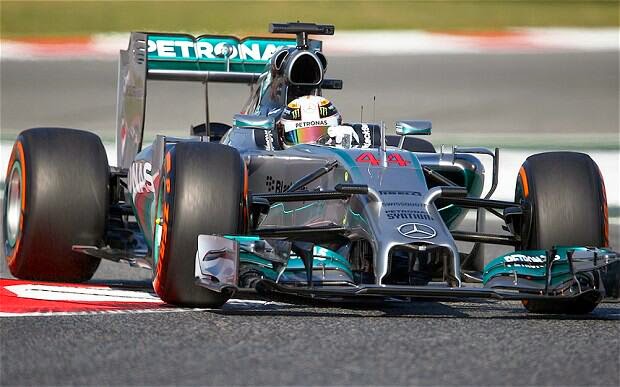
I'm ready to call it: Lewis Hamilton will be this year's World Champion. Pretty safe bet, I hear you snort, and you'd be right. But four wins out of five (and four in a row) isn't why I'm making it. I'm making it because we've now raced (and tested) at Catalunya, and it turns out there is no obvious weakness in the Mercedes W05. I thought the Red Bulls would maybe close the gap on such an aero-centric track; I didn't expect them to qualify more than a second behind. Predicting who will win the championship before a race at Catalunya is a vastly different game from predicting it after. But that's not the only reason either.

(via Telegraph.co.uk)
Y'see, I've also been reading Working The Wheel, a neat little paperback by Martin Brundle (reviewed it on Goodreads, if you're interested (and have Goodreads)). Martin's become the Voice of F1 since Murray Walker hung up his microphone, but his worthiness as a broadcaster is based on his earlier worthiness as a racing driver. Brundle raced through roughly a decade of Formula 1, with a little Le Mans action on the side, and in that time he counted both Michael Schumacher and Mika Hakkinen his team-mates. The man knows what he talks about, in other words.

Working The Wheel is a solid little read because it plays to his strengths i.e. being able to come across as One Of Us even as he's talking us through something an elite few ever get to experience. Happily he writes like he talks, to the point I'm pretty sure he just spoke into a dictaphone and let Maurice Hamilton insert the paragraph breaks and whatnot to turn it into written text. But I was watching the Spanish GP just after reading the chapter on the Hungaroring, which was handy because there Brundle talks about something I noticed in the winner of this year's Spanish Grand Prix as well.

It's 1994. Michael Schumacher is on his way to his first world title, and Brundle is running 3rd in the Hungarian Grand Prix, about to be lapped by Michael. But he's about to cop some pain via Schumacher's greatest asset - spare capacity.

I was on my way to a really solid third place when the team came on the radio and said the battery on my car was starting to go. I backed off and did a number of things to save power. With eleven laps to go, Schumacher, who was leading, came to lap me. That was going to suit me fine because, if he overtook, it would mean, when he completed the race, that I would have one less lap to do. The team reckoned I just might make it, even though the alternator was not working and I was running purely on whatever power was left in the battery. An F1 car is a massive drain on the battery because systems such as the engine and gearbox control units depend on it. These black boxes are power-hungry. But, when they stop, you lose the throttle, the ignition, the ability to shift gears, everything.

I was trying to coax the car home when Michael came up behind me. I moved over and let him through – and that was a crucial mistake. It triggered the thought in Michael's mind that I was too helpful. He immediately got on the radio to enquire about the whereabouts of Jos Verstappen, his Benetton team-mate, who was behind me in fourth place. When he heard that Jos was catching me, Michael slowed right down and I had no option but to unlap myself. If I had stayed behind Michael, Verstappen would have caught me and I would have lost my third place. So I had to go back on the same lap as the leader and prepare to do another 2.5 miles.

Michael also let Verstappen unlap himself; another clever move because, as soon as the leader crossed the line, anyone who had been lapped could not complete the last lap. Now Verstappen and I had to finish the seventy-seventh and final lap.

Sure enough, at the top of the hill between Turns 5 and 6, my car ground to a halt. Verstappen passed me. The fact that everyone else had been lapped and therefore could not take fourth from me was absolutely no consolation. When I finally got a lift back to the pits, I looked up at the podium to see Michael, Damon Hill and Verstappen spraying the champagne. The timing could not have been worse. I was two miles short of standing there myself.

By working that out, Schumacher had shown his mental capacity is one of the things that sets him apart. All the great champions that I've raced against have needed only 70 per cent of their capacity to drive the car while the other 30 per cent is used for reading the track, the race and the politics in and out of the car. If you look at a typical grid, the majority are high-level drivers and there really isn't much more than half a second a lap between them. The difference is their mental capacity. Those who have not had much success in F1 have needed 95 per cent or even 100 per cent of their ability to drive the car, leaving nothing in reserve to sort out everything else that is going on during the course of a race. The incident in Hungary is just one of a number of examples which demonstrate Michael's brilliance in that area. Ayrton Senna, Alain Prost, Niki Lauda and virtually any past champion you care to mention were all the same. That is why they were so good.

Damn right. "He was a genius," wrote Robertson Davies. "That is to say, a man who does superlatively and without obvious effort something that most people cannot do by the uttermost exertion of their abilities." Schumacher would even ask completely irrelevant stuff like how his brother was doing, so they tell us. And Alonso... well, if Schumacher was the king of spare capacity, then Alonso is Jesus. Pat Symonds has said Alonso has more spare mental capacity than anyone else he's ever worked with, and this is a man who's worked with Schumacher and Senna. Alonso's win in Japan in 2008 was simply incredible, working it all out in his head and asking to come in for fresh tyres so he could drive a handful of qualifying laps and make up the time to leapfrog the pack on strategy. It was intriguingly similar to Schumacher's famous win in Hungary in 1998, except that that was worked out by Ross Brawn, the owlish bespectacled man sitting quietly on the pit wall, talking to his driver. Alonso, by the by, did it all on his own.

And didn't look nearly as smug about it as you'd think. (via Formula1.com)

And did you notice something about the way the two Mercedes drivers ran their respective races at Catalunya? Nico was very quiet on the radio, just terse messages in between braking zones. Lewis, however, did nothing but whine all race long - how are Nico's tyres? Where are we on fuel? Why were they showing yellow flags when there was no-one parked on the side of the track? At one point he even asked how much time he lost to Nico in his second pit stop, to which he was told: "Not as much as he lost in traffic, Lewis. Carry on as planned." In other words, "Dude, would you shut up and focus on what you're doing?!"

Whining like a bitch is a bit of a faux pas for elite athletes, but  think about what this means: in the middle of a race, with G-forces trying to pull his heart out through his ribcage, with his rear tyres dying and in need of babysitting, Lewis still has enough brainpower left over to be worried about how much time he lost in that pit stop compared to his teammate. Because that might be the difference between first and second.

That, my friends, has got to be the Formula 1 version of First World Problems. And it's why he'll be champion this year... maybe...

Wednesday, 7 May 2014

Catalunya & the Riddle of Steel

What is carbon fibre next to the hand that steers it? What is turbo direct injection without the fire in the heart that drives a man to get on the throttle earlier, brake a little later, keep pushing his luck?

Formula 1 is a modern-day manifestation of the Riddle of Steel. That is, Which is fast? The Car, or the Driver? It's a question more relevant than ever as the old brigade of F1 fans get ever more elderly and ever more vocal in their whining that - *cue adenoids* - "In the old days a great driver could get a bad car to the podium. Nowadays the car matters more than the driver!"

For those who need to brush up on their geek references, it's a question that entered the culture through Schwarzenegger vehicle Conan the Barbarian. Conan has been taught that steel is strong, but the warlord Thulsa Doom (only in the 80's could you unironically name a character Doom) shoots down that interpretation with a grand little speech:


So that's the riddle: flesh or steel? Throttle control or downforce? On foot, Lewis Hamilton would be beaten by Usain Bolt; but put Lewis in his Mercedes W05 and Bolt will be left far, far behind. Yet, put me in that W05, and all you'll get is some scattered gravel and a smear on the Armco. Put nobody in it and it won't move at all. Clearly the problem gets more complex the closer you look.

Essentially, it's a modernist approach to a postmodern question. The answer, as with everything today it seems, is "both working together." It's the dynamic interplay between car and driver - to get needlessly pretentious, it's Clauswitz's schwerpunkt. As Niki Lauda said in Rush, "You don't suppose the fact that the car's so good has something to do with me?"

And despite what the old fogies will tell you, it's been like that since the beginning, even Fangio's day:
It was true that he always had the best car, and that was because he was the best damn driver! The cheapest method of becoming a successful Grand Prix team was to sign up Fangio. – Stirling Moss
That's also why Michael Schumacher was worth $50 million a year: putting Schumacher in the car made it half a second a lap faster. Finding half a second in the windtunnel or engine shop would have cost an awful lot more than $50 million...

And it's a question that has a special relationship with the Spanish Grand Prix, for two reasons. One, it's the first race after the "fly-aways", the first race of the European season. And two, it's run at the Circuit de Catalunya, which used to be called the test driver's second home (back when they still had test drivers). This was partly thanks to the mild Spanish winter, and partly because of the corner layout. Check it out:


Notice all those long, sweeping bends? Notice how they're all, like, a bit different? Notice how they all come together in a long, long front straight? There's nowhere to hide at Catalunya. To get a fast lap time you need everything - grip, power, handling - and you need it all working together. That's why it was the place to test a new car, because if something wasn't working, you knew straight away. Today, together with the scheduling, that means the Spanish GP sees the biggest round of car upgrades all season.

And that has serious consequences for the championship. Mercedes have had it all their way so far, but Red Bull did amazingly well considering their preseason woes. With that rate of progress, will they be able to catch up? Will Vettel, spending long hours in the simulator  with Ricciardo's data, have found a way to keep the tail of his RB10 under control? Will Red Bull's engineers have found a setup that gives him a stable rear end? Or will they have moved towards each other organically, meeting somewhere in the middle?

Alternatively, will Mercedes have polished the razor and found a few tenths to keep their drivers in front, or will their new updates be a backward step that drops them behind their rivals? Or will some hitherto unnoticed driver arrive in the first corner and  find the latest updates make the back end of his mediocre car come around just right, so he can drive it flat out all day and never make a mistake? If that happens it won't matter that Mercedes and Red Bull have more downforce, on race day our lucky driver will be faster.

It's happened before... (via bandeiraverde.com.br)

There's no way of knowing. That sweet spot where driver meets car is a moving target, and even if you get it perfect this week, by next week your rivals have moved on. Or your drivers could trip over each other at the first corner and all your painstaking upgrades will be wiped out in a heartbeat. At that moment, you might as well have put me in the car for all the difference it will have made. Just one of the things that makes Formula 1 so dynamic and interesting.

But my prediction? Races at Catalunya tend to be won from pole, and pole this year seems to belong to Lewis Hamilton. So unless Red Bull have come up with something major at the factory, this weekend's Spanish Grand Prix will be Hamilton's to lose. The result will be interesting rather than entertaining... but then I said that about Bahrain too.

See? That's the irony of F1: all the hard work to take the guesswork out of it just makes sure you can never tell what will happen next. That's the Riddle of Steel.

Tuesday, 6 May 2014

Ridin' With My Top Down

Look at this video I found:


That's Clay Regazzoni taking his BRM for a recon lap at the Österreichring in 1973. '73 gave us Smoke on the Water and Nutbush City Limits in music, so it shouldn't come as a surprise that in Formula 1 it was a year of both triumph and tragedy as well

You might think you don't know this this driver, but if you've seen Rush then you kinda do. This is the guy with the Dolmio moustache who befriended Niki (as much as you can befriend someone like Niki) and smoothed his path to Ferrari. A man with a name every bit as dashing as his face: Gianclaudio "Clay" Regazzoni.

They had to tone down the mow for the movie, cinemas couldn't afford the dry-cleaning. (Image via GrandPrix.com)
In legacy he was a bit like Gilles Villeneuve - didn't actually do much winning, but the tifosi loved him and never forgot him. Enzo described him best:

The inimitable Clay never lets up. Bon viveur, dancer, playboy, footballer, tennis player and, in his spare time, driver. He’s the ideal guest at the most unusual fashion shows, the great resource of women’s magazines. – Enzo Ferrari

Thing was, in 1973 he was kind of "between contracts" with Ferrari, so he found a job with BRM instead - a team half-forgotten now, but well-known and weirdly popular in their day. BRM had been founded as a British pride team, a massive, industry-supported team intended to showcase British engineering expertise. On that level it backfired badly, as they were never especially good at it, and even in 1973, nearly 30 years after their founding, the handicaps of that approach were still weighing on them. That year's car, the P (for Project) 160 had a handicap located between the driver and the rear wing called the P142, a V12 engine built by BRM themselves. In those days only three teams built their own engines, and of the three BRM had the smallest budget to do it on. Consequently, their V12 was completely gutless, the drivers complaining "all the horsepower went down the exhaust pipes."

Turn up the volume and watch it again. Yeah, it's no Matra, but still a great set of pipes.

On the other hand the balance and handling of the P160 was said to be quite good, but I have to wonder about that myself. Any car's handling seems better when it hasn't got any power, like my Corolla, which seems to be suspended on rubber bands but goes okay thanks to a miserable 1.6-litre engine.

Unboxing the sports suspension pack.

Either way, the BRM was going to be at a huge disadvantage here at the Österreichring, the "Austria-ring" in the former Habsburg playground of Styria. With those stunning mountain views, that first blast along the top of the ridge with bare dirt either side, it looks more like Pikes Peak than a Grand Prix venue. If you don't recognise that section, that's because it isn't there anymore. Twenty-four years after Clay's lap, Austrian phone company A1 put up some money for the track to be rebuilt, and the fast, mad part of the lap was ground off. The new A1-Ring became Michael Schumacher's bogey track and ground zero for most of his worst moments. It hasn't hosted a Grand Prix in years, but in 2011 it was bought up by a prominent Austrian soft drink company who are refurbishing it yet again and hoping to stage a Grand Prix. I'll let you have a wild guess who that might be.

You can see why they had to clip its wings though: the last race in this configuration was in 1987, so God only knows how frightening it was in a 1,000-horsepower turbo car. The second turn, the long, banked right-hander with the red-and-yellow Bosch sign on the outside, that's the Boschkurve, a corner that used to keep the drivers getting any sleep at night. The G-forces must have been just incredible, and with an Armco barrier only metres from the track they were probably on your mind, reminding you of just how hard you were going to hit the barrier if anything let go. With slick tyres and downforce to make the steering nice and heavy, Stefan Johansson once said, "At Boschkurve I literally have to wedge my elbows against the cockpit sides to put enough force on the wheel."

But Clay's not milking it very hard today, just cruisin' with a nigga lean, having a look at what the track, or the car, or both, are like today. Nowadays we'd call it an installation lap - kick the tyres, check for oil leaks, make sure the brakes are working (that's important) - but of course Clay has no data sensors sending telemetry to the pits, just his own ears, his own eyes, and his own arse telling him what the car is doing.

So on the exit of Boschkurve he stays wide and lets a dark-blue car past. No mistaking the white helmet with the tartan band, it's Jackie Stewart in his Tyrrell. Just two weeks before, Jackie had won the German GP at the Nürburgring, his twenty-seventh and last win, a figure was going to remain a record for a long time yet. In Italy he was destined to have a few problems, but still nail down enough points to make his third World Championship a done deal.

Then at the left-hander we see one of the sinister black Shadows go by, driven by I-don't-know-who (anyone know for sure?), but I'll take a guess at Jackie Oliver, who'd later rip the guts out of the Shadow team by becoming a founding partner at Arrows. After that it's a white March with a tall airbox - well that could only be James Hunt, in his debut season driving for Alexander, third Baron Hesketh of Hesketh, who'd taken to the sport in a way nobody had seen before.

Champagne and pheasants in hired marquees with Lady Hesketh, Alexander’s mother, complete with black eye-patch, presiding in a state of distraction; helicopters that flew ice and birds and more champers in and out of circuits; Master James cavorting among the Beautiful People with the exquisite Suzy, his model of a wife who eventually left him for the actor Richard Burton. It was a year of parties and night life, some good race results in an ever-improving car designed by Dr Harvey Postlethwaite, PhD. – Keith Botsford
James later got an awful lot of support from Marlboro and had to get into a habit of transferring his Rothmans cigarettes to Marlboro packets, which must have taken a while because he was a 40-a-day kind of guy. Marlboro of course were in bed with McLaren by then (not the mention the Holden Dealer Team), and would later switch to Ferrari, but if you want to know where Marlboro started in motorsport, it was right here, with BRM. Yes, the single most recognisable racecar livery of all time, and its first deployment was on a car nobody remembers.


Once Marlboro left them for McLaren, BRM never recovered. They closed up shop in '77 after their new car turned out to be too big to fit into a packing crate (not a good sign). Their final driver decided all Formula 1 teams were morons and returned to his home country - which, since his name was Larry Perkins, was here. Alan Jones was buying rides by then, so was the last time there were two Aussies in Formula 1 until Webber and Ricciardo last year.

As for Clay himself, he lost his job at Ferrari thanks to Niki's accident in '76. Ferrari hired another driver named Reutemann to replace Niki, and since Niki stubbornly refused to die, there was no room for Clay and he found himself bumped. From there he fell into one backmarker team after another, racing just because he loved it, until his career abruptly ended in loud noise and twisted aluminium. At Long Beach in 1980, his car lost its brakes in the worst possible place - the end of Shoreline Drive, where he was doing about 280km/h - and unable to stop, he ploughed into a retired car. When he regained consciousness, Clay realised he couldn't feel his legs. He spent the rest of his life in a wheelchair, but being the sort of man he was, he didn't let it upset him for long.

I was in hospital for a long time, and felt very sorry for myself, but when something like this happens, you move into a different world – a world you never thought about. And you feel ashamed. I remember Gunnar Nilsson talking about the children in his cancer hospital, how he had had years of good life which they would never have.

As for me, I can drive my Ferrari Daytona. I have my driving school for handicapped people. I can still go to the races, be part of them. I don’t want to be pitied. I have accepted that the miracle will not happen, but life can still be worth something. – Clay Regazzoni

But my favourite anecdote about Clay, the one that sums him all up, really, comes from Jonesy - and refers to the very same year as our video above:

Clay was once invited by Louis Stanley to look over BRM. Lou was there in his three-acre office and took Clay through his works and said, "My boy, you have seen my car and my organisation – with my team and my factory we will make you World Champion.” Clay said: “Fucka the Championship, how mucha you pay?"

Monday, 21 April 2014

Bahrain + Shanghai - "Daniel Is Faster Than You"

Watching the Bahrain and Chinese GPs - watching Lewis Hamilton take one easy win and one hard-fought one, listening to Vettel get the call to "move over and let Daniel by please," twice - I felt a bit like Beavis & Butthead watching an arthouse movie: "This MEANS something."

Image via ibnlive.com

It's not just the relief that my favourite driver is on track for his second World Championship - it's waaaay too early to be making calls like that. The F1 World Championship is a three-stage thing, like a good trigger sequence. First there's the early fly-away rounds that are run with the same machinery each time, purely because it's too hard to get upgrades made and flown out to whatever up-and-coming national economy Bernie's decided to grace next in a timely manner. So all the early rounds are usually won by the same people representing whichever team built the best car in the off-season. At the moment that's Mercedes, who did a Brawn and sacrificed last year's dead-end car to steal a march on this year, not that surprising when Mercedes IS the old Brawn team under new management. They've now laid the foundation for a run at the title, but that's in no way the same as clinching the thing for real because the next phase is the hard part - the long European summer, eight races run only hours from the team factories churning out new windtunnel data and upgrade gubbins 24/7. The real season, in other words, the bit that makes it Formula 1 and not just GP1. That's where titles are won and lost. So all credit to Nico and Lewis for taking four-from-four, but it's not done yet. They've only taken the safety catch off.

So the real interest is over at Red Bull, especially the RB10 driven by Daniel Ricciardo, which seems to be much faster than the one on the other side of the garage. Let's be honest, did any of us ever expect to hear Vettel get the call, "Sebastian, Daniel's faster than you, move over and let him by please"? No way. This was supposed to be Sebastian's team, wasn't it? The one where he'd spend his whole career raking in titles as Red Bull's golden boy? It's come as a very welcome proof of how F1 teams operate, that there really are no favourites, that fast is fast.
It doesn’t matter if the guy has got number one written on his forehead or tattooed over his whole body. If he’s second fastest, he’s number two. Period. - Alastair Caldwell, former McLaren engineering chief

You cannot make someone slower by contract... If he’s faster he’s faster. And whoever is faster is going to be the number one. – Michael Schumacher

The Schumacher quote is chosen deliberately. It was originally said when Rubens Barrichello joined him at Ferrari, and although it's finally starting to fade into history, the modern sport of Formula 1 is still run under the shadow of those days. We never got to see Schumi get his comeuppance for dominating so completely (and we're not sick enough to see a severe coma as any kind of justice - #KeepFightingMichael) so I have to wonder how much of the glee at Sebastian being shown up by his junior teammate is leftover from the red days a decade ago.

Image via CNN

But why is the lad with the hips from WA suddenly on top at Red Bull in the first place? Well, I'm a bit annoyed that Crofty and Brundle said it on the telly first and I won't get any credit, but I'm guessing Seb just doesn't have a feel for this new car. It's certainly not because he's suddenly revealed as an average driver (that would amount to saying the same of Mark Webber, and no true Aussie is going to say that). Seb really came into his own with the arrival of Pirelli's tyres - he won two championships easily by sprinting away at the start and controlling the race from there. What's interesting is he was able to be light years faster than anyone else without ruining his rear tyres, which speaks of some truly phenomenal throttle control. He drives with an amazingly soft touch, like a classical violinist, pushing the car right to the edge of its grip but not a bit beyond. Throw in blown- or double-diffusers sticking the rear of the car to the track, and you get a driver that's probably found a lot of his speed since 2009 by getting on the throttle early and modulating it to the contours of each corner just right.

Beautiful. Now put him in a car with turbo lag.

Image via telegraph.co.uk

These aren't the big-boost turbo cars of the 80's, of course, more like the old Lola-Fords of CART's glory days, engines with a fantastic stack of torque up to 11,000rpm and then a brief whack of turbo at the top. Seeing the onboard shots of drivers getting caught by surprise and correcting it mid-corner looks startlingly like Alex Zanardi back when he still had his legs. Fun to watch, and fun for the driver who doesn't mind getting sideways, but for a softy like Seb it's bam, advantage gone. The car's always kicking sideways just when you don't want it to, no matter how carefully you apply the power. Contrast that with roughly-hewn mastery of Lewis Hamilton, the metal guitarist to Seb's concert violinist, equally precise but much more comfortable with some on-the-spot improv. Lewis is at his best arriving at the apex in a four-wheel drift, and he spent some years in McLarens that handled like dogs, he's not especially worried about turbo lag kicking out the rear end every so often.

And on the other side of the Red Bull garage? A young man hardened by a few years in awful backmarkers with no power, no grip and almost no crash testing - Red Bull bought him a seat at HRT, remember. A man with no experience of the RB9, 8, 7 or 6. A man who doesn't know what he's been missing.

*Kssh* "Sebastian, vamos Daniel través por favor... Daniel es más rápido que tú... Déjalo por favor..."

Tuesday, 15 April 2014

Winton Wrap-Up: Celebrations with Fine Print

What a fantastic weekend! The breaks might not have all gone as the fans wanted, but the important stuff - the on-track mayhem - came thick and fast, with some very popular wins.

(Image via V8Supercars.com.au)


Huge congrats are in order for Lee Holdsworth, Betty Klimenko and the whole Erebus Mercedes team for their breakthrough win in the second 100km race on Saturday. Somebody had to end Holden's winning streak, and it couldn't have happened to a more deserving team. We're used to team bosses being very hard-nosed bastards, the emotions just barely seeping through the cracks in their stoney faces, but Betty seems to be an entirely different breed. The live feed of the Erebus garage in those last few laps made some of the tensest, most emotional television I've ever seen, and after all the hard slog and frustration of last year, no wonder.

And she still looks like P!nk's mum. (Image via V8Supercars.com.au)

Racing is a zero-sum game though, and making a winner requires a corresponding loser. To me, though, the big losers at Winton weren't Russell "the Enforced" Ingall and anyone caught out by the pit lane radar trap (and it really was a radar trap like the police use, right down to giving inflated speeds (amirite?). However low-budget it looked, it was all pretty typical of this sport's DIY ethic, and rather clever - point it at a car entering pit lane and the readings were all clearly visible to the TV cameras...). They get no sympathy because the readings were fine once they had the limiters on, they just got too ambitious diving for the line and paid for it.


Much as I'm delighted for Erebus, their breakthrough win came on a weird day when tyre wear was off the scale and throwing a wrench into everyone's carefully-planned race strategies. Everyone looks forward to a rainy F1 race because you might see something different, and it was the same principle here. Ergo, although Lee Holdsworth says they'll have upgrades on the car before the next race at Pukekohe, I still say they'd better be ready for a return to normal service when they get to East Bondi - if they want to win again, they'll have to outrun that #33 Volvo.

So to me, the big losers to me were Scott McLaughlin and Mark Winterbottom, for whom all three races were up for grabs. For the first time in his V8 career poor Scotty couldn't get a break - qualified on pole for one race, but didn't even get to start thanks to engine troubles. Led on Sunday for a third of the race, only to fall afoul of more engine gremlins and park it yet again. Clearly the speed was in the car, but he never got to use it.

More's the pity, we never got to see him late in the 200km Sunday race, with his rear tyres ratshit and Frosty playing the Jaws theme right behind him. What a race that could've been. Winterbottom finished all three races despite the high attrition, and more to the point, finished well ahead of where he started: for the first race of the weekend, he managed to come 7th despite starting from 23rd! And it looked like he could keep up that speed without lunching his tyres too, so if he'd started higher up it seems pretty clear he could have gone three-for-three and made the Winton 400 a sky-blue whitewash.

Image via Motorsport.com

I'll be delighted if this is a portent of things to come, but let's not get excited. If they moved the Italian GP to Fiorano (and with Ferrari's pace this year, they might), would anybody really be unable to predict the result? That's kind of the situation for Ford Performance Racing at Winton. FPR has a bigger testing budget than anyone except maybe HRT, and Winton is only an hour and a half from their factory in Campbellfield. FPR all but owns that track. It would be a bit premature to read much into Frosty's performance on a track where he's turned so many laps and recorded so much data.

So overall, there was plenty to celebrate at the Winton 400 - but in all cases the cheering comes with a definite asterisk.

Friday, 4 April 2014

Bahrain Preview + Winton Claustrophobia

A Bahrain/Winton double-header this weekend, and only seven days after a Malaysia/Symmons Plains double header too. Busy, busy...

Via Getty Images

First things first: the Kingdom of Bahrain is a postage stamp of an island in the Persian Gulf. To their credit, the Bahrainis were the first people in the region to have moved their economy away from oil, having converted to banking and tourism around the same time they decided to be a kingdom instead of a state. Overall a smart move - we all remember that this was the same race cancelled in 2011 thanks to protests, and run under a dark cloud in 2012 because of the "excessive force and torture" being used to keep the former protestors in line. The fact is the ruling Sunnis sit nervously on a majority Shia population, which is a bit like an Islamic version of Northern Ireland, where the people at the top were Protestant but most of the people under them were Catholic (if you're too young to have heard anything about that, do some Googling already). I'm not sure how much tourism a Gulf kingdom expects to get, but sun, sand and palm trees do make for nice beaches, even if it's a faux pas to swill margaritas while enjoying them. Unlike tourism, oil doesn't create many jobs where it leaves the ground, so I imagine we'd have seen a lot more races cancelled if the Shia plebs didn't have service jobs bringing glasses of fruit juice with umbrellas in them to disappointed tourists.

All of which is a long-winded way of saying, if you're wondering why the Bahrain Grand Prix is still run in front of empty grandstands, there's your answer: bankers aren't interested in motor racing, because money is boring, and waiters can't afford it. Ticket prices keep a surprising number of Aussie fans away from Albert Park, let alone despised Shia underlings. If they're not afraid to torture these people to stop them Taking It To The Streets, I doubt they'll be in a mood to raise their wages to Formula 1 levels any time soon.

Anyway, the track. My favourite detail about the Sakhir International Circuit is that they've glued down the sand to keep it from blowing across the track and burying it, without spoiling those authentic dashing-through-the-dunes visuals. I'll give them credit, it's a unique aspect and it looks pretty good on TV, and that should go double with this weekend's evening race, but the special effects can't hide the chronic shortage of plot.  There's never been a very interesting race here, and no wonder. Have a look at this layout:


There's really not a lot going on, just long straights and tight corners that make for some brutal braking zones. The only fun parts are Turn 12, which is a bit like Lukey Heights at Phillip Island where you can feel the car get light as it crests the hill, and diving into Turn 9, because braking and turning at the same time is always a bit exciting. With the desert heat this is the toughest race of the year for brakes, which means look for someone using tough but kinda-numb Carbon Industrie brakes to win, rather than talkative-but-soft Brembos.

Apart from that, it's sometimes true that anyone who does well in Bahrain isn't going to be fighting for the championship. The long straights prioritise cars with low drag and lots of power rather than the tonnes of downforce you need to clean up the rest of the calendar, so occasionally you see the grid get turned upside-down. Best example, the Toyotas (remember them?) in 2009, when they qualified first and second in Bahrain... then 19th and 20th (meaning last) in Monaco. Explaining that to head office in Aichi couldn't have been fun.

Anyway, my pick to win would be one of the Mercs, because they seem to have the legs on the rest of the field at the moment, and of them, I'll go with Britney Nico Rosberg. Nico seems to have a knack for the place ever since he set the fastest lap in his debut year in an unfancied Williams (and much as I love Lewis Hamilton, there isn't really anywhere for him to show his chops at this place. Lewis shines when the others get nervous about the tail letting go on entry to the corner. Since Bahrain never really makes them nervous that way, he's kind of just another driver here).

Via V8Supercars.com.au

Anyway, now Winton, my least favourite track in a V8 Supercar, but one of my very favourites in just about anything else (and not just because my only rFactor version is buggy as hell). Winton is a tiny little town in the Hume wasteland between Albury-Wodonga and Melbourne, only a stone's throw from Glenrowan, where Ned Kelly finally got his legs shot out from under him. It's the opposite of Bahrain, being short with tight, twisting corners, including a complex named with typical Aussie grace and subtlety, "The Tits". See if you can spot it here:


Winton is a fantastic club circuit, and I can't think of many places I'd rather drive in the Commodore or Excel Cup or those hilarious Aussie Racing Cars, but a V8 Supercar is a different beast. They might have less power than NASCAR, but it's still a lot more than anything with a roof in Europe, and on a track this short they never really build up a full head of steam. It's about as fun as swinging a sledgehammer in a backyard dunny, or locking a tiger in the cage you use to take your tabby to the vet. The winner will be whoever can maintain their focus and be precise without getting frustrated - meaning, in my opinion, Whincup or Lowndes. As we speak though my Facebook feed is showing Fabian Coulthard and Scott McLaughlin qualifying at the top, and if the Holden Racing Team can put a decent car together I'd say Garth Tander as well.

But let's be honest, if they could put a decent car together, they wouldn't be Holden. would they?

Tuesday, 1 April 2014

Race Relations 02/04/14

More opinions I am not qualified to have.

*********************************************************************************************************************

Apparently the feng shui in the heart of the RB10 is all wrong - no wonder it kept breaking down. It's also remarkable how closely the controversy over Daniel Ricciardo's disqualification at Albert Park followed the pattern set in 1987.

Image via Today Online

Essentially Daniel's DSQ was inflicted for failing to comply with the FIA's orders. The rules limit the fuel flow to a maximum 100 kilos per hour (although since they're limited to 100 kilos for the whole 90-minute race, they mostly have to run it at a lot less). The hassle was, Daniel's car had been fitted with a faulty flow meter. Christian Horner and all the crew at Red Bull knew that, and so did the FIA, so the FIA told them to adjust the readings to compensate. They did this, but using their own telemetry found the FIA's adjustment was a bit harsh - Daniel could run a bit more flow than they said and still be under the 100kg/h limit, just not according to the FIA's meter.

So although I hate siding with the FIA, it's pretty clear to me that Red Bull are the ones in the wrong here. It reminds me of that line from A Few Good Men, "It doesn't matter what I believe, it only matters what I can prove!" The rules say from the outset that the FIA's homologated flow meter will be the one they use to judge fuel flow, not your own, so protesting that you complied with the regulations according to your own telemetry isn't going to save you. Let that by and the standardised fuel flow meter will become irrelevant, the F1 version of an appendix, hanging around in the guts of the machine but long since engineered out of the loop. Everyone will switch to their own monitoring systems instead and when it squeals they've gone over the fuel limit they'll just shrug and say, "Gosh, another faulty one? What are the odds!"

Or to put it another way, you can swear until you're blue in the face that your new laser-cut metre rule is a more accurate one-metre length than the one in SI vaults in Paris, but it won't matter. The one in the vaults is the one everyone's agreed to use.

But the shape of the drama reminds me of the introduction of pop-off valves in 1987. Fitted to the monstrous turbo cars of the 80's, they were designed  to limit the cars to 4.0 bar (about 59 psi) of boost to keep power outputs manageable. Like the fuel flow meter, they were standardised pieces of hardware handed out by the FIA, and like the fuel flow meter, they proved faulty right away.

"Don’t talk to me about bleeding pop-off valves," said Arrows driver Derek Warwick after his first Friday session. "Most of the time mine was cutting in at 3.5 [bar] or thereabouts, and some of the time it was at 2.6! The whole thing’s a joke.” Benetton's Thierry Boutsen confirmed: "One turbo was cutting at 3.7, and the other at 2.7." But at the second race? Nothing. Not a peep. The bellyaching about the pop-off valves had completely disappeared: the teams realised that you really only ran into trouble if you actually used the valves, which tended to weaken them. Work around them and most of the problems just disappeared.

How much complaining about fuel meters did you hear in Malaysia?

None of this is to say the FIA doesn't have a responsibility to provide working equipment. But maybe someone should take Red Bull to a cricket match some time this week, and whisper that old truism in their ear: "No, the umpire isn't always right, but he's always the umpire." Or if that can't happen, would it at least be possible to see Charlie Whiting mouthing off like Jack Nicholson in the court of appeal? "Horner, I have a greater responsibility than you can possibly fathom. You weep for Ricciardo, and you curse the FIA. You have that luxury. You have the luxury of not knowing what I know - that Ricciardo's DSQ, while tragic, probably saved the sport. And my existence, while grotesque and incomprehensible to you, saves the sport. I have neither the time nor the inclination to explain myself to a team who rise to become World Champions under the blanket of the very regulations that I provide, and then question the manner in which I provide them. You want the truth? You can't HANDLE the truth!"

*********************************************************************************************************************

Next problem: the new F1 engines sound awful. It's true, here's a fantastic video that shows the difference from 2013 to 2014 (and also gives a fantastic impression of how they sounded when you were actually there).


Be sure to watch the video soon before they take it down again: for such a high-tech sport, Formula 1's guardians are amazingly reticent about letting us experience it online.

Anyway, there's no denying it: last year the sound of an F1 car at full speed was pure aural sex; now they sound like a Kenworth got frisky with a Victa. So it seems to me the clear solution - the ONLY solution - is to record each race without the sounds, and then let each viewer to dub in whatever engine note they'd prefer to hear. The possibilities are endless: Matra V12, Ferrari Breadvan, M1 Procar, or hell, why not the Renault that won the very first Grand Prix back in 1906? If we're going to stick with the principle of older = better, then surely that's the oldest, bestest GP car of them all? Mmm, just think of that old monster chugging along at 1,600rpm like a a vintage tractor... No?

Image via Wikipedia

Look, I miss the old engine note too. It was glorious. But I wouldn't have it stick around at the price of becoming a mere special effect. As I've said before, a huge part of the appeal of F1 is that it's real. From 2006 to 2013 the cars were really glorified karts, and that undercut the whole programme in many peoples' eyes (including mine). Formula 1 is not the WWF, where everyone knows it's just a show and the competitors in the ring know you know. Formula 1 is reality TV. The director might have to interfere to shake things up occasionally, but on the whole the appeal is watching real people have real meltdowns over the achievement of real goals.

If you want something shallow but entertaining, NASCAR's a-waitin'. Meanwhile, the real irony of the noise complaints is that F1's glorious soundtrack didn't vanish at the end of 2013, it vanished at the end of 2005. I was once at Albert Park when they were giving rides in the 2-seater Minardi, fitted with the last of the 3-litre V10 monsters. On one pass I tried it without ear plugs, and never did that again. The V10 was just on another level, as far above the V8s as the V8s were above this year's turbo sixes. Sweet, singing, piercing, eardrum-shredding magnificence.


And dead as the Nazi Empire. The past is great and worth celebrating. But it's also the past. Remember that.