Thursday, 2 October 2014

Bad Days at McLaren

What the hell is going on in Woking these days?

Seems like only yesterday they had a cashed-up title sponsor, the second best aero package on the grid, the outright best engine, and a pair of World Champion drivers - the sort of summary that'd make most team managers drool. Now they're switching to an unproven engine, are thinking about dropping their more valuable driver, and - most worrying of all - seemingly have no sponsors worth the term.

The good old days mentioned above were the result of the McLaren (read: Ron Dennis) way of doing things. The other teams just want to win; not particularly fussed how, just win, baby. McLaren are different: they don't just want to be the best, they want to be their best. The goal is, for lack of a better word, perfection. When you realise that, Ron's easily-mocked tendency to ask for the ultimate this and the ultimate that becomes perfectly understandable. For McLaren, winning is almost seen as a side effect of doing your job properly: when you have the best car, the best drivers and the best organisation, it's pretty much inevitable. It's an approach that explains why the McLaren team base looks like this.

Via FosterAndPartners

And I like that. When you're working with a $400 million budget and a world-class "Temple of Engineering", anything less betrays a scandalous lack of ambition. That's why I used to be such a McLaren fan, they gave me an ideal to shoot for, a point on the horizon to aid the navigation of my life. And while it was working, it was amazingly impressive: world titles for Lewis Hamilton, Mika Häkkinen, Alain Prost, Niki Lauda and of course, Ayrton Senna - most of them with crushing dominance. When they're hot, God Almighty, they're hot.

But when the wind stops and the sails fall slack, the the whole ship start to look a little silly. That's been McLaren's problem in 2014: the attitude hasn't changed, the this-is-my-serious-face expression is still there, but the effect is completely undermined by being stuck in the midfield. Except the car doesn't even look midfield, it looks like a backmarker. When Vodafone decided to pull the pin at the end of 2013, it ended what I consider one of the all-time classic liveries, the Vodafone chrome-and-Rocket Red. When it debuted in 2006 there was lots of jawboning about whether was tacky or just mildly tasteless, but there was no doubt it was distinctive. In a year dominated by white-and-something paint schemes, it stood out, and after a memorable world title for Lewis and the Silver Age of Button & Hamilton that followed, the Vodafone McLarens cemented their place as classic racing cars, up there with any of the Gulf, Martini or Marlboro liveries the old'uns love to get all teary over.

But Vodafone made their announcement in March 2013. Finding a sponsor prepared to cough up enough cash to fill the sudden $74 million hole in their budget couldn't be a fun job, but Martin Whitmarsh should've been up to it. Imagine what Flavio Briatore could do with that much forewarning - a bit of hand-waving, a few pissed-off phone calls, lots of "Jesus Christ-a"... and twelve months later, the cars'd have a blue-chip title sponsor, a media blitz skiting about it, and a new paint scheme optimised to show them off.

Although... (via AUSmotive)

So what did McLaren do with their twelve-month head start? Kept the chrome, added a Johnny Walker sticker, aaand... that's about it. Even the Johnny sticker looks like an afterthought, the car overall looking like a backmarker from the early '90s, the sort shaking in their boots at the prospect of dropping out in pre-qualifying and having to explain their dismal performance to the overdraft board. And even that's now over: Bernie Ecclestone has just done a deal to make Johnny Walker the official whisky of Formula 1 - a move that usually ends the sponsorship of any particular team. So Johnny Walker has walked, and now, oh yeah, Hugo Boss as well, having realised (as I did) they're Lewis Hamilton fans and not McLaren fans after all. And this all happened just as McLaren announced they were switching to Honda power, so their Mercedes power units haven't been free after all.

Just imagine the sort of budget shortfall that must create (hint: you can't). Panic stations must be in order, and it's no wonder Martin Whitmarsh has already been thrown to the wolves. Poor Martin was in line for the job of McLaren team boss for so long he was called F1's answer to Prince Charles. When Ron Dennis finally stepped aside he managed to make exactly one good decision - hiring Jenson Button - before it all started going south. Since then, all of the above has happened on his watch. And it's not just treasure, under the Whitmarsh Administration McLaren has been haemorhaging talent as well - names like Lewis Hamilton and key personnel like former technical director Paddy Lowe.

So the question now becomes, where do they go from here? The four classical elements were Earth, Fire, Wind and Water. In Formula 1, it's more like Engine, Chassis, Tyre and Driver; getting all four in harmony is the name of the game. Thankfully, two of those have been taken care of already: Pirelli's extended their tyre supply deal for another year, and McLaren are re-opening their partnership with their bosom buddies at Honda, who've just released their first pics of the new powerplant.

Via ESPNF1

That just leaves the chassis - which this late in the year is certain to be finished already, and is probably being wrung out by the windtunnel and computer sim teams to find performance gains as we speak - which just leaves the drivers, where most of the media interest is. The rumours that Jenson Button is about to lose his seat keep making the rounds, like a mosquito as a barbecue, and there's a cold kind of logic to it. Like Vettel, Jenson hasn't found this new-gen F1 to his liking: the extra torque, turbo lag and lack of rear downforce don't agree with his driving style. It was ever the same: 2007 was one of those years his teammate Rubens Barrichello humiliated him, because the Honda RA107 was twitchy and always stepping out at the back. Rubens could deal with that, drive around it; Jenson could not, and suffered for it. As soon as the car got some rear-end grip, however, courtesy of the double diffuser, Rubens was the one struggling and Jenson was storming to that fantastic 2009 World Championship.

So these days Jenson is slow, and probably always will be. But he has other virtues: he's a former Honda-affiliated driver and knows their people, has 15 years' experience in Formula 1 (very valuable in an age without much testing), including several with Mercedes engines strapped to his back. That by itself would make him my choice: despite the media frenzy, drivers will almost certainly be the least relevant aspect of McLaren in 2015. It's going to be their first season in 20 years without Mercedes power, a transitional year of hard lessons and mechanical gremlins. In a season like that, driver continuity is a plus, especially when one of them has bags of experience with the best engine on the grid.

But at the same time, McLaren are apparently eager to bring on young Kevin Magnussen, so even though he'll be out of contract this December, he seems likely to stay on next year. So who else is in the picture, given that Honda will have opinions on the matter and the cash to back them? There are numerous Honda-affiliated drivers out there (Lucas di Grassi, Takuma Sato, Bruno Senna) but none of them really stand out. Valtteri Bottas is attractive, but Williams are sure to cling to him like a barnacle to a rock, especially when they seem likely to bring in a rookie like Simona de Silvestro next year. Alonso remains a favourite, among the media at least, although it would surely be an expensive deal - Ferrari surely wouldn't have let him have a cheap buy-out option, even if his current stint is supposed to be ending - but if Honda are willing to pay for him, they can almost certainly have him. And Alonso is a deft hand in a bad car, and has a habit of getting them across the finish line far ahead of where it should be, a tasty prospect for a team likely to build a bad car next year.

A step up from certain to build a bad car next year... (via ESPNF1)

So it seems to me either McLaren will retain their drivers for next year, or maybe - maaaaybe - they'll turf Jenson in favour of Fernando, keeping Kevin because of his excellent stopwatch-to-dollar ratio. But as I said, that'll be the least important aspect of McLaren next year. Here's the most important: where the hell will they be getting their money? The sponsor question is so huge, so fundamental, it seems daft to even ask it. Keeping your deals quiet until the official announcement is standard practice, of course, but gossips mean secrets are hard to keep, and the stubborn silence suggests either Ron Dennis has already lined up a sponsor for next year or hasn't managed it yet and doesn't want anyone to know. Would you invest millions of dollars in a team if you knew you'd be the only one? Exactly. Confidence begets confidence.

And from that perspective, it makes a lot of sense that he's keeping Jenson's future in doubt - it's a wonderful way to keep the media distracted. And if that seems too Machiavellian for Ron, remember, this is the man who first called F1 the Piranha Club.

Monday, 29 September 2014

Remember the Red Trident?

Isn't it amazing how you can drive past something a thousand times without seeing what's actually there? Look what I just noticed around the side of my local Repco:


"Neptune." Just one of many oil companies - Atlantic, Amoco, Alba, Golden Fleece - that old fogies will remember coming and going as the oil giants went The Blob on their smaller rivals. Neptune was apparently founded in 1909 and traded under the Waratah name; they were sold back-and-forth a few times until they were bought by Shell in 1926, but didn't open petrol stations under the Neptune name until 1952, by which time Shell wanted them to be their franchise in rural Australia (God knows why). I asked around and it seems that back in the day this building was home to Continental Motors, the local Volkswagen dealer and repair garage, which implied petrol retailer as well (yes, petrol stations were once garages rather than mini-supermarkets. Tell your kids).

Like this one at East Denistone, NSW (via GasSigns.org)

Why does any of this matter? Because in 1964, Neptune's Rod Troone had the bright idea to blow his entire marketing budget on touring car racing, setting up one of the country's earliest professional racing teams. Since it was class-based racing in those days, Troone made arrangements with three separate owner-drivers to form the Neptune Racing Team: Norm Beechey in the over-2.6 litre class, driving a tweaked 170 kW Holden EH S4 Special; Jim McKeown in the 2-litre class, driving a just-as-tweaked Lotus Cortina; and Peter "Skinny" Manton in the sub-1.3 litre class, driving his Mini Cooper S (presumably tweaked). All were painted in Neptune Blue, a colour that washes all over a Google Image search for "Neptune Racing Team" and one guaranteed to lower your blood pressure at least a little.

Via PerformanceForums.com

The following year (1965) Beechey traded the EH for a Mustang and won his first Australian Touring Car Championship, beginning the Aussie muscle era in earnest. The next time he won it, in 1970, he was back in a Holden, but it was now painted yellow; Troone's bold gambit had either proved a bad idea or a spectacularly good one, because in 1969 Shell had moved in and taken over all the Neptune sites for themselves. The Neptune Racing Team became the Shell Racing Team, and it wouldn't be until the '80s when they formed a partnership with Dick Johnson that the Shell colours became as ubiquitous as Neptune's were back in the '60s.

Via AussieRoadRacing.com, which is very worth checking out.
Little bits of history, hidden in plain sight. Only motorsport tragics care enough to notice.

Friday, 6 June 2014

Preview: Oh Canada


The final corner of the Circuit Gilles Villeneuve in Montréal, home to the Grand Prix of Canada, is a tricky right-left chicane. To get through there on a fast lap you have to be as deft as a cat on a shelf full of china, because opposite the pits, right on the racing line, is a concrete wall cheerily emblazoned with the words Bienvenue au Québec. In 1999, Michael Schumacher led for half the race before he fumbled the chicane, drifted wide and smashed into the concrete wall, climbing from the crumpled remains of his Ferrari with a face as scarlet as his overalls - thankfully hidden by his helmet. Damon Hill (World Champion 1996) had already retired after hitting the very same wall, and Jacques Villeneuve (World Champion 1997) followed him not too long after, so ever since then the Quebec wall has been known as the Wall of Champions.


That little story tells you everything you need to know about the upcoming Canadian Grand Prix. Even the best can be caught out by the circuit on the Île Notre Dame: the odds are there will be crashes, safety cars, flying carbon fibre and general mayhem. And no wonder:


Fundamentally, this is a fast track where the cars break 300km/h in multiple places. That means wings are pared back for top speed and minimal downforce. Normally that would allow you to soften the suspension to make the car more forgiving, except that the need to stay nimble through the chicanes and around the hairpin rule that out in Canada. For the drivers, the cars are left feeling nervous, highly strung - and the barriers are never far away. In most places, the space between the ribbons of Armco is only as wide as a tennis court. High speeds, edgy cars and hovering barriers - what do you think is going to happen?

Just for extra variety - and once again, I'm indebted to Martin Brundle and his book Working The Wheel for pointing this out - the ideal setup on this track actually requires a little understeer to keep the rear wheels planted so you can get on the power early. That means - for once - the, lesser drivers can keep up with the big fish, who can't leave them behind like they usually do (or if they do, it's because they're over-driving like crazy - see "hovering barriers" above). There's every chance that when someone else has an accident, you'll just be in it. Now throw in a dash of the downright bizarre like hitting a groundhog (although that seems to have dropped off in the last couple of decades), and the World Sports Car race in 1990 that produced only genuine case I know of of a car sucking up a manhole cover*, and you have the recipe for a truly unique race.


Although, come to think of it, we saw this all the time.

Just in the nick of time, then, for Renault's round of new engine upgrades. Renault's overheating problems in preseason testing meant for the first few races they had to devote 100% of their resources to getting some reliability - with, it must be admitted, spectacular success. Compare Daniel Ricciardo's regular podium finishes to his inability to even complete a an outlap in January, and you see just how far the crew at Viry-Châtillon have come.

The downside is that hasn't left much time to chase kilowatts and drivability, and as I said drivability is huge in Montréal. The driver who can get on the power first, wins, and the Renault's nasty habit of kicking the car sideways as the turbo spools up is about the worst trait the engine could have, either robbing the car of traction at the exit of each corner or - even worse - robbing Vettel and Ricciardo of confidence, so their throttle application becomes ginger, hesitant.

Remi Taffin, Renault's man at the track, says:
“The long straights demand maximum power for a high percentage of the lap, therefore stressing the [internal combustion engine] hugely. I expect we’ll see speeds in excess of 330kph as we did in Barcelona so we will rely on the MGU-K [kinetic energy harvesting unit] and MGU-H [heat energy harvesting unit] to boost both top speed and acceleration. With very few corners energy recovery via the MGU-K will however be pretty difficult as the cars do not slow frequently over the lap. As a result the emphasis will be on the MGU-H to recover energy through the exhaust gases - we’ll need as much energy as we can as we’ll be right on the limit with the fuel consumption here.”

No, I have no idea how the MGU-H works: I keep imagining a miniaturised cyberpunk boiler, complete with tiny engineers heating their soup on the steam pipes, but it's probably much cooler and more interesting than that. Renault Sport employs people much smarter than me, and the Red Bull otherwise seems like a damn fine chassis, so if Renault can keep up their current rate of progress I predict they'll win a race before the year is out - Hungary maybe, or Abu Dhabi after the sun goes down and the temperatures drop.

Lastly, I have to give credit where it's due - Vettel is taking this season amazingly well. No, I know nobody in Australia wants to hear that, but it must be said. We haven't seen any of that boyish Backpfeifengesicht and its beaming smile like we used to, but that's no surprise. He's losing and he's not happy about it, and - come on - why should he be happy about it? The success of the last four years is pretty easy to get used to, but now he's being shown up by his "junior" teammate, he's finding the car doesn't like him, and even if they don't admit it, every single journalist out there sees the whole situation as karma. Maybe he's let off some steam in the German press, but in the Anglosphere I haven't heard a whisper of complaint. Given how much frustration there must be under that helmet, and I have to respect that.

But I also have to admit - and not just because I called it weeks ago - the schadenfreude of finding out he's been studying Ricciardo's data is delicious.


* Yes, I know Mythbusters supposedly busted this one, but the IndyCar they tested it with has a regulation flat bottom. Those Group C monsters had venturi tunnels which, combined with their phenomenal top speeds, must have produced some truly staggering levels of downforce. Adam, Jamie, I have four words for you - re-visit with ground effects!

Tuesday, 3 June 2014

So That Was May...

...the golden month of motorsport. And what a May it was.

I know the Indy 500 doesn't get much respect over here, but it should. As I've pointed out before, I've been for a ride in an oval-track racer, and from that perspective the broadcast looks... intense. Even a lumbering stock car corners so hard that if you dropped your pen it would stick to the window, and as the man said, here the cor wheighs hef as much and the tah-ers are twahce as waahde. This article has some actual figures if you're interested - for the rest of us, let's just say the G-force on your head is like lifting a shopping bag full of four 2L milk bottles with your neck - 800 times in two hours. No wonder they fit a sissy pad to brace against.

Now watch how hard these guys were racing at the end of two hours.


A good race and a good win for Ryan Hunter-Reay, even though with just a couple of engines and a only single chassis allowed, it does seem a little pointless. I hope one day the series is rich enough to go more open-formula again. A huge part of the appeal in the old days was the series regulars matching it with oddballs entering just this one race, cars developed and engineered on the fly. Porsche got interested back before it all went to hell; so did Ferrari. If they ditched the control chassis for a more laissez-faire approach, would we see other great racing dynasties come? A McLaren IndyCar, perhaps... (they've already got the Honda engines)? And what about the rising superpowers China, India and Brazil? Would we ever see a Dongfeng overtake an Agrale to chase down the leading Tata? Or would the Americans commit seppuku before they'd let that happen? I don't know, but I'll say again what I wish someone had said to Tony George twenty years ago: Indy can be a great race, or an American race, but not both.

The other kinda shame is that a week later they weren't racing at Milwaukee, but Belle Isle in Detroit, sharing the bill with the NASCAR-backed United Sportscar Series. A sign of the times: the Indy-Milwaukee double-header used to be an important beat in the season's rhythm, but NASCAR has cash and there's none to be made at the cramped, outdated Milwaukee Mile, which can't pack in enough customers to cover costs.

*********************************************************************************************************************

Congrats also to Nico Rosberg, Prince of Monaco for another year - but really, are we that surprised? He did grow up there. His dad Keke was World Champion himself once, moved to Monaco and left behind his native Finland so completely that Nico doesn't even speak Finnish, hence his official listing as German. But Nico spent his childhood on those streets, so I'm not too surprised that he beat Lewis. If they had a race on the streets of Stevenage, the result would probably have been different. Or maybe not - Nico's precise "classic" driving style did him better service than Lewis' roughly-hewn mastery.

Pic not from this year, I just couldn't waste an opportunity to post it.

But I'm still backing Lewis for the championship. Monaco is an aberration, after all, so Nico's win doesn't necessarily herald a comeback. And - once again - all we heard from Lewis was nonstop whining, pointing to plenty of extra brainpower inside his helmet that Nico didn't have. It's just a shame that Lewis doesn't find a more worthy outlet for it...

Then there was Nico Hülkenberg's moment of the race - hell, the moment of his career, overtaking Kevin Magnussen through Portier. I've been watching and studying Formula 1 for nearly a decade now but I don't think I've even heard of anyone passing at Portier before (this is the corner that ruined Ayrton Senna's perfect race in '88, let's not forget). His boss, Indian bling king Vijay Mallya, hailed it, "one of the best overtaking moves of this season," and even though the season is less than half over I bet it'll stay that way. Let's watch it again:


Seriously, can we get a .gif of that? I want it on permanent loop for every time someone bellyaches the old days were better.

*********************************************************************************************************************

Lastly, this May reminded me over and over again of the only man alive who's won both Monaco and Indianapolis, the Colombian bruiser Juan Pablo Montoya.

Pictured above.

His 2000 Indy 500 win is better detailed by Motorsport Retro, who recently published a good piece about it. It's a seedy story full of politics, because IndyCar at the time was in the middle of the long war between Tony George and the CART barons. The end result was, even though he was a 500 winner: “My face is not on the trophy. That won’t change.”

What a shame.

His Monaco win in 2003 was a happier story, but a much harder fight. Late in the race Kimi Räikkönen and Michael Schumacher had caught up and were stuck behind his Williams in a long snake the journos cutely named "Monty's Python". The reason why was less funny - his engine was on the verge of exploding.
Then in the last six laps Juan Pablo was on the radio saying, "There’s no fucking power, no fucking power." They said, "Yeah, we know. We’ve got some temperature problems; we’re decreasing the revs." A few laps later Montoya is under enormous pressure: Kimi Räikkönen is all over him. Juan Pablo says, "If you don’t give me some more fucking revs, I’m going to stick it in the fucking wall." This was typical Juan Pablo. He meant it: he was driving the wheels off that car. So they agreed that they would give him a burst of power through the tunnel to protect him down to the chicane. Meanwhile the temperatures are still climbing and everyone is sweating in the pits. This thing is about to let go at any point. But somehow everything held together and we won the race.

The car arrived in parc fermé and there were puddles of water under it. Everyone in Williams knew it was the same problem that had happened at the previous race. There was a realisation within the team that we were within an ace of throwing away a win at Monaco. – Jim Wright, Williams: In Their Own Words
There's progress there, in a way. Monaco doesn't put much airflow over the radiators so it's a hot race for engines, and the BMW engine that year cranked out about 670 kW, plus or minus. The dinky little V8's last year weren't an awful lot further behind, but had no reliability problems whatsoever. Amazing what a decade of R&D can do. So let's not rib Renault too much for their overheating problems, they'll be back - and they'll be bringing Daniel Ricciardo with them.

Tuesday, 20 May 2014

Jack's Monaco

We lost Sir Jack Brabham just a few days ago, at the age of 88, the greatest - certainly the most important and successful - Aussie Formula 1 driver of all time. His career culminated in three World Championships, one hard-fought and worthy of a movie (1959), one as dominant as a Schumacher or a Vettel (1960), and the one that will follow the comma after his name forever more, won in a car he designed and built himself (1966). Jack's teammate Denny Hulme took the title in 1967 as well, and after he sold the team to a certain Bernard Charles Ecclestone, they went on to take two more drivers' titles with Nelson Piquet, including the first to be won with a turbo engine. His son David also won Le Mans with Peugeot, and his grandson Matthew absolutely wiped the floor with last year's Pro Mazda Championship, stepping stone to the Indy 500.

Via leblogauto (I know, wat?!)

No shortage of silverware for the Brabham name, in other words, but by a handy coincidence, it all started on the streets of Monaco, the upcoming race in this year's F1 World Championship. There's no point embedding a Google Maps image for Monaco - if you can find the route on a map, you don't need it anyway - so instead I thought I'd kill two birds with one stone and combine my Monaco preview with a tribute to Jack. This is the story of Jack Brabham's maiden Grand Prix victory...

Quick biography first: unlike the rest of the Commonwealth drivers, who universally learned their trade in 500cc Formula 3 Coopers, Jack had got his start tearing up Australia’s quarter-mile dirt speedways in midget cars. Nowadays that's how you breed NASCAR drivers, not F1 World Champions, but success had brought backing from the Redex fuel additive company, and a banged-up Cooper-Bristol that Jack Frankensteined back into an awesome car (mechanical trade picked up in the RAAF) and rechristened the Redex Special. This special machine had taught Jack how to identify and correct your machinery’s most severe faults, an essential skill if you wanted to go Grand Prix racing, and soon Australia was forsaken for the lure of Europe. He left behind his wife Betty, young son Geoff, and a workshop he knew intimately: “The thing I missed most,” he sighed, “was my lathe."

Via Foxsports

After fart-arsing around for a year or so, he invested every penny he could scrape together into a Maserati 250F, painted a patriotic green and gold. Jack had fallen in love with its classic Italian lines, but sadly the Mazzer didn't love him back, spending 1955 emptying his wallet with expensive engine failures. Then Reg Tanner of Esso said the magic words: “He told me, ‘You’ll never be able to afford to run this Maserati, why don’t you drive for Cooper?’” So Jack was offered a full-time drive with the team in September 1956, with Esso support. “It was the best thing that ever happened to me,” said Jack.

Cooper were a father-and-son concern run by Charlie and John, respectively. That they had also built the Cooper-Bristol that became the Redex Special was not prescient; their business was customer racing cars, and business was good. Between 1951 and 1955 they'd sold over three hundred of their beautiful little Formula 3 cars, and won 64 out of 78 major F3 races. Charlie was a survivor of the Great Depression, who understandably viewed his bottom line as the bottom line, so when Jack suggested they build a new F1 car with the engine in the back, just like those jewelish F3 cars, Charlie's response was: "There's the workshop, go and build one."

So of course, he had. And that was how Cooper Cars Ltd came to do business through the late 50's: Jack driving the racecars and twirling spanners in the workshop, virtually for free; John Cooper fudging expense reports so his father wouldn't notice; and Charlie Cooper, when he found the piggy bank mysteriously empty, bleating, "Why change it when we're winnin'?!"

The crucial breakthrough came at the tail end of 1958, with the arrival of a new engine called the Coventry-Climax FPF. Strictly speaking it wasn't new, having been in use for a couple of years now. It was, believe it or not, a repurposed firefighters' pump, but since they had to be light enough for two people to carry between them, that had made them pretty sweet for racing. Lots of enthusiasts had got into the habit of buying FPFs and modifying them to improve the rev range and get them closer to F1's maximum capacity; first 1.5-litres, then 2.2-litres was the limit the block could take. Climax themselves, realising there was a market, eventually agreed to build a full 2.5-litre version for Formula 1, provided Cooper themselves covered the cost of developing it. Charlie baulked, so in stepped Rob Walker, scion of the Johnnie Walker whisky dynasty and gentleman team owner who was one of their best customers, and agreed to fund the engine provided he got dibs on the first one delivered. Which he did, in time for the for the start of the 1959 season.

And with the Argentine Grand Prix cancelled, the first championship race of 1959 was, of course, the Monaco Grand Prix.

Via thejudge13 (on a personal note, I just love that it opens with a verse from The Man From Snowy River!)

So Cooper Cars Ltd arrived in Monte Carlo with their new cars, new engine, and some old rivals. On one side they had Rob Walker and his driver, Stirling Moss. Moss was certain to be quick and was driving a Cooper that was almost - almost - identical to Jack's own. On the other side was Scuderia Ferrari and a brace of drivers including the English dentist, Tony Brooks, and the French hothead, Jean Behra. None were going to be a pushover.

Funnily enough, although Monaco has always been a unique circuit, it was a bit less unique in 1959 than it was in later years. It probably reached Peak Unique in the early 80's, when most of the Formula 1 season ran on permanent circuits and Monte Carlo had barely changed since the 50's. Since then it's become more and more modified and more like a modern Tilke-drome, but ironically in Jack's day it was pretty similar to the average circuit for the opposite reason. More than half the races each year (most of which didn't even count for the championship) were in either France or Italy, and run on open roads or city streets - Pescara, San Remo, Reims, Pau, stuff like that. So Monaco wasn't quite the culture shock in 1959 it was in later years, but still, we need to get this out of the way:

The road was a normal street like the one outside your house, so it wasn't flat, it was crowned to sluice off rainwater. When you're right on the limit, that means a hell of a lot, because turning the car you'll have extra resistance right up until you reach the middle of the road, where it will suddenly fall away and you'll crab across and probably hit the barriers. Except there were no barriers in Jack's day - if a spot needed protecting, they did it with haybales, but even they were to protect the crowds, not the drivers. From the climb from Ste Devote to Casino Square, one of the faster bits of the track, you had to be careful not to break a wheel off on a lamp post. If you even made it as far as the waterfront, you'd find a flimsy wire fence that would do nothing to keep you out of the harbour if something went wrong, and the surface was smooth white concrete which could, in high winds, easily cop a splash from a wavelet. Imagine arriving at Tabac and finding the concrete was now wet concrete, slippery as ice. This was the environment in which the XVII Grand Prix de Monaco was flagged away.


In the early laps it was a race between Jean Behra and Stirling Moss, two lads who never backed down from a fight. The power of the Ferrari had given Behra the advantage off the line and he'd taken the lead, but the battle went on until lap 22, when a faster Stirling finally squeezed past. Brabham's nimble Cooper gave him the edge over Behra's Ferrari as well, and he managed to elbow his way past soon after - which turned out to be rather pointless, as Behra's engine died on lap 23. So today the customer really was coming first, as Stirling's private Cooper led Brabham's factory Cooper around and around the streets of the beautiful people's paradise. It didn't look like Jack was going to catch Moss today. Wrote Gregor Grant for Autosport:
In truth, on a circuit such as Monaco, Moss is now in a class by himself. At no time did he appear to be caning his motor car, and his passage around the circuit was as smooth and delightful to watch as anything ever witnessed. It was an exhibition of virtuosity in Grand Prix racing such as few drivers can ever display.
But it wasn't quite over yet. If Moss was better a straight-up driver than Jack, Jack knew his car far better, down to the last nut and bolt. Since both Rob Walker and the Coopers had found the new full-size Climax engine was a bit too muscular for the flimsy gearboxes they'd been using, both had sought solutions. Walker had commissioned a Modenese ex-Maserati designer named Valerio Colotti to build them one, and that proved a mistake.
Colotti was a pretty good designer and, when it was working, it was a beautiful ‘box to use. The trouble was the metals: at that time they didn’t have very good materials in Italy, so it kept on breaking. – Stirling Moss
Cooper, on the other hand, had sent Jack to see ERSA who made them, an accidental stroke of brilliance.
I could hardly believe my eyes! We came across hundreds of Citroën gearbox cases fresh from casting. It suddenly hit me: it’d be dead easy to modify some cores before they were cast. Luckily the foreman was a bit of a racer, and he agreed to the modifications if I did the job myself. So I spent the rest of the day putting in ribs of plasticine and adding metal in all the places where we’d had trouble. – Jack Brabham, The Jack Brabham Story
On lap 81, Stirling's Colotti 'box came back to bite him, and he was forced into the pits to retire. For the next 19 laps, Jack's hard work paid off as his gearbox held together, and he didn’t make a mistake for the rest of the race - which in itself was quite an achievement, as heat from the radiator pipes was spreading to his pedals and burning his feet! #AussieGrit didn't start with Mark Webber, kids...
Late in the race, John began signalling that Tony Brooks of Ferrari was catching up. I just couldn’t press the pedals any harder, the soles of my shoes were sizzling, the heat all but unbearable. But there was too much at stake, too much within reach, to give in. I just managed to hang on, and suddenly here was the chequered flag. Glory be, we’d won the Monaco Grand Prix! – Jack Brabham, TheJack Brabham Story
He'd never win it again, either, although funnily enough the year he came closest was 1970, the year he retired. What a nice bookend that would've made... but all that was a long way in the future, and today was for celebration.
I found myself limping up to accept the trophy and laurels from Prince Rainier and Princess Grace. Old Charlie Cooper was beside himself, quivering with glee. That night we had an uproarious celebration at the race dinner in the Hotel de Paris, including a strawberry fight. – Jack Brabham, The Jack Brabham Story
It laid the foundation for Jack's first World Championship, which set him up to win it again in 1960, which in turn led to starting his own team and all the hard work and triumph to come. This was the first domino, the one that set Jack Brabham on a path to becoming a legend of the sport and the only man to become champion in his own car. And it doesn't hurt that Australia couldn't have asked for a better ambassador, either.

We'll miss you, Jack. Australia and I can only say, from the bottom of our hearts: Thanks, mate.

Sir Jack Brabham, AO, OBE. 1926 - 2014 (via Wikipedia)

Saturday, 17 May 2014

Lewis Goes Spare

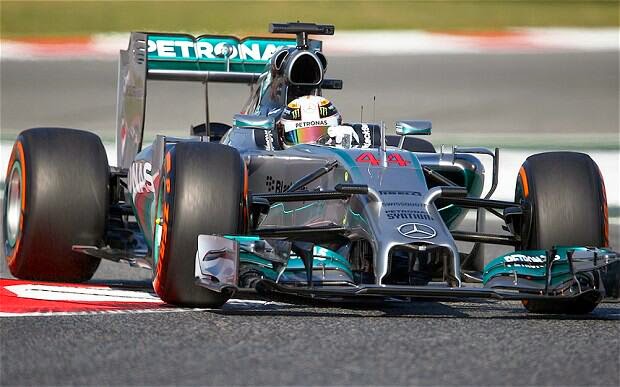
I'm ready to call it: Lewis Hamilton will be this year's World Champion. Pretty safe bet, I hear you snort, and you'd be right. But four wins out of five (and four in a row) isn't why I'm making it. I'm making it because we've now raced (and tested) at Catalunya, and it turns out there is no obvious weakness in the Mercedes W05. I thought the Red Bulls would maybe close the gap on such an aero-centric track; I didn't expect them to qualify more than a second behind. Predicting who will win the championship before a race at Catalunya is a vastly different game from predicting it after. But that's not the only reason either.

(via Telegraph.co.uk)
Y'see, I've also been reading Working The Wheel, a neat little paperback by Martin Brundle (reviewed it on Goodreads, if you're interested (and have Goodreads)). Martin's become the Voice of F1 since Murray Walker hung up his microphone, but his worthiness as a broadcaster is based on his earlier worthiness as a racing driver. Brundle raced through roughly a decade of Formula 1, with a little Le Mans action on the side, and in that time he counted both Michael Schumacher and Mika Hakkinen his team-mates. The man knows what he talks about, in other words.

Working The Wheel is a solid little read because it plays to his strengths i.e. being able to come across as One Of Us even as he's talking us through something an elite few ever get to experience. Happily he writes like he talks, to the point I'm pretty sure he just spoke into a dictaphone and let Maurice Hamilton insert the paragraph breaks and whatnot to turn it into written text. But I was watching the Spanish GP just after reading the chapter on the Hungaroring, which was handy because there Brundle talks about something I noticed in the winner of this year's Spanish Grand Prix as well.

It's 1994. Michael Schumacher is on his way to his first world title, and Brundle is running 3rd in the Hungarian Grand Prix, about to be lapped by Michael. But he's about to cop some pain via Schumacher's greatest asset - spare capacity.

I was on my way to a really solid third place when the team came on the radio and said the battery on my car was starting to go. I backed off and did a number of things to save power. With eleven laps to go, Schumacher, who was leading, came to lap me. That was going to suit me fine because, if he overtook, it would mean, when he completed the race, that I would have one less lap to do. The team reckoned I just might make it, even though the alternator was not working and I was running purely on whatever power was left in the battery. An F1 car is a massive drain on the battery because systems such as the engine and gearbox control units depend on it. These black boxes are power-hungry. But, when they stop, you lose the throttle, the ignition, the ability to shift gears, everything.

I was trying to coax the car home when Michael came up behind me. I moved over and let him through – and that was a crucial mistake. It triggered the thought in Michael's mind that I was too helpful. He immediately got on the radio to enquire about the whereabouts of Jos Verstappen, his Benetton team-mate, who was behind me in fourth place. When he heard that Jos was catching me, Michael slowed right down and I had no option but to unlap myself. If I had stayed behind Michael, Verstappen would have caught me and I would have lost my third place. So I had to go back on the same lap as the leader and prepare to do another 2.5 miles.

Michael also let Verstappen unlap himself; another clever move because, as soon as the leader crossed the line, anyone who had been lapped could not complete the last lap. Now Verstappen and I had to finish the seventy-seventh and final lap.

Sure enough, at the top of the hill between Turns 5 and 6, my car ground to a halt. Verstappen passed me. The fact that everyone else had been lapped and therefore could not take fourth from me was absolutely no consolation. When I finally got a lift back to the pits, I looked up at the podium to see Michael, Damon Hill and Verstappen spraying the champagne. The timing could not have been worse. I was two miles short of standing there myself.

By working that out, Schumacher had shown his mental capacity is one of the things that sets him apart. All the great champions that I've raced against have needed only 70 per cent of their capacity to drive the car while the other 30 per cent is used for reading the track, the race and the politics in and out of the car. If you look at a typical grid, the majority are high-level drivers and there really isn't much more than half a second a lap between them. The difference is their mental capacity. Those who have not had much success in F1 have needed 95 per cent or even 100 per cent of their ability to drive the car, leaving nothing in reserve to sort out everything else that is going on during the course of a race. The incident in Hungary is just one of a number of examples which demonstrate Michael's brilliance in that area. Ayrton Senna, Alain Prost, Niki Lauda and virtually any past champion you care to mention were all the same. That is why they were so good.

Damn right. "He was a genius," wrote Robertson Davies. "That is to say, a man who does superlatively and without obvious effort something that most people cannot do by the uttermost exertion of their abilities." Schumacher would even ask completely irrelevant stuff like how his brother was doing, so they tell us. And Alonso... well, if Schumacher was the king of spare capacity, then Alonso is Jesus. Pat Symonds has said Alonso has more spare mental capacity than anyone else he's ever worked with, and this is a man who's worked with Schumacher and Senna. Alonso's win in Japan in 2008 was simply incredible, working it all out in his head and asking to come in for fresh tyres so he could drive a handful of qualifying laps and make up the time to leapfrog the pack on strategy. It was intriguingly similar to Schumacher's famous win in Hungary in 1998, except that that was worked out by Ross Brawn, the owlish bespectacled man sitting quietly on the pit wall, talking to his driver. Alonso, by the by, did it all on his own.

And didn't look nearly as smug about it as you'd think. (via Formula1.com)

And did you notice something about the way the two Mercedes drivers ran their respective races at Catalunya? Nico was very quiet on the radio, just terse messages in between braking zones. Lewis, however, did nothing but whine all race long - how are Nico's tyres? Where are we on fuel? Why were they showing yellow flags when there was no-one parked on the side of the track? At one point he even asked how much time he lost to Nico in his second pit stop, to which he was told: "Not as much as he lost in traffic, Lewis. Carry on as planned." In other words, "Dude, would you shut up and focus on what you're doing?!"

Whining like a bitch is a bit of a faux pas for elite athletes, but  think about what this means: in the middle of a race, with G-forces trying to pull his heart out through his ribcage, with his rear tyres dying and in need of babysitting, Lewis still has enough brainpower left over to be worried about how much time he lost in that pit stop compared to his teammate. Because that might be the difference between first and second.

That, my friends, has got to be the Formula 1 version of First World Problems. And it's why he'll be champion this year... maybe...

Wednesday, 7 May 2014

Catalunya & the Riddle of Steel

What is carbon fibre next to the hand that steers it? What is turbo direct injection without the fire in the heart that drives a man to get on the throttle earlier, brake a little later, keep pushing his luck?

Formula 1 is a modern-day manifestation of the Riddle of Steel. That is, Which is fast? The Car, or the Driver? It's a question more relevant than ever as the old brigade of F1 fans get ever more elderly and ever more vocal in their whining that - *cue adenoids* - "In the old days a great driver could get a bad car to the podium. Nowadays the car matters more than the driver!"

For those who need to brush up on their geek references, it's a question that entered the culture through Schwarzenegger vehicle Conan the Barbarian. Conan has been taught that steel is strong, but the warlord Thulsa Doom (only in the 80's could you unironically name a character Doom) shoots down that interpretation with a grand little speech:


So that's the riddle: flesh or steel? Throttle control or downforce? On foot, Lewis Hamilton would be beaten by Usain Bolt; but put Lewis in his Mercedes W05 and Bolt will be left far, far behind. Yet, put me in that W05, and all you'll get is some scattered gravel and a smear on the Armco. Put nobody in it and it won't move at all. Clearly the problem gets more complex the closer you look.

Essentially, it's a modernist approach to a postmodern question. The answer, as with everything today it seems, is "both working together." It's the dynamic interplay between car and driver - to get needlessly pretentious, it's Clauswitz's schwerpunkt. As Niki Lauda said in Rush, "You don't suppose the fact that the car's so good has something to do with me?"

And despite what the old fogies will tell you, it's been like that since the beginning, even Fangio's day:
It was true that he always had the best car, and that was because he was the best damn driver! The cheapest method of becoming a successful Grand Prix team was to sign up Fangio. – Stirling Moss
That's also why Michael Schumacher was worth $50 million a year: putting Schumacher in the car made it half a second a lap faster. Finding half a second in the windtunnel or engine shop would have cost an awful lot more than $50 million...

And it's a question that has a special relationship with the Spanish Grand Prix, for two reasons. One, it's the first race after the "fly-aways", the first race of the European season. And two, it's run at the Circuit de Catalunya, which used to be called the test driver's second home (back when they still had test drivers). This was partly thanks to the mild Spanish winter, and partly because of the corner layout. Check it out:


Notice all those long, sweeping bends? Notice how they're all, like, a bit different? Notice how they all come together in a long, long front straight? There's nowhere to hide at Catalunya. To get a fast lap time you need everything - grip, power, handling - and you need it all working together. That's why it was the place to test a new car, because if something wasn't working, you knew straight away. Today, together with the scheduling, that means the Spanish GP sees the biggest round of car upgrades all season.

And that has serious consequences for the championship. Mercedes have had it all their way so far, but Red Bull did amazingly well considering their preseason woes. With that rate of progress, will they be able to catch up? Will Vettel, spending long hours in the simulator  with Ricciardo's data, have found a way to keep the tail of his RB10 under control? Will Red Bull's engineers have found a setup that gives him a stable rear end? Or will they have moved towards each other organically, meeting somewhere in the middle?

Alternatively, will Mercedes have polished the razor and found a few tenths to keep their drivers in front, or will their new updates be a backward step that drops them behind their rivals? Or will some hitherto unnoticed driver arrive in the first corner and  find the latest updates make the back end of his mediocre car come around just right, so he can drive it flat out all day and never make a mistake? If that happens it won't matter that Mercedes and Red Bull have more downforce, on race day our lucky driver will be faster.

It's happened before... (via bandeiraverde.com.br)

There's no way of knowing. That sweet spot where driver meets car is a moving target, and even if you get it perfect this week, by next week your rivals have moved on. Or your drivers could trip over each other at the first corner and all your painstaking upgrades will be wiped out in a heartbeat. At that moment, you might as well have put me in the car for all the difference it will have made. Just one of the things that makes Formula 1 so dynamic and interesting.

But my prediction? Races at Catalunya tend to be won from pole, and pole this year seems to belong to Lewis Hamilton. So unless Red Bull have come up with something major at the factory, this weekend's Spanish Grand Prix will be Hamilton's to lose. The result will be interesting rather than entertaining... but then I said that about Bahrain too.

See? That's the irony of F1: all the hard work to take the guesswork out of it just makes sure you can never tell what will happen next. That's the Riddle of Steel.