Wednesday, 24 June 2015

Making Mad Max a Reality Programme

Since both Formula 1 and V8 Supercars have defected to Foxtel - which I can't afford, thankyou very much - I can't really keep up this blog's original mandate and cover those two racing series anymore. I don't blame James Warburton or Bernie Ecclestone personally, it's the broader trend of money being upwardly mobile that gets me. Aiming for max eyeballs on the screen only works as long as those eyeballs have access to wallets that might be opened to the sponsors who pay for the teams and the TV scheduling alike; if the money is restricted to a smaller segment of the populace, it only makes sense to follow it. Eventually when all the money is in the hands of a sociopathic few it will inevitably trigger a Paris 1789-type response, but that's beyond the scope of this blog. Suffice to say if I had the income I would absolutely get Foxtel and treat myself not just to V8s and F1 but IndyCar, NASCAR and Le Mans as well.

But I can't, so I hate it. In the meantime, I'm broadening the focus of this blog, opening it to whatever the hell is on my mind this week. It will also be updated on a shameless when-I-feel-like it basis. So, with the pleasantries out of the way, let's nuke Melbourne.


A few days ago I re-read an old triptych of essays called Nuclear Warfare 101. These essays (guess what they're about?) are a good primer for anybody who's at all interested in such things, because the author was once part of "The Business," as they call it, planning genuine no-bullshit world-ending nuclear strikes. I highly recommend just reading the text I linked above, since all I'm doing is applying a few of its principles.

In particular, I remember on first reading I was intrigued that, "...we don't target cities at all per se. We target things, some of which happen to be in cities." That seems perfectly obvious to me now, today, but to a kid raised on T2 that was an eye-opener. And my last reading got me thinking what targets might exist inside Australia's cities. I chose Melbourne because I used to live there and know the layout reasonably well, and because a good chunk of it is absolutely dead flat (unlike Sydney, a 19th Century ants nest built in the cracks of a mountain range by the sea), which makes visualising the blast easier. For this I'll be using Nukemap 2.42, which has gotten way better since the days of Nukemap Classic and even comes with a 3D version for Google Earth!

Before we begin, I'd like to say a big hello to whichever overworked/underpaid member of the AFP is currently checking this blog, and reassure you that I don't have access to nuclear devices of any kind and would have no desire to use them if I did. All the information I'll be using is publicly available and easy to Google, so I'm not spilling security secrets either (as far as I know). This is just a gedankenexperiment, nothing more.

Got that? Cool, let's get cracking.

The scenario as I imagine it is an invasion of Australia from the north, which is, let's face it, where any invasion is going to come from. No I don't think it'll be Indonesia, thanks for asking. Yes, I know they're impoverished, overpopulated and sitting only 200km off the coast, but the TNI is geared towards terrorising their own people more than ours. Barring a major shake-up to their leadership and/or national character, I don't see them becoming a strategic threat in the near future, despite the dreams of groups like Jemaah Islamiya. In any case I'll be using U.S. devices only, because as two-fifths of the ANZUS treaty they're our allies and it'll avoid libelous remarks (and the U.S. is pretty invasion-happy anyway, amirite?).

So: as part of their invasion, the  Bad Guys want to render Melbourne - the largest, most populous city in the country, with the busiest port and a solid industrial base - non-functional. How does one go about shutting down Melbourne with a few well-placed miniature suns?

I started by looking up the most obvious targets - military installations, especially joint U.S.-Australian ones - and was a bit stunned to find a site called AusSurvivalists has a list of the Top 40 Australian Strategic Targets, which includes everything from Pine Gap to the Lithgow Small Arms Factory and, you'll notice, the exact latitude and longitude for each. Man, I can't believe a list like this is actually legal, but there you are: forty juicy targets oughta prime the pump nicely.

But very quickly I discovered that as far as military targets go, there kind of aren't any in Melbourne proper. The nearest air force base is RAAF East Sale, but that's only a training base with little actual combat hardware. There's the mooring for HMAS Cerberus, but we'll be getting to that when we attack the port. Puckapunyal, home of the army's School of Armour, School of Artillery and School of Ordnance seems like a pukka target, but it's about 100km north of the city proper and beyond the scope of this blog. Apart from that there's a few bits and pieces (Simpson Barracks, home of the Defence Force School of Music, anyone?) and the Victoria Barracks, which is heritage-listed and absolutely gorgeous by the standards of military architecture. I doubt the Bad Guys will give five-eighths of a fuck about preserving our cultural heritage, but as a target it's a bit small for a nuke, and anyway most of the people in there are better kept alive: "Killing the only people who can surrender is not terribly bright," as it says (yes, slaughtering the grunts and keeping the pigs in command alive is enshrined in policy now).


But that doesn't mean we're out of strategically promising targets. Among the Top 40 are every major oil refinery in the country, one of which is owned by Mobil and located right there on the beach at Altona. For some reason though they didn't count the Shell refinery at Geelong, but as a servo attendant I can promise you it matters. I had the privilege of working in north Melbourne a few years ago when someone opened the wrong valve there and shandied up a few million litres of diesel; we had no choice but to hang signs on our pumps and apologise to the panicking tradies and truckies. It was almost four days before diesel crept back into our city. So taking out either of those refineries would cause a major disruption to the fuel supply. Hit both and you'd bring the southern half of Australia - the bit with the Ford and Holden assembly plants, where every other knob on the road has a Haitch-Ess-Vee or Eff-Pee-Vee - to a screeching halt.

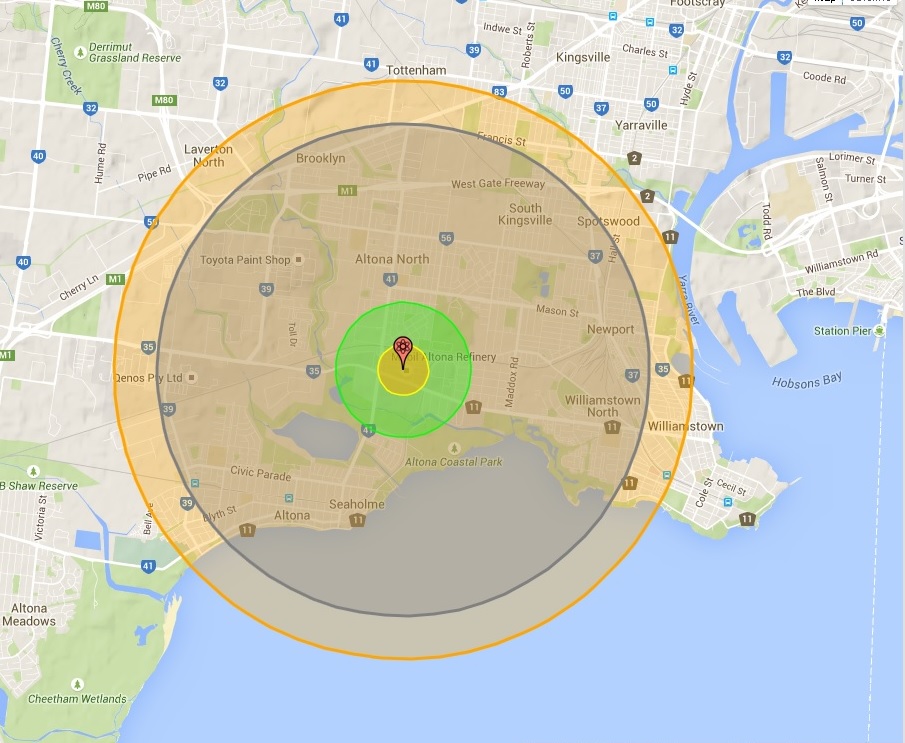
So let's hit both of those right now: airburst W-76s, 100 kilotons each.


That should do it. Those fractionating towers are now plasma, along with half a square kilometre of other Mobil property. The residential parts of Altona are gone; the West Gate Freeway is probably still there, but any cars riding it have probably been blown off the road. Nukemap guesstimates about 105,000 casualties, including nearly 22,000 deaths. Anyone within 4.4km and unprotected now has third-degree burns, although that mightn't be so bad as Nukemap cheerfully tells us such burns, "are often painless because they destroy the pain nerves." Oh, good.

The refinery strikes are a good start - at the very least they should trigger the Mad Max fantasies all those HSV and FPV owners secretly nurse - but we have even bigger fish to fry. If you really want to cripple a country, you need to take out its airports. Next stop, Tullamarine.

This will be a jittery experience for me because if we miss we're going to destroy Calder Park Raceway, of which I have very fond memories. To take down Tullamarine you can't just flatten the radar and departure lounge, either; the RAAF will just move in and make the place their own regardless. To really cramp their style we're going to have to use a groundburst to dig a big fat hole in those nice smooth runways. That means a large device, because blast at ground level won't travel as far as it will from up high. So we'll also use a bigger nuke, a W-87 currently deployed on the Minuteman III - yield 350 kilotons.


It's hard to see, but most of Tullamarine is contained in that red circle, which delineates blast pressure above 20psi, enough to demolish even concrete buildings. Nukemap claims another three-and-a-half thousand deaths, but that seems very conservative to me; depending on the time of day the airport could contain 10,000 warm bodies all by itself. More importantly, both runways are under the yellow circle outlining the fireball itself, which just dug a crater 260 metres across (which, since the weapon has a 200m CEP, is easily big enough), putting both runways out of action permanently. Calder Park is also just barely outside the 100% chance-of-third-degree-burn range, so people inside the Thunderdome might be okay; unfortunately, you'd basically have to be at Flemington to get off with zero chance of burns, and we're also about to have our first run-in with the F-word: fallout.
Fallout is caused (mostly) by debris from the ground being sucked into the fireball, irradiated and spewed out of the top," says the expert. "This radioactive plume coalesces in the atmosphere and falls back to earth. It's a mix of isotopes of varying half lives. The most vicious of these isotopes have short half lives and are gone in a few hours (usually before the fallout makes it back to the ground). The milder ones can hang around for millennia but their effects are tolerable (speaking relatively again). The really dangerous ones are those that have a half life of between 5 and 6 years - these are long-lived enough to be seriously contaminating and hot enough to be dangerous. The worst is cobalt.
And by digging a big hole, a groundburst creates huge amounts of fallout, and if you follow the plume you'll notice a lot of it has just landed in Greenvale Reservoir. Everyone in Greenvale and Roxburgh Park who's still alive will be buying bottled water for the next decade. Or pouring it on their burns.

Last but not least, the really crucial part - the port of Melbourne, on the banks of the Yarra near Swanson. The busiest port in the country. If you want to prevent the ADF getting any resupply, this has to be a priority target. But more than that, I'm intrigued by what the guru had to say about targeting railway lines:

The first shot at targeting will be stunningly disappointing so you play games with warhead types and yields and with burst locations until you get as many of target set as you can. Take that marshalling yard; sounds easy doesn't it? Believe me railway marshalling yards are a whirling son of a bitch to take down. They are virtually invulnerable to airbursts; we have to groundburst a blast directly on the yard. 800 yards outside and you might as well not have bothered. The problem is those yards are not that big. So now we have a problem called CEP. This stands for Circle of Equal Probability (NOT Circular Error Probable which is a totally meaningless term invented by those of the intrepid birdmen). This is a measure of the accuracy of the missile and is the radius of the circle that will contain half the missiles aimed at the center of the circle. That means that half the inbounds will fall outside that circle. Now we have a second concept; the radius of total destruction, the radius within which everything is destroyed. Its astonishingly small; for a 100 kt groundburst its about 800 yards (now see where the marshalling yard came from).. Now if the RTD exceeds the CEP we're probably OK, if it doesn't (and in most cases it doesn't) we've got problems.

I'm in the mood for a challenge, so let's aim our device not at the port itself, but the set of railway lines just to the north: that's how all the containers get out of the city, so a lucky hit here will cut the lines and leave the containers stranded. If we manage to damage the port facilities and take out the cranes at well, that'll just be icing on the cake. So let's groundburst a mid-range W-80 right there on the lines, 150 kilotons.


Oh yeah. Those railway lines are gone; from the looks of it about half the port itself would be inside the fireball, and the rest would be halfway to Tasmania by now. Even better, the city CBD with things like the Queen Victoria Market is located outside the blast radius, meaning a lot of it probably survived (albeit with the world's most epic glazier bill). The downside is, the wind in this part of the world tends to blow northeast off the Bass Strait, so...


...uhh...


...Yeah, we just gave the northern suburbs a deep-tissue tan as well. Epping, Mill Park, South Morang, Greensborough and Hurstbridge will be inhabitable for several years at least, even if you manage to fight off the mutants who now live there. A lot of the dust fell into the Dandenong ranges too, where it'll get into every nook and cranny and probably stay there forever. Worst of all?


The Kerrigans won't be visiting Bonnie Doon anytime soon. Might as well sell your holiday home Darryl, schedule a weekend there and you're dreamin'.


Total casualties? Nukemap comes up with a minimum 51,000 deaths (which could easily double, depending on the breaks), and 210,000 to a flat half a million injured. But for that price  we've managed to ruin Melbourne as an entity and turned it into Australia's biggest welfare slum. Which, considering all the Sun-reading, rort-raging, right-wing members of Rupert Murdoch's zombie army who who call the place home, serves 'em right.


Wednesday, 11 February 2015

Thunderbird for a Thunderdome

I know I talk about Dick Johnson and NASCAR a lot on this blog, so I thought I'd kick off the new year with... more Dick Johnson and NASCAR. Specifically, a video of the inaugural Goodyear NASCAR 500 at Calder Park - the first NASCAR race outside North America, and the grand opening of the Thunderdome.


What's often forgotten in these cars is the wider context - simply, they were the fastest stock cars ever built. When the Thunderdome opened in 1988, Daytona had just seen its first restrictor plate 500. The year before had seen the final generation of cars to run at Talladega without them, where on April 30 Bill Elliott set a qualifying record that will absolutely never be beaten: 212.809mph, or 342.483km/h. The opposition were horrified: Elliott was more than two seconds faster than them, and Monte Carlo drivers said at that speed their wheels were actually leaving the tarmac entering Turn 3. And Elliott was disappointed: in testing over in the winter of '86 he claimed he'd managed a one-lap average above 345km/h. By comparison, Mario Andretti's pole at Indianapolis that year was "only" 346.637km/h.
It was 1983 when Cale [Yarborough] turned over trying to run just a little over 200 and then here we are four years later running 210 around that place. I guess why I said it impressed me the most is I was sitting down watching Cale try to run that deal, and I saw him get loose and lose it off turn four and turn over. I’ve said this a thousand times, but when I left pit road that day I didn’t know what would happen... It probably took me another 30 minutes to start breathing normal again. - Bill Elliott, interviewed on Motorsport.com
Clearly a very special driver with a very special team behind him. What I didn't know until I started researching this article is what a garagiste operation Elliott's team actually was. Coming out of the Euro F1/Australian touring car tradition you learn to accept factory teams as the norm, expect to find them everywhere. But no, Elliott's team was just a family business, started by his dad George and run out of their workshop in Dawsonville, Georgia. The engines were built by his brother Ernie, and by the mid-80s were on a level beyond anything the other teams were putting together, even the Wood Brothers. In the '85 Winston 500 at Talladega, a broken oil fitting cost him two whole laps - five miles. Nothing daunted, he came roaring out of the pits, put the hammer down and, in a shocking display of power and reliability, made them back up - under green - to take the win! In fact, they did such a good job that some conspiracy theorists believe the restrictor plate rule was put in place not for spectator safety, but to keep Elliott from dominating any further. When they have to change the rules to put you on a leash, you're morally crushing on a Michael Schumacher level.
 

The design of the '87 Thunderbird itself didn't hurt, either. Of course Elliott's car was a "Thunderbird" in name only, since NASCAR had already made the leap to bespoke tube-frame chassis that V8 Supercars wouldn't make until 2002. The roadgoing version was actually a shopping-friendly front-wheel drive V6, not a fire-breathing 358ci V8. But it was a genuine Thunderbird in its most crucial aspect - its aero. For the first time since the 1970s Detroit was tweaking its cars for competition, and the '87 Thunderbird became one of the first mass-production cars to be put through a windtunnel, with fabulous results.
If ever there was a car shaped to go fast it was Ford's 1987 Thunderbird. From the point of its slick beak to the slightly elevated trunk lid, the '87 T-Bird was shaped like a perfect projectile – three-quarters bullet and one-quarter B-1B wing. - Daytona's Top Ten Stock Cars
And it's not like the opposition was hanging around being a punching bag, either. Like V8 Supercars, NASCAR in those days was strictly Henry vs. The General, since Chrysler had pulled the Dodge boys out for the time being. But where Ford were represented by the 'bird alone, GM entered models from all their subsidiaries - Pontiac, Oldsmobile, Buick, the lot (but Chevrolet's "Aerodeck" Monte Carlo SS was the most dangerous). It wasn't hard to do, NASCAR had already ruled the Chevy small-block could race under the bonnet of any GM product, so all it took was a different "aluminum" skin and a team willing to use it.

So these were the cars delivered to Australia in February '88, mostly in kit form. A Thunderbird for Dick Johnson (in the colours of Redkote, the American brand of Ross Palmer's empire); a Pontiac Grand Prix for Neil Bonnett; a Buick LaSabre for Bobby Allison; and, most impressively, an Oldsmobile Delta 88 for Allan Grice, who qualified an astounding 3rd. Despite what you may think, NASCAR favours those who can really hustle their cars over the smooth-n-easy types, partly explaining Gricey's unexpected talent for the 'dome. By rights Dick Johnson should therefore have been starting right alongside him (he was always better at winning the ATCC than Bathurst, remember), but I'm guessing all his time and money had gone into the Sierras and left the Thunderbird an orphaned side project. In the end it didn't matter though: they were both wiped out in an early pile-up.


Either way, the vision there is stunning: the onboard shots bring it all back for me, the heat, the violence, the sensation of being in a tunnel, the incredible G-force (seriously, it's like leaning against a freezer). A fantastic kind of racing, whatever the snobs say. The confines of Calder were never going to allow Ford's 'bird of prey fly as high as it had on the superspeedways, but just thinking of a great driver like Dick Johnson at the wheel of a car as fast as Bill Elliott's has me nursing a semi. And at the same time, isn't it nice to know in those days we were building a Falcon better than the Thunderbird and a Commodore better than a whole shelf full of GM products? Hmm?

Wednesday, 5 November 2014

Formula Fiscal

There isn't enough money in the entire world for Formula 1.

http://www.virgin.com/news/marussia-virgin-racing-testing-success

That's not just a nice bit of hyperbole, it happens to be literally true: if the entire $75 trillion GDP of Planet Earth was poured into Formula 1, we'd get some superb racing machines, sure, but the teams would still be screaming for money. There is no upper limit on spending when it's going towards R&D for a competitive activity. Only the military gives you that same crippling equation, which is why only defense can give you more out-of-control spending than Formula 1.

But on a more-practicable, less-hypothetical level, it seems that statement has become true as well: there aren't enough willing investors to keep every Formula 1 team afloat, and certainly not if you want to spend at the same level as the big teams. Which you have to, if you want a chance at winning.

So it is that two of Formula 1's backmarker teams have bitten the dust - Marussia and Caterham. Both arrived on the grid in 2010, born out of then-FIA president Max Mosely's idea to force a €30 million spending cap on the teams. Four teams thought that sounded pretty workable: Campos Meta (which became the Hispania Racing Team); Manor Grand Prix (which ultimately became Marussia); Lotus Racing (which became Caterham); and USF1 (which became a hellish mess). All of them were counting on Mosely's budget cap idea to remain in business, so of course, the established teams shot it down in flames. Mosely lost his job as FIA president, the budget cap idea was dropped, the hovering threat of a breakaway series vanished and the new boys weren't needed as insurance anymore. They found themselves diving into the familiar F1 shark tank - without Mosely's steel cage.


HRT hit a financial brick wall before they even got to the grid, and Spanish squillionaire José Ramón Carabante was forced to buy the team to protect his initial investment, naming it after his Hispania Group. He called in Colin Kolles (then running Audis at Le Mans but with plenty of hands-on experience running several F1 teams), who put together a real Frankenstein monster of a team: Italian cars ("Dallara," said technical chief Geoff Willis, "thought the car would be a super-duper GP2 car, maybe 30% better, but it needed to be ten times better"), Spanish finance, British mechanics with DTM, Le Mans and Formula 3 backgrounds, but not much actual F1 experience, mechanics trying to convey information in Spanish, Italian, German and English... a real dog's breakfast. HRT first hit the track, not in practice for the Bahrain GP, but in qualifying: Karun Chandhok felt them bolt the floor onto the car under his backside when Q1 had already started.

The first time this car ever had an engine in it.

So nobody was too surprised to say adios to HRT in 2012; by then they weren't trying to become a proper F1 team, they just wanted someone to buy them and take the financial loss, the Greater Fool theory in its practical application. They were even still running the same Dallara cars, never having had the money for new ones.

Marussia was better, but not by much. At its core was a crew of Formula 3 stalwarts, Manor Motorsport from Sheffield, with a commercial office in London and R&D from Wirth Research in Bicester. The Wirth connection was the biggest clue - in those days Nick Wirth was championing the idea that CFD (Computational Fluid Dynamics) would soon make windtunnels obsolete; that the digital windtunnel would soon be giving better results than the real thing. That was Manor's great flaw, trying to go Grand Prix racing without a windtunnel. Cutting one of the most basic corners in the game was a bold gamble, one that attracted Sir Richard Branson's attention and made them Virgin Racing for their first couple of seasons, but in the long run it backfired badly. It turned out CFD couldn't do the job alone (or just couldn't do it alone yet, depending on who you asked), and Wirth was given the flick. From there they were on borrowed time: Beardy Branson got out while he could and sold his stock to Nikolai Fomenko, whose Marussia sports car company gave the team its new name. Then in April this year the Marussia company itself shut down, and it was just a matter of time until we said Пока! to the F1 team.

So the loss of HRT and Marussia was no real shock; the real surprise was Caterham. If any of the Class of 2010 looked promising, it was Caterham. The team started as a Malaysian pride project, partly owned by the Malaysian government, but the frontman was billionaire AirAsia owner Tony Fernandes, with support coming from Proton who gave permission for the team to be named Lotus. The new Lotus was started from scratch ("At the middle of September ['09] we had three staff and an empty factory near Hingham," said Fernandes, although sign of the times, the first room completed was the prayer room for the team's Moslem employees). But the real mover and shaker was Mike Gascoyne, the man who'd moved Renault to the front of the grid in the early Noughties and almost managed the same with Toyota. Gascoyne wisely built a relatively heavy, conservative car that did what none of the other teams could do, finish races, and so ended the year best of the bottom four (which, because of a bet, resulted in Sir Richard Branson serving as a flight attendant on an AirAsia flight).

He rose like a phoenix to the occasion.

But then the ex-Renault factory team changed their name to Lotus, kicking off a huge legal row that ended with Fernandes buying the Caterham company, makers of the Caterham Seven kit car, just for the rights to the name (why they didn't just call the team Proton, a name easy for Westerners to pronounce and sizzling with Rise-of-the-Third-World cool, is beyond me). Yet this year Fernandes seems to have lost interest: in Monaco the team set a record for the most races without scoring a single point (just to rub in salt, the same weekend Jules Bianchi gave Marussia their first points); then 40 staff took him to court for wrongful dismissal (a sure sign the budget butchers were at work). Now they've entered administration, and although next year's entry list still shows a Caterham entry, it seems pretty unlikely.

So what happens next? There's talk of the remaining teams being forced to each enter a third car in next year's championship - a sign things are in a bad way, but sadly, not an uncommon one. You only have to unwind the clock 11 years to find that sort of talk coming up again. And the lessons from that time will be the subject of my next blog.

Saturday, 1 November 2014

When Gricey Scalped the Greats

God, I love this.

So I'm most of the way through a great video providing good insight into the time the Holden Dealer Team went to Europe, when I'm distracted by a tale of outrageous theft. This is why racing is awesome, people.


Let's start at the beginning. It's 1986, a year that started on a high note as Peter Brock's long-delayed Commodore evo  finally arrives. The car - the VK Commodore SS Group A (a bit of a mouthful, better known as "Blue Meanie") - was well worth the wait, fast out of the box and responsive to good driving and careful preparation.

The first Australian Touring Car Championship for Group A cars had been won (by a BMW), as well as the first Group A Bathurst (by a Jaguar), leading some to decry this invasion from foreign cars as a misstep. Peter Brock, however, grabbed the stick from the other end - he realised the Commodore was now eligible to race in Europe. With a brand-new "World Touring Car Championship" having been announced for 1987 (which would visit Australasia thrice, including races at Calder Park, Wellington in East Bondi, and the big one at Bathurst), it would probably be a good idea to send a car to Europe and get a taste of the opposition. Ergo, a VK SS Group A was crated up and flown to Italy for the 500km race at Monza - Round 1 of the '86 European Touring Car Championship.

Source

In those days the ETCC was as cutthroat as touring car racing got: a marathon 13 races, each 500km long, plus the prestigious 24 Hours of Spa-Francorchamps (these days it's a GT race for gran turismo cars, but back then it was for ordinary touring cars, or piccolo turismo, as I like to think of them). People who could make a living out of this were not to be trifled with, and 1986 saw more works teams on the grid than ever before (or since): BMW's Schnitzer Motorsport; reigning champions Eggenberger, who'd just signed on as the new Ford works team; the Volvo Motorsport Division, who after the breakup with Eggenberger were on the rebound with Belgian team RAS Sport; and Tom Walkinshaw Racing's ongoing stint as the Bastos Texaco Rover team.

To stand against that, Holden would have to field the very best – so Peter Brock got on the phone to his old rival Allan Moffat, who'd spent 1985 on the sidelines, unable to get a drive. Yes, do not adjust your screens, Moffat actually signed up to co-drive a Holden with Peter Brock! Despite their old rivalry, Moffat was the ideal man for the job, a driver with plenty of overseas experience and a wide range of international contacts, not to mention amazing mechanical sympathy. Moffat signed to do development work and the co-drive the famous #05, which the FIA sadly reduced to just #5 for the European events. More promisingly, as part of the global General Motors caliphate, Brock and the Mobil HDT were allowed to operate out of Opel's racing skunkworks in Germany. 

Source

And funnily enough, Allan Grice made the trip too, showing once again was sort of the antimatter version of Brock. Grice's car was also a VK Group A, but unlike Brock's, it hadn't been prepared by the factory. Instead, it had been put together by Les Small's Roadways workshop in Melbourne, one of two VKs Les Small built for Gricey that year and widely considered the best two cars he ever built. One of them stayed in Australia and was raced locally, while the other was flown to Europe to contest the ETCC alongside Brock. It had almost no sponsorship (just frozen chicken magnate Graeme Bailey's Chickadee logo, plus some help from Yokohama as he outlines in the video), and the car was run not from a glossy manufacturer's factory, but from Aussie expat Alan Docking's Formula 3 workshop. It was the ultimate contrast of factory glitz and gritty privateer.

And amazingly, it was advantage Grice. At Monza Brock snapped an axle within six laps, a mechanical failure unthinkable back home, while Grice led the race for quite a distance and caused quite a stir among the Establishment. The race fell to Tom Walkinshaw, but the Volvo, BMW and Rover drivers still left the circuit muttering to themselves and staring disconsolately at calendars, checking the dates for their next round of factory upgrades. It's only been okay to say it since the announcement that Broadmeadows is closing, but it now seems it was true: Aussie cars were actually pretty good.


Source

Oh yeah, and the theft? At Spa Gricey broke a seat, so he pinched one out of Tom Walkinshaw's unused display car. Not to be outdone, Win Percy confirms that yes he did, then goes on to describe cannibalising some poor bastard's brand new Mazda in the car park, because a Mazda team needed the parts! Tacitus once wrote, "Crime, once exposed, has no refuge but in audacity." The people in motor racing all got that memo.

Damn, I love this sport.

Tuesday, 28 October 2014

Zero to Hero

How do you go from never winning a single race, to completely dominating your series in only six months? With the same car?

Source

Yes, it is a trick question. Racing cars tend only to exist as cars on race day anyway, spending the rest of their time lying around the workshop in bits. Ship of Theseus-type questions are inevitable. But it's still the question Jim Richards, the John Player BMW Team and the BMW 635 CSi were facing at the conclusion of the 1985 Australian Touring Car Championship. Nobodies in December, Champions in July. What gives?

Wise readers will already know what changed: the ATCC made the jump from the local Group C regulations to the FIA's international Group A. Frank Gardner's JPS team'd done their best campaigning the BMW, running it for four years straight without managing a win, because sometimes there's nothing anyone can do. Group C had recognised four classes based on engine size: 1,300cc (a tiny Fiat or something), 2.0 litres, 3.5 litres and a whopping 6.0 litres. Tyre regs had split the field into only two, giving the smaller cars 8½-inch tyres and the bigger ones 10½. With minimum weights up to the none-too-transparent discretion of CAMS, that really left only two kinds of car in the ATCC: big, stonking, V8-engined muscle cars, and backmarkers.

Click here for a great article by Mark Oastler on this car. You have to sign up for Shannons Club to read it, so it's up to you whether it's worth providing free market research for (hint: totally).

The BMW fit into the latter category. The design dated from 1979, and it showed, with a forward-tilted radiator grille and that fat '70s airdam (in those days engineers weren't interested in using the airflow under the car to produce downforce, they were trying to keep it from getting under there in the first place). That made the car an aerodynamic nightmare, but that was slightly offset by its smaller overall size, which kept its drag figures manageable. But it had one handy ace up its sleeve - its engine, which had been taken from the stillborn BMW M1 supercar. Since the M1 had begun as a homologation special for a defunct sports car series, that meant the 635 got its power from a racing engine that had been sanitised for road use, not a production engine that had been tarted up for racing.

That should have given the Beemer a major advantage in the endurance races, where its drivers could keep revving it hard while their rivals were falling by the wayside, but there was just no living with the V8-powered XE Falcons and VH Commodores. Bentley's Maxim - that there's no substitute for cubes - was proved right time and again on racetracks across the country, which tended to be stop-start affairs sorely lacking in the long, flowing corners the BMW was used to. By the European definition, Australian touring cars weren't so much "touring cars" as "drag cars that could go around corners."

Until 1985, that is. Suddenly the old rulebook was torn up, and a new one brought in that had been written around machines just like this one. Like Group C, Group A used an equivalence formula that matched bigger engines with heavier weight limits and fatter tyres, but in much finer increments, letting the engineers match everything up a lot more closely. Since the JPS team was a "works" effort with support from Munich, they got access to BMW's collective parts bin, giving Frank Gardner's crew a huge head start on Group A. The result? Suddenly the BMW's 3.5-litre engine was producing some 250 kW, but only had to haul around 1,185kg, and was dancing around on bespoke fully-independent racing suspension - a recipe to make any racing driver drool.

Source

Compare and contrast the opposition. Ford had picked this moment to kill off the V8 Falcon, leaving Dick Johnson with little option but to buy a gutless Mustang from Zakspeed in Germany. Peter Brock had it even worse - the Commodore's 5-litre donk left it at the extreme end of Group A, saddled with a beefy 1,300kg minimum weight. Even worse, the production-based engine was far from sophisticated (pushrods and carbs, oh my) and Brock's cash-strapped Holden Dealer Team couldn't have afforded custom suspension gubbins like BMW's even if Holden was making any.

Even so, Brocky drove out of his skin to win his home ATCC race at Sandown, while Robbie Francevic drove one of those Swedish refrigerators to win the following race at Symmons Plains, and the season closer at Oran Park. But all the rest - including six races in a row from Barbagallo to Amaroo Park - fell to Gentleman Jim and the black-and-gold BMW team, at last earning Jim the crown of Australian Touring Car Champion (one of those races, the Eurovox Trophy at Calder Park, appears on one of Channel 7's "Magic Moments of Motorsport" DVDs, Group A Touring Car Classics. Yeah, free plug for them, but I'm trying to incentivise them to release all the races from 1960 onwards, so go buy it already).

Wait, the best bit was yet to come. For Bathurst, tyre magnate and retired champion Bob Jane indulged both his taste for European machinery and his deep pockets in equal measure, and brought over another BMW 635 to compete with the John Player team. Not just any 635, either - one built by Schnitzer Motorsport, BMW's much-feared works DTM team, which had already placed 2nd outright in the Spa 24 Hour race (apparently Janey had wanted the winning car, but it had sported one of those famous "BMW Genuine Parts" paint jobs that advertised all the bits and pieces under the bodywork. Jane of course was going to run his Bob Jane T-Marts colours, which would obliterate the BMW Genuine Parts livery - and putting it back was going to cost $10,000. Jane swallowed, blinked and shelled out for the silver-medal car instead. It's now in the Bowden collection, and you can read the car's whole history here).

Source

Anyway, so there was a rival BMW on the grid for the Great Race of '85, one built by the pros in Austria and funded by one of the wealthiest men in the country... and it was still out-qualified by the locally-built JPS car of Jim Richards! Richo's Hardie's Heroes lap was a solid 2 minutes 21.396 seconds, while in the same session Jane's driver only managed a 2:22.874. One-and-a-half seconds faster in - really, truly, genuinely - the same car. That's some class. Imagine Australia's surprise when we found out our touring car scene was on a level with the professionals in Europe! Cultural cringe is a funny thing.

So to answer the original question, how do you go from never winning a single race to dominating your series in only six months? Well, it doesn't hurt to have the rules rewritten in your favour... but to make it work, you also have to be among the best in the world.

Source

Wednesday, 22 October 2014

A Long History Of Blowing Hot & Cold

We need to stop buying Fords.

That was the conclusion I reached on hearing that the blue oval will likely stop funding V8 Supercars after 2015. Given that Broadmeadows is shutting down in 24 months and the deal with Fox will shrink the TV audience to nothing, it makes a cold sort of sense, if you're myopically focused on the Falcon.

But at this stage - after years of strangling Dick Johnson, the Stone Brothers and FPR - Ford's been quitting for so long I'm starting to think of them as one of those crazy girlfriends who are forever breaking up with you just to get some attention. Do they imagine if they draw the agony out as long as possible, we'll miss them more or something?

In 2009, this team were doing all Ford's winning; Broadmeadows turned off the money hose, and now they race Commodores. Stick to beat themselves with: made. (source)

Not that it should come as any surprise. Ford's been pulling this sort of thing as long as they've been in Australia. Like in 1973, after Allan Moffat won them the ATCC and Bathurst in the same year, they shut down Ford Special Vehicles within months because, "We’re selling every damn car we build and we don’t need racing." Moffat was given a racecar as a parting gift and left to run it all on his own. In 1977, same thing: Moffat gives them that famous 1-2 finish at the Mountain - probably the most photographed moment in Aussie motorsport ever - and the next year, zap, Ford and their money vanish like spit on a hotplate, leaving Moffat out in the cold again. We've got our marketing benefits, thank you very much, no need to keep paying through the nose for it. No wonder Moffat went to Mazda.

2010: This man is crowned Australian Touring Car Champion in a Ford. 2011: He's driving for HRT. (source)

I've said it before: Ford doesn't seem to like motorsport, doesn't understand motorsport, and doesn't get why the rest of us like it so much. It's not just a Ford Australia thing either - wade through Jackie Stewart's vast autobiography Winning Is Not Enough and you find a revealing conversation aboard Dearborn's corporate jet, on the flight home from the '96 Canadian GP.
There was four of us sitting together and they asked if I would help them make a decision about what they were going to do. I told them they should get out of Formula 1 because they weren’t fully committed to it. “You’re either in, or you’re out, and the way you’re doing it, at the moment, is not giving you the chance to get the success that you expect or want.” They said, “No. We can’t get out because the market will think it’s wrong and in the rest of the world, lots of countries really want it.”
Don't like it, don't want to pay for it; have to do it because the customers force them to, with the result that they come across as sulky and resentful. If that's not proof the accounting trolls are running the company, I don't know what is. Show them a racing team budget and all they'll see is red ink to be minimised. The penalty of such a short-term view is that it's trapped the company in a spiral of ever-diminishing returns, slashing funding to Ford Performance Racing so much that they - the factory team - now have to run a Pepsi livery to make ends meet. So in their attempt to minimise promotion costs, Ford are paying $2 million a year to give Pepsi an edge over Coke. Bang-up job, guys.


I'm not a businessman, but I remember one lesson from my business classes very clearly: if you have to cut fat from your budget, you slash everything except marketing. I didn't pull that $2 million figure out of the air, it comes from a very good article from James Phelps that's been making the rounds this week. You should totally read the whole thing, but here are the highlights:
[FPR] are fast, and right now facing an uncertain future because Ford can’t see the value in taking $2 million a year from a $60 million marketing budget and spending it on … wait for it … cars. No apparently it makes more sense spending it on the Bachelorette and the Voice...

Since announcing they are shutting down their Australian operation at the end of 2016 and axing the Falcon, people think the company is in decline. Some people even think that Ford will not exist in Australia soon. The company needs to be as visible as possible so what can FPR do? Well how about the 3.775 million people who sat in their homes watching a 300kph an hour advertising board win Bathurst...?

And then there are the thousands of fans who spend $60 to become mobile advertising boards themselves by buying the shirts, hats, and flags. Wait, they pay to advertise your brand? Yep.
That "$2 million a year" was jarring: "Wait, only $2 million? That's it? Why not twenty?" The rule of the thumb right now is that it costs $10 million to run a top-tier V8 Supercar team for a year: $20 million out of Ford's marketing budget there would fully fund FPR, prop up Dick Johnson Racing (useful when they've just lost their Wilson Security deal), and still leave enough to assist the handful of extras who enter Bathurst each year, putting them in Falcons instead of Commodores or Nissans. At the very least, surely there's more benefit in spending $10 million to put this on track...

Source

...than $2 million for this:

Source

Or look at it from the other side: all the bad publicity from announcing they're thinking of quitting V8s, and it's only going to save them $2 million a year? Couldn't they make one less of those cringeworthy TV ads instead, and keep FPR rolling? TV advertising is the least cost-effective way you could spend your marketing dollars these days anyway; Millennials like me are just too good at tuning it out, especially when I make that Mute button my best friend. Besides, what can you do with $58 million you can't do with 40?

So it seems to me there's only one thing we can do: stop buying Fords. They got into racing in the late 1960s because they were trying to overthrow Holden's massive market share (50% in those days. Yes, really). Desperate times, as they say. So if we stop buying Fords, maybe, just maybe, they'll get desperate enough to be that cool once again. It's gotta be worth a shot.

Tuesday, 14 October 2014

Race Relations 15/10/14

So this year's Bathurst was dramatic and exciting, while the inaugural Russian Grand Prix was... rather less so, if we're honest. But I'm inclined to give Sochi the benefit of the doubt - I think it was less the fault of the circuit and more a sign of how every race could've gone this year had Mercedes not allowed their dudes to race.

Source
So credit to Mercedes for that decision. Their first victory in Russia since Kursk brought them the 2014 World Championship for Constructors, a prize they've been chasing for 60 years and their first one ever (it didn't exist in 1954). A sign of how much times change: from Fangio's world titles in 1954 and '55 it took nearly half a century for Renault to win another title for a manufacturer team (depending on how you classify Ferrari, of course); now, only eight years later, Mercedes has won it again.

That's one sign of the times: here's another, the "Grand Prix of Russia" itself. The first time Formula 1 went behind the Iron Curtain it was 1986, the Curtain was still up, and the venue was Hungary. "No problem, Formula 1 in a communist country," said one anonymous taxi driver: "We're only communists when someone's listening." Which reminds me of one of my favourite East German jokes: "How do you know the Stasi [secret police] have bugged your house? Your block gets electricity." Martin Brundle was a young nothing driver in those days, and he recalled that,"Hungary provided a culture shock both for the locals, who were in awe of the shining transporters and their million-dollar cargos, and the teams, who were dismayed by the quality of the hire cars waiting at the airport – assuming you could get one." He went on to say:

The Hungaroring is 12 miles to the east of the city. Even in 1986, there was a motorway, the M3, which was very impressive as far as it went. Which wasn't far. It led toward Miskolc – wherever that is – but in actual fact, for some years, the motorway only went as far as the racetrack. One day, I missed the slip road, drove on for a short distance and, suddenly, it was as though I had dropped off the end of the world. The motorway stopped and, presumably, you had to find your own way to Miskolc on very rural roads. - Working The Wheel

No signs of that sort of thing in Sochi, though: Russia's come a long way since perestroika and glasnost and, thanks to some pioneers (hehe) among the finest upstanding members of the world of organised crime, has embraced capitalism with gusto. Earlier in the year, when we still hated them for bullying Ukraine, John McCain called Russia, "A gas station masquerading as a country!" - quietly ignoring how that description applies twice over to Republican BFFs Saudi Arabia. Oil doesn't generate many jobs where it actually leaves the ground, wherever that happens to be, so the money tends to pool in the pockets of whoever owns the pipelines.

Like so (source)

Which is really where modern Russia meets modern Formula 1 - never mind Tolstoy and Prokofiev, Russia today is more of a bigger, chillier Gulf state; if you want to know why Bernie did a deal with Putin and not Yeltsin, there's your answer. Not that it looked too chilly in the broadcast, of course: the Black Sea coast is a gorgeous part of the world, you can see why the Russians want it so badly. But the track itself just reminded me of a blend of Valencia (remember Valencia?) and Korea - those long, curling straights lined with concrete walls. The Sochi circuit seems basic but functional, with that long Turn 3 that must be a great place to see the cars in action, but few other spots of interest, or so it appeared on this visit at least. Next year the teams will have some data and setups ready, so everything will hunker down and become a bit more marginal and, hopefully, produce some more fireworks. Hopefully. Even if they don't, there's still a solid reason to keep staging the Russian GP:

Source
Okay, so moving on to Bathurst. There was no shortage of grumbling that the action was stopped when the track needed repairs, but really, I think the people on the ground handled the situation amazingly well. It could have been much, much worse. The track disintegrated before the Dallas Grand Prix of '84 as well, which was bad enough, but then in came a 50-lap Can-Am race that destroyed it completely. Dallas Fair Park was left looking like a rally stage. The Formula 1 teams were instructed to get out there and practice anyway, with predictable results: one of the Tyrrells finally lost control and rebounded off the walls, breaking the driver's legs and effectively crippling his career (that driver was, of course, Martin Brundle. Man, that guy shows up everywhere).

I don't know if that example was in the officials' minds specifically, but that's more or less what they were fearing. If you thought "just yellow flag the problem areas" was a viable solution, you've either, a) never been in a racing car and felt the forces involved in cornering for yourself, or b) you've never actually met a racing driver: if there's a competitive advantage in risking their neck, they'll risk their neck every time. With Jules Bianchi's crash only a week in the past, there was no way the race could go ahead with the track in that condition, so to me the impressive thing was that the repairs actually held: they sure didn't in Dallas.

Now watch this drive.