Marking as it does ten years since 2006, in 2016 I'm drawn to ponder a strange phenomenon – ten years ago, all my favourite bands seem released weak follow-ups to classic landmark albums. I have no idea why, and given that "my favourite bands" is a pretty small sample there mightn't even be a why exactly, although I'm tempted to blame excessive touring off the back of aforementioned classic albums (insert "metal fatigue" joke here).
Example: in 2004 Cradle of Filth released Nymphetamine, soundtrack to a garden party for rich libertines the night before the French Revolution; 2006, and it's Thornography, which if not for the vocal prowess and, erm, other assets of Dirty Harry (aka. Victoria Harrison) it would've been completely unmemorable. Temptation is just a pop song with some guitars to fill in the background; the video isn't even R-rated.
Similarly, Killswitch Engage's As Daylight Dies. Funny as the video is, it says a lot that the most memorable song on it was a Dio cover:
Lamb of God? 2004 and it was Ashes of the Wake, an album that absolutely defined what American metal should sound like. 2006, and it's Sacrament, which was somehow nominated for a Grammy. Can anyone explain to me why? The songwriting that made Ashes so very very good is gone, this is just a bunch of riffs that whizz by too fast to really connect.
On the plus side Black Label Society gave us Shot To Hell, but given all Zakk Wylde albums sound exactly the same it's hard to draw any meaningful conclusions from that.
On the other hand there were a few albums that were unambiguously good, like Scar Symmetry's Pitch Black Progress. The reason? Because they weren't following up their big landmark album, this was their big landmark album.
And my favourite Evergrey album of all time, Monday Morning Apocalypse, dropped in 2006, and I didn't even realise that until I checked the Wiki page. Regardless, they took the muddy gloom of The Inner Circle and cleaned it up a bit, and the result is just a slab of classic rock. Every song on the album could've been the single, they were all just that good.
Honourable mentions also went to Strapping Young Lad for The New Black (Far Beyond Metal alone was worth the price of admission), Slayer for finally realising they were shit without Dave Lombardo on drums, returning to thrash metal and cranking out Christ Illusion before they lost Jeff Hannemann, and Rammstein for the wonderful evening that was Völkerball, although that last one's is a bit iffy because the live DVD was actually recorded at Nimes in – when else? – 2004.
Good times. And also some of my last times. Unemployment and waning interest meant it was about this point that I stopped buying Metal Hammer every month, so I lost track of the scene and my music collection just sort of stopped about here and hasn't moved since. And nothing makes me feel older than the fact that I am completely okay with that. When I tell you this was also the height of the Guitar Hero craze, it'll suddenly hit you how long ago all of this was. But it does give me the perfect way to close this blog:
Auto Action's Phil Branagan "isn't sure how he feels" about news V8 Supercars will be backing a programme to fund a female driver into the series, possibly as early as 2017.
Well, let me help you out there Phil: you should be stoked that a female driver somewhere will be getting such an opportunity.
In fact, let me get extracurricular and tell you how you should feel about yourself having vomited this sexist piece of drivel onto a typewriter somewhere in the Auto Action offices: deep and bitter shame that can only be redeemed by ritual seppuku. Of the testes, which you're no longer fit to bear.
Phil's real attitude is revealed by the cheap shot at the end of his feeble little screed: "If I see one headline that reads, 'Kardashians in Bathurst Bid?', I may not be able to be held responsible for my reaction." That's what Phil really fears, that the Old Boys' Club will find itself crashed by Barbie dolls who go around shunting their cars because they were checking their makeup in the rearview or squealing because they broke a nail changing to third.
I'm guessing Phil saw Anchorman and thought it was about the high-pressure atmosphere of the newsroom in the 70's.
Danica Patrick, looking smug and leaning on a big fucking trophy after winning the 2008 Indy Japan 300.
His objection, which he's good enough to state early on in the piece, is that the lucky recipient's "path into the premier category could be made considerably easier than it might be for a male of similar capabilities and experience." It's queer that he never grabs the other end of the stick and applies his own logic: that there might be female drivers out there equally talented, equally deserving of a seat, who so far have been unable to attract sponsorship or the attention of team bosses. He just assumes that any female given this helping hand will be less talented, less committed... just less. Less of a driver, and less of a human being.
He comes infuriatingly close, noting that: "In theory, motor racing is a meritocracy, as well as being one of the rare sports where both sexes can compete on an equal footing." And that's true: the fitness demands of professional motorsport are so extreme it doesn't really matter what sort of body you start with, they're all going to end up the same.
But he never puts this data point together with two others: that, in Australia at least, women make up slightly more than 50% of the population, yet only two of them made the V8 grid last year. Two drivers out of 54... let me check the math here... is 3.7% of the grid, and even that was only at Bathurst, where Simona de Silvestro and Renee Gracie were entered as wildcards. For the bulk of the season, it was a big fat zero. I checked: if it hadn't been for Chelsea Angelo racing in the development series, the V8 paddock would've been a complete sausage fest (I almost gave them the benefit of the doubt over "Jesse Dixon", but a Google Image search confirmed that he, too, has a Y chromosome).
But even that 3.7% represents a stark mismatch with the more than 50% of the general population. Imagine the reaction if you told Roland Dane you were arbitrarily cutting off 50% of his possible talent pool. He'd throw a pink fit, and rightly so. And yet it's okay if you do it based on genitalia?
It's not like it never occurs to them. My ex-girlfriend told me when she was a little girl she wanted to be a V8 driver; my reaction was that I should give her a spin on rFactor with my racing wheel and pedals, thinking I might end up with someone to race against (I am an idiot). But somewhere along the line she either lost interest or absorbed the lesson that girls weren't supposed to drive V8s, and failed to take up the career path.
Which brings us to the real issue here: we'll leave aside the question of whether Phil is also homophobic, but does he actually realise why gay people down at the Cross are so flamboyantly out-n-proud? Because that's just how gay people are? Because, as the fundies scream, they want to turn our children gay? No, it's so, if there are any young people watching who are already gay, they'll know they're not alone. They're not recruiting, they're showing the world they're gay and fine with it, paving the way for the next generation to grow up mentally healthy and become stable, prosperous adults.
It's also why V8 management was absolutely right to slap David Reynolds with a $25,000 fine for referring to the Gracie/de Silvestro car as the "pussy wagon." The offhand nature of the comment didn't make it okay, it was part of the problem. The next generation has to be shown that the Mad Men days are absolutely behind us and they'll be taken seriously as competitors.
Bluntly, we need to go out of our way to put women in top-level motorsport, just so the kids grow up seeing it as normal – and credit to V8 management for understanding that.
And if I hear one more peep from Phil Branagan that suggests whichever woman ends up getting some seat time will be less deserving of it than an equivalent man, well, I may not be able to be held responsible for my reaction.
Every year PNC publishes its Christmas Price Index, listing the current price for all the true love's gifts in the song 12 Days of Christmas. This year it was over $155,000, and thinking that isn't very relatable to the average American, every year blogging great Fred Clark publishes his own price index using another song, Robert Earl Keene's Merry Christmas from the Family.
As you can tell from the triple-barrelled name (with "Earle" in it, no less), it's a southern-fried good ol' boys kinda song, but the scenario is probably familiar everywhere: the celebrations are in mid-revel, the inlaws have placed unanticipated strain on the logistics, and somebody's going to have to head down to the local Kwik-E-Mart Stop-N-Go to pick up a list of items – 12 of them, in fact:
ice
extension cord
can of bean dip
Diet Rites
box of Pampers
Marlboro Lights
celery
can of fake snow
bag of lemons
Diet Sprites
box of tampons
Salem Lights
But the whole point of this list is that it's relatable, and I had no idea what half those items even were. So, this year I thought I'd have a go at calculating the Keene-Clark Christmas Price Index for myself. Not a huge chore – nobody knows what's on the shelves at the local convenience store better than me, I put most of it there myself. But since some of these things don't exist in Australia, I did my best to substitute a local equivalent. Fred, I hope these match up.
Ice was easy enough: 5kg bag, $4.20. Next.
Extension cord? Also easy. Coles own brand, $10.00.
Can of Bean Dip? I have no idea what "bean dip" is, or why it comes in a can (refried beans maybe? Seems a bit stiff to run Doritos through...), so I focused in on that one word, "dip," and went for a common brand that'll be appearing everywhere: Kraft French Onion Dip, $2.50.
"Diet Rites" is apparently a cheap knockoff brand of cola; it doesn't exist in Australia (and apparently it barely exists in the U.S. outside the deep south anymore), and although its rival RC can be found if you have some variety in your 24-hour convenience stores, it's not available anywhere near me. So I substituted another cheap knockoff cola brand: once again, Coles own! At 75 cents for 1.25 litres, easily the cheapest item on here.
Pampers turned out to be a brand of nappies, the rough equivalent here being Huggies. And a bulk 54-pack of those goes for $16.00.
Marlboro Lights are tricky given the black & white nature of Australia's tobacco advertising laws, since I'm not sure if this will count as advertising. I'll try and skirt the issue by not revealing the carton size and point out it was Keene who mentioned the brand, not me. Either way, $29.99.
Celery sold in 300g bags for $3.00. Presumably to go with that can of bean dip French Onion Dip.
You know noothin', can of fake snow. And you're just Impossible to find. I tried Target, I tried both supermarkets, I even tried The Reject Shop that's just opened: nothing, 404, zip. But I'm thinking that's okay actually, because real snow doesn't play a big role in an Australian Christmas either. So I substituted what everyone will absolutely be needing – a replacement gas cylinder for the barbie, which we can swap out for $25.00. Done.
Bag of Lemons: No dramas, $4.50.
Diet Sprite: $5.30 for a bottle. The difference between that and the price of Coles cola reflects the difference between buying a knockoff at a supermarket vs buying a name brand from a servo. Even though ours closes earlier than the supermarket.
Box of Tampons: Only brand we stock are U, in Regular or Super Slim. Either way, $5.00.
Salem Lights aren't available in Australia, so I had to choose an equivalent pack of cheap crap. And since this replacement brand was necessarily of my choosing and choosing a particular brand absolutely does count as advertising, I'm not going to mention what it was. But I will say it cost $20.99.
Which brings the total bill for our servo run to $127.23, which at current exchange rates works out as $92.20 in USD. That's remarkably close to Fred's 2013 total of $91.31, especially given the colossal just-quit-already tobacco prices in this country, so the only answer must be that Americans are paying too much for literally everything else. And paying for it with a minimum wage you can't legally pay a minor in this country.
There you go: I didn't set out to prove a point, but I have anyway. Happy Christmas, Hanukkah, Ashura and New Year to you all and enjoy whichever solstice it is you're celebrating, even if you end up being the one who has to go and get all this stuff.
And since all of this could be construed as Coles advertising, let me redress the balance: shop at Aldi instead.
Ever wondered how a Soviet moon landing would've gone? Well don't wonder no longer.
That was done using freeware space simulator Orbiter, and I have to say, the dude Timm behind it sure knows his stuff. I downloaded Orbiter a week ago and wow, you basically have to know rocket science. Like music, the basics are not difficult to learn, but actually putting the specifics into practice will take a lot of, well, practice. In theory a low Earth orbit is just applied geometry – since gravity is a constant, X altitude just requires Y speed, right? In practice, working out exactly what Delta-V you'll need to circularise your orbit and therefore how much thrust for how many seconds to give you that Delta-V (and in which vector) will absolutely have you pulling your hair out. And don't even get me started on the complications if you get lazy and try anything without circularising your orbit first...
Ahem. Anyway, the Soviet moon landing. Highlights include:
0:00-1:27: Actually getting the N1 rocket to work. The N1 (from the Russian nossitel, or "carrier") was the Soviet equivalent of the Saturn V, except without the rockstar status, payload capacity, enviable reputation among cosmonauts or a single successful launch. The Soviet moon programme wasn't begun until 1965 – four years behind Apollo, and ten years behind the massive Rocketdyne F-1 engines that made Apollo possible. Without a heavy-lift engine of their own, the Soviets had to make do with lots of little ones instead. So in Block A, the N1's massive first stage, instead of five F-1s they had thirty NK-15s, designed to produce a single unified plume seventeen metres wide. On paper, the N1 was actually more powerful than the Saturn V.
I believe it.
Unfortunately, the N1 never got to set any records, because four out of four test
flights ended in catastrophe. Block A was too powerful to test as a unit, so every launch was affected by vibrations breaking stuff, vibrations that didn't show up when you tested each engine separately (if you could be bothered – only two engines from each batch of six were fired up before being installed on a spacecraft). And as any regular Mythbusters viewer could guess, getting them all to light at once was a bitch. The internal plumbing was like a 90's screensaver, trying desperately to get enough kerosene fuel and oxidiser to thirty engines at once, kerosene that was non-rocket grade and prone to coking (i.e. covering everything in soot).
Please note that the things dragging it out to the launch pad are freaking diesel trains.
The net result was that no N1 launch even made it to first-stage
separation. The most famous of these non-events was the second test (unmanned, they were all unmanned) on July 3, 1969 – only thirteen days before Apollo 11 was due to blast off. Just before liftoff, the liquid oxygen pump on engine #8 exploded, damaging the internals and creating multiple fuel leaks that triggered a secondary explosion just as the base cleared the tower. All the engines shut down automatically, as per safety precautions, all except #18 which remained lit throughout the flight (for reasons still unknown), causing the whole thing to lurch over like a skydiving sperm whale and drop back onto the pad. Whereupon it exploded, in a 5-kiloton blast, the largest non-nuclear explosion in history that was seen 35km away in Leninsk. Amazingly, only a tiny fraction of the onboard fuel actually burned – as little as 15% – and technicians on the pad half an hour later reported unburned fuel was still raining down. And thankfully, the escape tower did its job and got the crew compartment out of danger, so if there had been anyone on board they absolutely would have survived.
But of course none of that happens in the Orbiter video; this N1 actually flies. And it's a beautiful, beautiful thing, because although the N1 had feet of clay, the rest of it was actually pretty good.
2:29-3:10: Trans-Lunar Injection and the Three-Day Coast. Mostly glossed over in the video, but I want to turn a spotlight on it (I have Jeffrey Kluger's Lost Moon, the book that became Apollo 13, and the figures are really interesting). To become the first people to loft themselves out of Earth orbit, the crew of Apollo 8 had to initiate a prograde Delta-V of some 3,000m/s – or in English, they had to jam the throttles wide open and accelerate from the 28,000km/h needed for Earth orbit up to more than 40,000km/h – above 11km per second – to extend their orbit from a circle to a weird egg shape to a long, lassooing loop that encompassed the moon as well. Speeds like this were necessary because the second they shut down the engines, the Earth's gravity resumed tugging on them, bleeding off their speed like a car coasting uphill. For two days they steadily lost speed, dropping to 30,000km/h, then 15,000, until at the five-sixths distance the gravity of the home planet gave way to the Moon's where they were crawling along at barely over 3,000. With the moon's gravity pulling them in by the time they arrived on the dark side they'd have been up above 8,000km/h again, requiring a shortish four-minute burn to slow down and drop themselves into a nice, cosy lunar orbit. The Soviet machinery was a bit lighter than the Apollo versions, so the
speeds could've been a bit lower, but overall they'd have been broadly
similar.
All this would've taken three days, which – I can't stress this enough – all would've been spent inside a Soyuz capsule. Soyuz was not Apollo's four-bedroom mansion, it was a quaint duplex only designed for Earth orbit. It was like going to the Moon in a modified Gemini capsule (which idea actually was tossed around for a while). If not for that spherical rumpus-room at the front, it wouldn't have been any more spacious than the Smart ForFour Richard Hammond and James May spent 24 hours in – only for more than a week instead of just one day, and without a backseat to climb into when nature called.
4:18-5:00: EVA over to the LK. Cliches should generally be avoided, but like the T-34 tank, the Soviet lunar vehicles were crude but effective. The Americans docked the Lunar and Command Modules together so the crews could shimmy from one to the other any time they liked. The Soviets decided this was for childrens and told their crews to suit up, roll down the window and bloody well spacewalk out of their capsule and over to the lunar lander.
I'll say that again: a spacewalk in lunar orbit. Imagine. The. View. The Apollo astronauts said it looked like you could just reach out and touch the Moon, and that was while fighting for viewing space at the cabin-cruiser porthole they gave you in the CSM. With nothing but a visor between you and your destination, the view would've been utterly gobsmacking. Consider how the moment would've lived in your memory if you were one of the lucky few. Then consider the inconvenience of spending the rest of your life with a regulation extra-large wheelbarrow, which is what you'd need to cart around your massive brazen balls in a 1g environment. Because in case you didn't know, space doesn't really feel like floating, it feels like falling, because that's exactly what it is. You're falling back towards the surface of the Moon like normal, it's just that you also happen to be moving sideways so fast that by the time you get to the ground it's not there anymore, but curving over the horizon, so you keep falling forever. So now imagine your inner ear screaming that it's time to pull that ripcord and looking down to see half a gazillion overlapping grey craters spread out beneath you? I can't comment on Soviet tech, but NASA didn't invent the jetpack until 1984, and I don't see any tethers in the video. And of course, you have to do it again on the way back too. And no offense, but the hand rails were installed by communists.
And scaled correctly the Earth-Moon distance looks like this. They were a long, long way from home.
5:24-7:00: Descent of the LK. If Soyuz was a capsule, then the lander itself was more of a suppository. Called the LK for Lunniy Korabl, or "lunar ship," it was very much the poor man's LEM. It was only big enough for one cosmonaut, and the legs were just a sort of detachable guitar stand, using the same engine for ascent and descent. The advantage of the LEM's separate ascent and descent stages was that if something went wrong on the way down you could pull the abort handle, fire up the ascent engine and make a sharp exit: if a single thing went wrong with the single engine on the LK, that single cosmonaut was going to die. All the same, you just know Timm landed that bastard manually, because you would, wouldn't you?
Historically, a couple of LK's did fly, but only unmanned and only in Earth orbit – test missions launched by normal Proton rockets. More recently it's been given a cameo in 2011 film Apollo 18, which at least gives us a wonderfully realistic look rather than the unskinned model in Timm's video.
I haven't seen Apollo 18 in its entirety, but for what it's worth I don't recommend you do either. In theory a lunar mission offers plenty of material to the horror writer – sense of total isolation, staring unblinkingly at a hostile and uncaring the universe, etc, etc – so much potential! And what did Brian Miller give us? Aliens that look like rocks. I can't even.
12:13: A Hair-Raising High Speed Re-Entry. On the flight back to Earth, the speed equation works the same, but in reverse – it takes a very small rocket to get you away from the moon, but once big beautiful Earth gets ahold of you you're in for a wild ride. From a virtual standstill at the threshold, your velocity builds and builds, until you'd arrive back in the upper atmosphere with the same 40,000km/h you left with – about the same velocity as the Chelyabinsk meteor. And if you got the angle wrong you'd suffer the same fate as the Chelyabinsk – too steep and the G-force would crush the crew, use up the heat shield and probably break the ship up completely; too shallow and, as the movie of Apollo 13 was at pains to tell us, you ricochet off the atmosphere and never come back (except Apollo 13 would have come back, but that's another story). With 40,000km/h to wipe off in only 400km of atmosphere, the safe corridor between these two extremes is only 2.5 degrees wide.
For a final flourish, Timm brings it home by parachuting safely to a landing on actual land rather than an American-style splashdown: the Soviet Union had plenty of landmass so there was no incentive to put it down in an ocean somewhere. In Vostok 1 Yuri Gagarin actually had to bail out and parachute to the ground himself, a fact the Soviets tried to keep to themselves because Yuri had set a lot of records and the aviation rules said they only stood if you brought your craft down to a controlled landing. When they found out, the international community rewrote the rules so Yuri could keep his records.
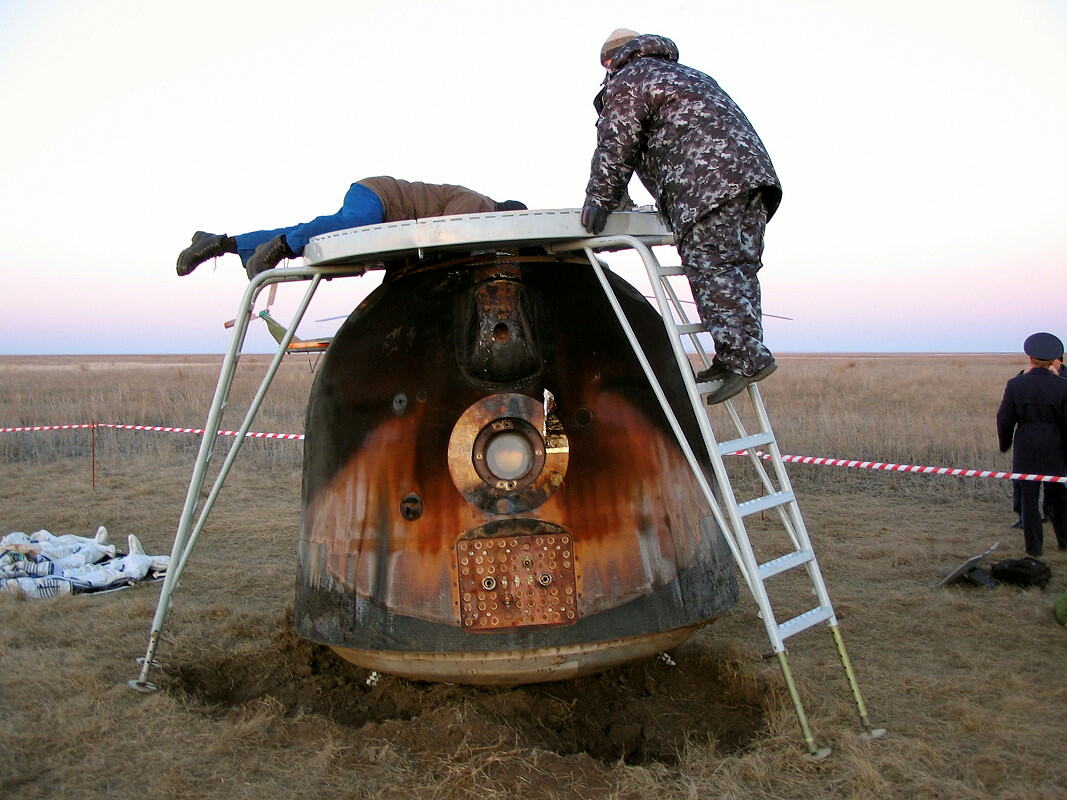
A photo of the damn thing on the ground, in case you needed reminding how small it is.
Annnd that's about it, that's more or less how it would've gone. So what if they'd actually done it? Would the Americans have moved the goalposts again? Would we have seen Nixon pledging a mission to Mars, to boos all-round like Bush? It's a nice thought. Unfortunately that was never going to happen. The Soviet moonshot was partly hamstrung by a 1965 starting gun – way too late to compete with Apollo, which had been in development since 1961 using off-the-shelf equipment that had been in development since 1955 – and partly hamstrung by the death of Sergei Korolev, the heart and soul of the whole Soviet space programme. His death (in 1966, of complications following surgery for cancer) quite took the wind out of Soyuz's sails, his successor Vasily Mishin having neither the political clout to keep the funding coming nor the technical skill to solve the myriad problems coming up. It was on his watch that the N1s went four-for-four, and in the end his only contribution to manned spaceflight was the Apollo-Soyuz Test Project – scientifically worthless, but politically priceless. The Buran shuttle aside, it says a lot that parts of the International Space Station were launched in Soyuz capsules.
I really hope next year's launch goes well. I got a taste of space-excitement with New Horizons; I'm more than ready to watch every minute of a Mars mission. Bring it on.
It's always a bit eerie when you stumble onto the dark side of something wonderful.
Okay, so Apollo 11 blasted off from the Florida launch pad in 1969 by firing up five Rocketdyne F-1 engines – the big, stonking, bell-shaped bastards sticking out of the bottom of the Saturn V's first-stage booster. Collectively they burned 13 tonnes of fuel per second to generate the more than 3,400 metric tonnes of thrust needed to loft Apollo 11 up to an altitude of 67km and a speed of 8,300km/h – at which point the second stage would take over and get the astronauts up to the blistering speeds needed for Earth orbit. The F-1s did the heavy lifting of the Apollo project, struggling for forward motion where the gravity was most intense and the pesky nitrogen cloud we call the atmosphere was at its thickest, getting lesser rockets into a position to finish the job and have their moment of glory. At the time of writing they remain the most powerful rocket engines ever fired (though apparently we'll be launching something even bigger in 2017, so hello if you're reading it from that side of history), and still hold the payload record for hauling the 140 tonne Skylab into orbit.
Anyway, looking into the backstory of this Ahnold among engines, this snippet jumped out at me:
The F-1 was originally developed by Rocketdyne to meet a 1955 U.S. Air Force requirement for a very large rocket engine. ... The Air Force eventually halted development of the F-1 because of a lack of requirement for such a large engine. However, the recently created National Aeronautics and Space Administration (NASA) appreciated the usefulness of an engine with so much power, and contracted Rocketdyne to complete its development. – Rocketdyne F-1, Wikipedia
Huh. So the USAF had the need for a very large rocket engine in 1955. That's not suspicious at all.
On an unrelated topic, on 1 March 1954, the Americans ran the notorious Castle Bravo nuclear test, their first detonation of a dry fuel Teller-Ulam thermonuclear hydrogen bomb. It was remarkable because it was a fusion bomb – that is, rather than splitting the atom as the Hiroshima and Nagasaki bombs had, most of the energy was to come from fusing hydrogen into helium, hence the term hydrogen or H-bomb. Incidentally this is exactly the same process that makes the Sun shine, so it was quite impressive that the puny Earthlings had worked out way to bring a tiny part of the Sun to life inside their biosphere using languages that were only meant for telling one another where the good bananas were.
The main advantages of fusion were a much cleaner blast (less nasty radioactive fallout) and vastly greater energy yields for the size of the device. The catch was that fusion only becomes possible at really, seriously high temperatures – the kind where it doesn't really matter whether you measure it in Celcius, Fahrenheit or Kelvin, as long as you get the number of zeroes right. No problem, said the physicists at Los Alamos, we already have a device that can generate temperatures like that – the atomic bomb itself! Pack a normal fission bomb in one end of a tube, place the fusion fuel at the other end, a little engineering witchcraft and bam, the fission explosion should compress and ignite your very own fusion reaction. Thus, I view the fusion bomb as the moment where the nuclear weapon community officially crossed over into mad scientist/Bond villain territory, taking the greatest weapon the world had ever seen and using it just to light the fuse on their real bomb.
When that fuse was lit, the scientists shat an almighty collective brick. Thanks to a minor mistake, it turned out their 5-megaton device was actually good for 15 megatons – equivalent to fifteen million tonnes of TNT or, if you prefer, seven hundred and fifty Hiroshimas. Remember that saying about assumptions? The scientists had assumed that the enriched lithium-7 in the bomb would remain inert like normal lithium, not contributing to the end result; instead it had proved all too willing to join the party, like pouring a bottle of water to douse a small fire in the kitchen and finding out, too late, that it was actually nitroglycerin. One second after detonation, the fireball was seven kilometres across, and Castle Bravo became the most powerful nuclear weapon the U.S. ever tested.
And oh yeah, officially, this test was a secret. Somehow.
No, that's not a natural formation. That's the Castle Bravo crater.
The lithium assumption (either a band name or a Big Bang episode, your choice) meant the estimates on the fallout footprint were way off, with the result that Castle Bravo became the worst accidental radiation contamination disaster in U.S. history. Fallout gave residents of nearby atolls radiation poisoning and left their homes permanently uninhabitable. The crew of a Japanese fishing boat also came down with sever radiation sickness, and one of them died. But the test was judged a startling success, so I guess in the end it was all worth it: after a few more tests and development things had happened, the U.S. had a deployable version, the Mark 17 air-droppable munition. And it was implausibly, unfeasibly huge.
This thing would be the primary weapon for the new B-52 bomber, the jet-powered replacement for the "aluminium overcast" itself, the B-36 Peacemaker. Professional nutjob Curtis LeMay (the inspiration for General Ripper) had wrangled the B-36 fleet into something he called "Strategic Air Command" and now had them holding station just outside Russian airspace 24/7, waiting for the go-code from the President. But, you know, planes can be shot down, even ones that can take off from the continental U.S. and bomb any point on the planet. Sometimes it's handy to have options, you know? A nuclear bomber with no crew, no mercy and no brakes – that's the kind of thing that appealed to the kind of cold bright mind that thrived at SAC. Something like a rocket.
But you'd need a really big one.
The timing can't be a coincidence: the USAF puts out a request for a big sexy rocket engine right when they're starting to deploy their first-gen hydrogen bombs? Fat fucking chance. The F-1 was intended to toss Mark 17s at Moscow, I'm sure of it. But then a funny thing happened: in 1954, at the annual May Day parade, the Soviets showed the world a massed fleet of enormous jet bombers that looked perfectly capable of bombing the U.S. – Russian B-52s by another name. And so the American military-industrial complex went into full panic mode and started sucking hundreds of millions of taxpayer dollars out of the system to pour into developing a fleet of high-altitude supersonic interceptors with which to shoot them down, stuff like the F-106 Delta Dart which the pilot could barely see out of, which was armed with a mad weapon, the AIR-2 Genie (fighting fire with fire? A hobby for invalids and children. Come back when you're ready to shoot down formations of nuclear-armed bombers using unguided nuclear-armed rockets).
You couldn't make something like the Cold War up.
Of course, it was all a con. The Russians really did have the bombers – a type NATO had given the reporting name "Bison" – but there was no massed fleet. The same four aircraft had made themselves look like a massive fleet using the oldest trick in the book – circling around unseen and flying overhead again, over and over and over. By the late '50s U2 spy planes were starting to give clues that the real Russian strength lay in missiles, triggering another panic about a so-called "missile gap" and hoovering up even more money to build the Polaris and Minuteman missile systems. The interceptor fleet was palmed off on the Air National Guard.
In the fuss, the mighty F-1 had been abandoned. Nuclear bombs were getting smaller and lighter with every generation, so a heavy lift rocket like the F-1 was seen as an unnecessary expense. Until along came NASA, which even with the unlimited funding they enjoyed in those days was in such an expensive business they had to economise a little, and if that meant taking an off-the-shelf engine from SAC, they'd take an off-the-shelf engine from SAC. And so the F-1 was dusted off and put through its development paces on NASA's dime, and was eventually pointed at the Moon in 1969 for its date with destiny in the mission we call Apollo 11.
It's a sobering thought: the first 168 seconds of greatest achievement in the whole of human history was completed using a device originally designed for mass murder.
I'm glad they found a more noble use for it. Something you can really set to stoner music.
The Nostalgia Critic's done a review of Event Horizon.
And I'm surprised that I find myself having to call him out on it; he's not omniscient, but he does seem to "get" his material more often than not, his reviews are usually beautifully put together, and Tamara and Malcolm give him some serious acting talent to work with.
This one, however, seems more phoned in and disinterested, like he only did it to satisfy fan requests. I can't fault that – no-one's expecting him to make a classic every fortnight, and all credit it to him for paying attention to his fanbase – but I'm surprised a guy who brands himself the Nostalgia Critic has to be reminded to respect the context of a prior decade. His claim that EH goes halfway and then gives up might seem true today, but it certainly wasn't in 1997. In its day, Event Horizon had two things the Nostalgia Critic failed to mention:
A Setup
A Payoff
Let's explore those, shall we?
The setup was a surprising level of realism. Space had become safe and fictionalised by '97. Apollo 13 was '95, but it was kind of the only thing out there that had done its homework on space. All the rest of it – Independence Day, Total Recall, even Starship Troopers – all showed space travel as no different to taking the bus. Zero gravity is expensive to replicate (Apollo 13 used the Vomit Comet, a plane that climbs to altitude then plunges for 30 seconds to give you an experience of zero grav – apparently it doesn't matter how good you are, you will be filling that airsick bag the first time) so most just ignored it and went with another generic set. Space in the movies became comfortable, convenient, not-at-all realistic place to be.
Now watch those opening scenes from EH again: the crew has to be awoken from cryo-sleep because they're been coasting for months, giving us a profound sense of isolation (the same technique was applied to Wolf Creek, for the same reasons); despite that, we're only as far out as Neptune, a familiar part of Earth's neighbourhood and a seemingly achievable destination; we're shown a surprisingly realistic docking sequence; the technobabble explaining how the gravity drive works namedrops Hermann Weyl, a real mathematician whose work really did centre around the curvature used in special relativity; and they actually have to go to the trouble of switching the Horizon's artificial gravity on – a handwave perhaps, but at least it showed they weren't taking us for complete idiots. Even the Weir's uniform showing the Aboriginal flag has been merged into the flag of Australia was a nice grounding detail reflecting real (and, in the U.S., probably mostly unnoticed) social tensions. Functionally, the set design of Event Horizon might've been ripping off Alien, but the effect was more like The Martian. This movie starts by putting us firmly in our own universe.
And the payoff? Well, consider that in 1997, "horror" by and large meant Scream clones. The story of how Scream
was supposed to bury the slasher genre once and for all but ended up reviving it instead is well-known
today, but in '96 I and a whole generation like me were too young to've
seen the movies it was mocking. Scream was my first slasher, and it stood on its own merits as a slasher; that it was also the Cabin in the Woods
of its day didn't really register, but it was good enough that it
didn't need to. I just took it as I found it, which was seriously enough that it
was able to support its own parody, Scary Movie, in 2000 (and that one really hasn't aged well).
So Scream and all the movies that piggybacked it (the only one I can remember now being I Know What You Did Last Summer)
revived the slasher genre, but ironically, by modern standards they
pulled their punches quite a bit. Blood and gore was rather lacking.
Plenty of people got stabbed or hacked to death, sure, but these moments were skipped over very quickly and the
camera didn't linger on injuries much. And it
wasn't a case of "Of course not, old movies are lame" either, all the
classic slashers of the '80s were happy to give us a bit of splatter.
There was nothing in Scream that could compare with Freddy
Krueger's death scenes a decade earlier; even the blink-and-you-miss-it skinning flashbacks in Dredd were more than you'd get from a '90s horror movie.
This isn't to say hardcore splatter wasn't out there – the Hellraiser
franchise was trucking on, somehow, for example – but if you wanted to see it you generally had to leave the mainstream, which was hard to do
in the era of VHS. If you didn't know somebody with a fuckhueg video
collection you had to know where the specialty shops were, or hope your
local video rental place had something on the shelves.
Do you see where I'm going with this? It did go all the way, Critic. I know this won't impress those with the stomach for a Saw marathon, but in its day this was a horror movie that was actually horrifying. The infamous crew's log and the images Weir projected into Miller's head were seriously fucked up, and they flashed by so fast you were left thinking "what the hell did I just see?!" And it had an effect. The line "Where we're going, we won't need eyes to see," is basically a meme, and one redditor said that, when Sam Neill appeared here in Australia in ads urging us to eat more red meat, they found they were really not comfortable with Weir talking to us about meat. I get that today, after Saw and Hostel have created a genre so graphic they literally call it Torture Porn, Event Horizon must look like a boring movie with the good stuff mostly edited out. But it wasn't like that at the time; it was A Serbian Film.
Now, I'm not arguing that it was actually a good movie, the cast really did seem bored with it and the ghost stuff is pretty cringeworthy. But don't look at it from grimdark future of 2015 and scratch your head like it's a mystery why anyone was ever scared by it. Those quick cuts were the stuff of nightmares.
Also, the black guy survives. That's gotta be worth something.
Millennial-bashing seems to be a sport on social media.
Or as a few point out, every generation gets bashed, and we're just the first to have it happen on social media. Either way, the rhetoric is always the same: that we're lazy, entitled, irresponsible narcissists.
Usually I'd focus just on that last one and link you with this again, because it's one of my favourite articles ever and worth another read. But then I came across this on Frankly Curious.
There's really only one group that worries about Sharia law in the US: fundamentalist Christians.
Not surprisingly, it is a matter of projection. You know how it goes. Ever since Watergate, the Republicans have been obsessed with fake scandals involving Democrats because they just know the Democrats must be up to the same things they are. Or look at organized voter fraud. Every time an actual case comes up, it turns out to be Republicans. This is why Republicans know there is widespread voter fraud: because they're doing it! And when it comes to worries about Sharia law, it comes from the Christian nationalists — because they want nothing so much as to force Biblical law onto our nation.
That made me wonder, what if Millennial-bashing is a matter of projection too? Those four major themes – laziness, entitlement, irresponsibility and narcissism – don't they all apply equally to the Baby Boomer generation? These guys were molly-coddled by their parents before it was legal to coddle with Molly; the only reason we didn't call them helicopter parents was because helicopters had only just been invented; to a generation that had spent their childhood in the Depression and their adulthood amidst the carnage of WWII, these kids must've seemed the duck's guts.
You didn't suffer during the war, because you weren't born yet. Instead, you enjoy all the benefits of the war being over – a nice home, good schools, and so forth. But most important, your parents treasure you. They had waited until after the war to have you, and they want you to be the happiest child in the world. They shower you with attention, and they satisfy your every whim. You get used to
getting your way. – Basics of Generational Dynamics
The only problem is they've carried that attitude all the way through their lives; they were the only generation that never grew out of it. And they really don't like anyone spoiling their rosy opinion of themselves. So could it be when they call us lazy they're trying to justify holding 58% of the wealth and shutting us out of the housing market? That when Joe Hockey cut back on the Dole and said, "The age of entitlement is over," it was the dying embers of a moral conscience trying to square with sponging $365,868* p.a. in government money? That when they call us irresponsible, they're hoping we don't ask why they've wrecked the environment and made sure they're the last generation to collect a pension? That when they call us narcissistic, they're trying to put aside that last botox injection?
As the noted sage Bernard Black said: "I've never seen such projecting. It's in CinemaScope with Dolby surround!" Bernard is my personal patron saint, if you wanted to know; I can tell you exactly who should be patron saint of the Boomers.
* That was just his parliamentary salary, that's to say, that's just what you, personally, were paying him; that was supplemented by his lucrative property investments and, presumably, whatever bribes the just-about-to-panic coal industry sent his way**. I'm sure he'd tell me he earned every cent of it, and who am I to disagree? A man who can bend spacetime far enough to apparently work 300 hours a week*** is clearly a genius who deserves everything he gets.
** Now he's ambassador to the U.S., that figure's gone up to $450,000, or just 150,000 middies.
*** Calculated using my hourly wage as a rough guide. If you really want to see what I'm taking home, go ahead.