Friday, 29 June 2018

Reaching for the Sky

The events of 1987 and the failure of the World Touring Car Championship rather knocked the wind out of Group A. The momentum had vanished, replaced by a hollow uncertainty and unease about where things were supposed to go from here. After 1987, just two manufacturers bothered homologating new cars for Group A in Australia – Holden, who had no other choice, and Nissan Australia.


The new HR31 Skyline wasn't really a feature of the Australian Touring Car Championship in 1988, and neither would it be in 1989, only coming into its own with some helpful rule adjustments in 1990. In season '88 you simply wouldn't have noticed if wasn't there: George Fury didn't give it its maiden outing until Round 5 in Adelaide, where he suffered an inglorious DNF; he didn't finish a race (a lowly 8th) until Round 7 at Sandown. Glenn Seton likewise didn't see the chequered flag until the finale at Oran Park, where he finished an unspectacular 6th.

Yet 1988 was where the HR31 had its awkward, unheralded birth, and the reality for the roadgoing version couldn't have been further from its staid on-track image. For Nissan Australia, the R31 was a make-or-break model.

When I Were A Lad
Confession time: although I'm a Ford driver from an old Ford family, I actually really like Nissans as well. This isn't just because I'm a Millennial and the R34 is God (although I am, and it is): it's also because when I was a kid, our family cars were Nissan Patrols (for which Dad gave my Land Cruiser-driving uncle no end of shit). Our first Patrol was a poverty-pack MQ wagon, a machine from an age when terms like "poverty pack" really meant something: with its brown plastic interior, it was only a gun rack and a rising sun badge away from being a troop carrier. Its former owners weren't the Army however, but the Central Mapping Authority, which explained its highly noticeable yellow-on-brown colour scheme (we called it Coco Pops, because again, kids). A consult with the Old Fart has revealed it had the 3.3-litre turbo-diesel SD33T engine, which gave it a scarcely-believable 70 kW at 3,800rpm and 237 Nm of torque at 1,800. I suspect ours had rather less, but Dad never let it hold us back. We took it on holiday to Fraser Island, and made a bundle of memories I'll treasure for a lifetime.

Like this, but in daffodil yellow. People were always telling us where we'd been. (Image via YouTube)

One of the best was negotiating Ngkala Rocks Bypass, a patch of diabolically soft sand about a third of the way from Waddy Point to the northenmost tip of the island. Here you had to leave the beach-highway and box around the aforementioned Ngkala Rocks: the complication was the sand here was so fine it was almost powder, and deep enough to swallow even high-riding 4x4s up to the guards. When we arrived it was already strewn with casualties, and we watched as a few more hopefuls had a go, got bogged, winched out and decided to quit while they were behind. Everyone was milling around letting more and more air out of their fat tyres, and one bloke wouldn't stop muttering about how not even "his best gear" was up to the job. Dad had a couple of goes and, being the incredible driver he is, somehow got us through – in our ageing MQ, with no lift kit or other mods, on skinny standard tyres. We were free to explore all the way up the Sandy Cape and trek up to the lighthouse, which was powered by a battery of large solar panels, a rare curiosity in those days.


Sadly, delays in packing up on our final day meant we missed low tide. Heading back to the barge, we had to drive through seawater up to the door sills including a few scary moments where the waves washed against my window and knocked us badly sideways. We made the barge, but after its saltwater bath the old Patrol was never the same, developing endless faults that needed constant maintenance.

Inevitably Dad traded it in, which brought us our second Patrol – a GQ ST wagon in dark olive green, with the 4.2-litre TD42 engine, a naturally-aspirated diesel inline six with [consults notes] 85 kW at 4,000rpm, and 264 Nm at 2,000. That was all it had to shift its 1,839kg bulk (and with us and all our camping gear on board, it was probably over three tonnes) – and again, being secondhand, ours probably had less. But it did have the extra pair of seats in the back, or "Catholic pack" as Dad insisted on calling it, making it a five-seater with cargo space during the week ("I'm feeding four men!" Mum would despair as she brought in the shopping), but a seven-seater on weekends when we had friends over – de rigueur on soccer-mum transport nowadays, but an optional extra back then. This was also the poor abused vehicle that had the honour of bearing my L-plates, for which I repaid it by not screwing the radiator cap on properly one day and cooking the engine. That was one of only two mishaps I've ever had in a car: I never reversed into a tree or hit a roo (Dad), I never stormed through a puddle and lost a hub cap (bro), just this one oversight that happened to cost $10,000, more than all their bumps and scrapes put together. In retrospect, that kind of set the tone for my adult life: I make no small mistakes.

Under the Button plan the GQ was also sold as the Ford Maverick, advertised by Peter Brock and his jumper.

But my time in the tank-like Patrol meant I could immediately tell the team behind rFactor's Touring Car Legends mod had done their homework. The first time I took the HR31 Skyline for a blast up Mountain Straight, I had a good laugh when I looked across and realised the heater controls had come straight out of our old Patrol. And given how Australian car manufacturers had to recycle parts to keep costs down, that's probably exactly what had happened.

There are prettier mods out there, but for physics and sheer carfeel, TCL is the gold standard for rFactor mods.

Hard Times Bring Good Cars
Did you know we made Skylines in this country? I didn't, not until I read Joe Kenwright's column on the Shannons Club (again, if you don't have a Shannons Club login, let me encourage you to sign up: there's some rigmarole involved and a small amount of email spam, but it's a minor aggravation relative to the benefits). In those days "Skyline" still meant a perfectly ordinary compact sedan, however, so the cars rolling out of Nissan's assembly plant in Clayton had less in common with today's hi-tech turbocharged GT-R super-coupé and more to do with its great rival that also began local manufacture about this time, the Mitsubishi Magna.

The origins of Nissan Australia lay in the far-off days of 1966, when the Pressed Metal Corporation started assembling Datsun 1600s in Enfield, Sydney; when that venture failed, Motor Producers Ltd took over over from the early 1970s, putting together 1600s in their Clayton plant in Melbourne (the same factory where Volkswagen Australia had once manufactured the Beetle). The 1600, sold as a Datsun in export markets, was nothing less than a revelation over here, the car that made Australia sit up and begin to take notice of this funny little Japanese brand. We were left scratching our heads at how its willing 1.6-litre overhead cam engine (a copy of an earlier Mercedes engine) could possibly generate 70 kW only a year after Holden had reached that benchmark with their 2.4-litre six, and although a long way from its intended role as an urban runabout, its independent suspension meant the 1600 loved our rough roads. At a time when even basic things like heaters and seatbelts were usually optional extras, the Datsun had them as standard.

Calling it a "Deluxe" seems amusing now, but at the time it was very well equipped.

So the 1600 established Datsun, but the follow-up models (like the 180B and 200B) never quite hit the sweet spot the same way, and the brand remained banished to the small-car ghetto the Japanese had made their own. This was an era of increasingly gutless engines as Australia followed Jimmy Carter's America in leading the world for emissions control. John Wright bemoaned this as an era of "regress not progress," but I'm not sure in what world breathing in less leaded smoke is a bad thing.

Either way, what brought the Japanese manufacturers to prominence was the Second Oil Crisis of 1979. The first one in 1973 had rattled the windows here in Australia, but not much else. The second, kicked off by the Iranian Revolution and the outbreak of the Iran-Iraq War, however, made its conventions grimly familiar. Long queues at petrol bowsers and odds and evens days for buying fuel became the norm in the early '80s, and the very term "V8" almost became a dirty word. Fights were even known to break out if someone jumped the queue, which inspired a young paramedic-turned-moviemaker create a sequel to his earlier PSA about the dangers of reckless driving.


In this environment, the traditional large car with its big six or V8 engine seemed as outdated as beehive hairdos and disco. From now on, the thinking went, the mainstream car would have to be more compact with a 2-litre four-cylinder engine that sipped fuel rather than guzzled it. Fleet buyers responsible for choosing next year's company cars switched over to the "small three," the Mazda 626, Mitsubishi Sigma (the Galant under its local name) and Nissan Bluebird. Of the Big Three, Ford axed its V8 engine range and made ready to switch to the front-wheel drive Telstar, Holden downsized to the compact Commodore and lopped two cylinders off its Red six to create the Starfire-4, and Chrysler shut up shop entirely. Basically, at the dawn of the '80s the local manufacturers who'd dominated for two decades all found ways to stumble, creating an opportunity for those who were used to getting the most out of a small floorplan.

Unfortunately, it soon emerged that the 2-litre compact sedan was a false economy. Used to the lavish interior space and lazy torque of a Falcon or Kingswood, the sales reps came to hate their new cars with a passion, and drove them accordingly. With so few cubes the lack of power was most noticeable at this level, with Nissan's 2-litre engine unable to provide even as much power as their own 1.6 had 15 years earlier. To keep up with the traffic you had to rev them until the valves bounced through the bonnet and launched into the stratosphere, and given that speed limits were an innovation only six years old (and one that Australians were in no hurry to pay attention to), the end result was that these new cars spent their lives being ragged without mercy until all the fuel savings were eaten up in extra maintenance costs and steep depreciation.

The Toyota Corona was another of this unloved cohort, so boring it barely rated a mention, even to complain.

But the same problems affected Holden's Starfire-4, which was soon dubbed the Misfire-4, so even with these missteps the Japanese still managed to steal sales from Australia's Own. Having taken over Chrysler's operation in Adelaide, Mitsubishi saw their opening and pounced, gearing up to create a wide-body version of the Galant called the Magna that would come with an optional V6 as well as the standard inline-four. Mazda would probably have done something similar had they not been joined at the hip to Ford, who were never going to allow a rival to the domestic Falcon (the real winner of this troubled time, thanks to holding firm on the big-car concept and fitting a more economical six tweaked by Honda). For Nissan, however, the turning point was most extreme, for the next Bluebird was in no way suitable for the Australian market – too small, too gutless and now front-wheel drive.

Rear-wheel drive was almost essential to succeed in the Australian market at this time: when the weekend came around, Australians all hitched up trailers, boats and caravans and headed out for some serious work or play, depending on the breaks. A car that couldn't tow was a car that couldn't sell, and FWD, so conventional wisdom said, was useless for towing. A FWD car would only see its drive wheels lifted off the ground by the weight of a trailer, especially if it was a light Japanese compact, so RWD was needed to give the necessary traction. Very well, Nissan's product planners reasoned: since they couldn't keep doing what they'd been doing anyway, they might as well see if they could deliver a well-made RWD compact with both four-cylinder and straight-six engine options. Succeed at that, and they just might beat Holden at the game they were trying to play, and at last have their foot in the door of the mainstream family and fleet car markets. If they could pull it off, not even the sky would be the limit.

Immigration Reform
Like the Bluebird before it, however, the Skyline would have to be localised before it could begin manufacture in Australia. To our chagrin, this generally this meant getting rid of anything high-tech that was too expensive to produce at our tiny volumes, so the first thing to go was HICAS.


Nissan's HICAS system, or High Capacity Active Steering, was a rear-wheel steering device designed to counter the toe-out roll-steering effect native to semi-trailing arm suspension designs. Anyone who's driven a VT Commodore hard with any substantial weight on board will probably be familiar with the problem – because of the way the suspension works, too much load would angle the rear wheel outwards until the whole car started crabbing sideways. The usual way of controlling a car stepping out at the back wouldn't always work, because the car wasn't sliding, but steering itself sideways. HICAS was intended to correct the problem by mounting the rear suspension on a subframe attached to rams energised by the power steering pump: as the rear wheel toed outwards, the rams would move the whole subframe in the same direction as the front wheels, correcting their toe setting and letting the car sail smoothly through a turn.

It was a clever idea, but the execution was mechanical rather than electric, so it was neither consistent nor effective and it absolutely destroyed the suspension bushes. To keep costs down and durability up, HICAS was binned in favour of an Australian-made five-link Borg Warner live axle, the usual upper rods and lower arms supplemented by a Panhard rod similar to the local Bluebird. Other JDM trinkets like fluorescent instruments and electrically-adjustable dampers were likewise left on the shelf. They did, however, spring for a bigger Nissan CA20E engine, a 1,974cc twin-plug inline-four with Multiport Fuel Injection taken from the imported Gazelle, capable of 78 kW at 5,200rpm and 160 Nm at 3,200. The business case required that they not abandon their four-cylinder faithful, so the R31 Skyline with the four-cylinder engine launched first as the new Nissan Pintara.


The Pintara, featuring some very '80s styling by origami, dropped in June 1986 and was followed a month later by the six-cylinder Skyline. Nissan differentiated the two with separate grilles and headlights: the Pintara had a simple and crisp fine bar grille with quad square headlights; the local Skyline had an impressive six-headlight face with a single bar grille unique to Australia. Also separating the Skyline from the lesser Pintara was a Nissan RB30E straight-six, one of a versatile family of iron-block, alloy-head overhead-cam engines designed with capacities from 2.0 to 3.0 litres with various layouts of carburettor or EFI, single-cam/two-valve or twin-cam/four-valve heads (some with butterfly intake runners), and naturally-aspirated or turbo induction. Nissan Australia had negotiated to import the big 2,962cc single-cam version to provide the low-down torque Australians expected, with the "E" signifying electronic fuel injection to comply with 1986's ULP emissions restrictions. The key to the project was that Holden was already importing this engine for the VL Commodore, and it was already going into other Nissans like the Patrol, which helped the numbers come out right in the accountancy department.

The RB30E was standard in all: the GX and GXE sedans and wagons, and the sedan-only Ti luxury and performance Silhouette. It offered 117 kW at 5,200rpm and 252 Nm at 3,600, and although derided as "high tech" (meaning "fragile") at the time, it has since proven an extremely durable engine, many showing 400,000km on the odo with little more than routine servicing (the camshaft was driven by a toothed rubber belt that needed replacing every 100,000km, but thankfully the RB's pistons didn't smash into the valves if it broke). It came with either a 5-speed manual gearbox or a Jatco electronic 4-speed auto, and with the manual could make the run from 0 to 100km/h in 9.3 seconds (which compared very favourably with the equivalent Magna's 10.3 or the XF Falcon's 11.4, if a little behind the lighter VL Commodore's 8.5). All models came with power steering and four-wheel discs – plush for the time.


The different engines allowed Nissan to pitch a single model against Mitsubishi's Magna and Toyota's Camry in the four-cylinder compact market, as well as muscle in on Holden and Ford’s dominance of the six-cylinder family and fleet markets. That said, being based on a design from Japan, where smaller cars incurred less tax, the Nissan was narrower inside than the Commodore (the Holden was just over the 1,700mm width limit, the Nissan was just under it), and much more cramped than the wide-body Falcon. So although it had belts for five, in Australia it was realistically only a four-seater, which counted against it for both families and fleet buyers – Telecom weren’t likely to abandon their Falcon wagons for GXE Skylines. But for those with smaller families or an eye on build quality, the Skyline made a certain amount of sense, and Nissan's core buyers were already accustomed to trading cabin space for build quality and a proper engine. Wheels tested it back-to-back with the VL and declared the Skyline to be the better-built, quieter, better-handling and better-performing car. There was even a unique Australian performance version called the Silhouette GTS, which I talked about last year, and which I'd still love to drive one day.

The Racer – GTS-R
The ultimate version of the R31 however was the Japan-only HR31 GTS-R coupé. Released in August 1987, this stripped-out version of the two-door R31 featured a reworked version of the normal RB20DET engine, a 1,998cc turbocharged twin-cam fuel-injected straight-six, but equipped with a much larger turbocharger on a tubular steel exhaust manifold, as well as a much larger front-mounted intercooler and a 5-speed manual gearbox. Power was boosted to a claimed 154 kW, which in race trim became more like 300 kW, about 50 more than the outgoing DR30. The purposeful-looking spoilers front and rear added some much-needed high-speed stability, and although it shared similar chassis architecture to the DR30, with same the MacPherson strut front and semi-trailing arm rear suspension, continual development had done much to eliminate the weird arcs and spooky handling that made the DR30 such a handful.


Indeed, they might have overdone it: as a road car it shared the basic R31 malady – a willingness to be driven so fast but no faster – which it combined with much greater turbo lag to produce a rather frustrating driving experience. The turbo didn’t spool up until 5,300rpm, so with a 7,000rpm redline the usable power band was woefully narrow, which left you with no way to deal with the understeer that reared its head early in every corner. Driving the GTS-R required a slow-in/fast-out approach, timing the turbo boost to fire you down the next straight and just accepting that you were going to lose a bit in the corners. Overall, it felt like a collection of cool parts needed for racing rather than a cohesive whole, which as a homologation special is almost exactly what it was. 823 were ultimately built for Group A, all of them in Bluish Black – that's not a description, that’s what it was actually called!

Although the GTS-R didn't do much in its first year in Australia, it showed tremendous potential racing on the other side of the world. Nissan had finally taken the hint and embarked on a toe-in-the-water programme in the European Touring Car Championship, which in 1988 was basically the WTCC in witness protection. The drivers were not Hasemi Masahiro and Hoshino Kazuyoshi* as you might've expected, however, but Australia's Allan Grice and his co-driver from Bathurst last year, Britain's Win Percy. Grice was probably there because of his personal sponsorship deal with Yokohama, who provided the Nissan team's tyres; Percy was probably there because of Gricey. The pair knew they could work together and trust each other with the machinery, so they were a good choice for a Nissan company probably not overly keen to have this exploratory season become common knowledge in the home islands.


The new Nissan Motorsports Europe team made their debut with a single car at Britain's Donington Park. Despite the brand-new car, they gave the Eggenberger Ford and BMW Motorsport establishment a fright right from the word go. After three and a half hours, with just half an hour to go, they were leading the race by a whole lap! Unfortunately, whatever development work they'd done hadn't revealed their existing brake package was a bit weedy for the strain of racing. In theory, with a 2.0-litre engine that worked out as a 2.8-litre by the FIA's turbo equivalence formula, the Skyline had the same 1,035kg minimum weight as the Sierras. In reality, this was a minimum weight it struggled to reach, Fred Gibson later revealing that in its entire career the GTS-R never went racing with less than 1,100kg on the scales. The extra weight took a toll on its brakes, which gradually faded over the course of the race until Percy pitted to have the team inspect them. They had a quick look and sent him back out, only to find his brake pedal was still soggy and he spun off at Redgate, leading the team to withdraw the car after 95 laps. It seems the team was bit green, having left the tools needed to change the brakes at home! You could also see that it was an unsorted new car, just look at the way it porpoised through Goddards at 2:51 above! Understeer, suspension tune and engine response all needed some attention there I think.

After their surprisingly good showing at Donington, the Nissan team skipped Estoril and Jarama to make their second appearance in the 500km de Bourgogne, at France's Dijon-Prenois circuit (starts at 3:36 in the video). Again they raised some eyebrows by running with the Fords early on, but again teething problems cut their performance short – this time, the gearbox packed up. From there the team skipped the Vallelunga round in Italy but returned for the Grosser Preis der Tourenwagen at the Nürburgring (doesn't show up in the video), where they finally made the finish, albeit in only 19th place.

In the pits at the Nürburgring (source).

Next up however was the big one, the Spa 24 Hour classic (6:20 in the video). For this race you needed three drivers, so the team roped in former Volvo star Anders Olofsson. Gricey had already won the King's Cup here in a Commodore two years ago, but that had been thanks to his private effort being counted with the factory-backed Mobil Holden Dealer Team cars. This year his Nissan was the sole entry, so they'd be fighting a war of attrition against Ford of Europe and BMW with no backup if things went wrong. In truth things didn't go very badly wrong, the stability of the GTS-R probably finding a good match in the long, fast curves of the Spa-Francorchamps circuit, its moderate power not such a handicap when the Sierras also had to wind back the boost to make the finish. There were niggling problems of course (there always are in a 24-hour race), but nothing serious – the video shows Gricey tossing the knob off the gearstick to Nissan product planning manager Howard Marsden in one of the pitstops, and by evening Percy was telling the cameras how their extreme camber setting had put unexpected stress on the front-left wheel bearing, requiring a precautionary change – but the car was still running, much to the surprise of onlookers. Indeed, by 1:30am Gricey was able to point out that they were actually gaining laps on the leaders, not by going faster but simply by maintaining their pace when everyone else was slowing down with one mechanical malady or another. They finished the race with 485 laps to their credit, 27 behind the leaders – an incredible achievement given they'd stopped to replace the entire front assembly five times over the course of the race! Had they had the parts to do the job, it's not inconceivable that they could have won.

But in the end it was another Spa 24 Hour trophy for BMW, a glorious 1-2-3 in fact, but 6th outright went to the #23 Nissan Skyline, a fine achievement for a car in its rookie season. From there though the remainder of the season never quite reached the same heights – they DNF'd at Zolder (gearbox), although they claimed fastest lap; they DNF'd again at Silverstone (another gearbox) where Dick Johnson made the rest look silly; but they managed a strong finish at the Circuit Paul Armagnac in France. Here the round was run over two heats, and in his heat Grice fell off the road and incurred yet another DNF. That left Percy to start his heat from the very back, around 30th place, and they'd just been informed they wouldn't be allowed to race the GTS-R at that Bathurst in a month's time. That meant this was effectively Percy's last drive in the Skyline, so he ragged it for all it was worth, rising from dead last to cross the finish line 2nd outright after 250km, beaten only by the Sierra of Steve Soper.
Boy did I have fun. Starting from the back of the grid to a 2nd place finish, only to be beaten by Steve Soper in the works Cosworth, I just wanted to show what the car could do, and I did. – Win Percy
Sadly, Gricey's off bumped them back to 11th in the final standings, largely hiding Percy's achievement in the history books. Nissan finished the year with just 41 manufacturer's points, compared to 310 for returning champions Ford.

Source

All Revved Up With No Place To Go
The really heartbreaking part of the video was when commentator Richard Hay mentioned Nissan was running this season to prepare for a full tilt at the ETCC in 1989. Problem was, there wouldn't be an ETCC in 1989. For two years the series had been dominated to the point of boredom by the established marques, Ford nearly always winning the races outright, BMW usually taking the lower class, and the two giants fighting it out for the title without ever running wheel-to-wheel on the track. As a consequence spectator interest had fallen down a mineshaft, and with so little interest from the teams and circuit owners the FIA simply neglected to run it the following year, letting the concept lapse into a coma that would last the next 15 years. Not until 2005 would we see another Europe-wide championship pick up the torch.

So Nissan were left with a brand-new, rather promising car, and no major international series to run it in. Our own ATCC hardly counted on that front, however crucial it was to the local branch's marketing plans. Nissan Australia needed to get the Skyline name out there and in the public consciousness, which partly explained why they'd been so keen to hand Fred Gibson a ready-made touring car team in 1986, complete with factory-supplied DR30 racecars. The funny thing was, for nearly half its life the Australian Skyline was represented on the track by the older DR30; by the time the GTS-R turned a wheel as a racecar, the road version was nearing its Series III facelift.


But then again, it mightn't have made any difference either way. The roadgoing Skyline was a fairly beige car whichever way you sliced it: a friend of mine says her family actually had the four-cylinder Pintara version when she was young, but when I pressed her for an anecdote to put in this blog, she couldn't think of any. That probably says all you need to know about how memorable it was. In the end, the HR31 was the awkward middle child, a transitional fossil layered between the monstrous DR30 and the sublime R32. It's day was worse than over; it would never really begin.

*Names written according to the Japanese custom, with the patronymic first. I ummed and ahhed over which way to put them longer than I'm proud of.

Wednesday, 13 June 2018

The Gap is Closing

Way back when I first started this blog – five years ago, seriously? – one of my first entries concerned the Old Hume Highway, which had recently been consigned to history by the completion of the Holbrook bypass, which at last linked Sydney and Melbourne with an unbroken stretch of smooth dual carriageway, a poor man's autobahn. My scribbling was motivated partly by a similar (i.e. better) article in Australian Muscle Car #69, and partly by the realisation that so many of the landmarks it mentioned were virtually on my doorstep. The narrow Little Harbour Bridge and the even narrower bridges of Gundagai were easy enough, but the one I wanted to see the most was beyond reach – the notorious Sylvia's Gap.

Pictured here in 1962 1982, looking south.

For those who came in late, Sylvia's Gap was nothing less than the worst accident black spot in the country, a narrow stretch of the Hume meandering through the hills just southwest of Tumblong in NSW. And I mean it when I say through the hills: much of the road's lethality lay in the way it was cut through sheer rock, with absolutely no wiggle room if, for example, someone tried to overtake at the wrong moment. This was a constant temptation because of the hills themselves, which would've taxed something like an Austin A40 (the most popular car in Australia immediately before the Holden), with its wheezy 1.2-litre engine, to say nothing of the feeble 100-horsepower prime movers around in those days. If you got stuck behind one you were in for a puckering ride: I've been told first-hand stories of climbing that hill hand-over-fist, sitting less than a foot behind the semi in front, with another semi less than a foot behind. No wonder so many were tempted by the sliver of clear sky seemingly just ahead of them and decided to risk it: l'apel du vide was strong with this one.
The Hume, or Highway 31 as it was called, was punishing, a mostly single-carriageway accumulation of old wagon tracks, mixed surfaces and badly aligned curves that followed the topography and went through towns you’ve never heard of: Yanderra, Breadalbane, Jugiong, Collector, Towrang and the appropriately named Bookham. If the coppers didn’t get you, the trucks on Sylvia’s Gap might. Your chances of dying between Sydney and the border at Albury were exactly 15.2 times greater than they are today.

This was the road, with all its lumps, bumps, expansion joints, off-camber blind bends, one-lane bridges and cracked concrete, that shaped the character of Australian cars. While the outback red dirt was the mystique, the Hume was the reality. This was our Road Most Travelled and it dictated a standard of ride, handling and steering so foreign to arrow-straight American freeways. And toughness and durability not required on the Continent. This road shaped our national motoring character, but it was such a bastard that it could never be as glamorous as Route 66.

Travelling from Sydney to Melbourne along The Deadly Hume, as the tabloids called it, could take 13 hours – at least – with stops at the Golden Fleece for motor spirit and a quart or two of oil...

The truckies had names for every bit of road on the old Hume. Turkey Town, Steps and Chairs, Carbon Black, Biscuit Bridge, Three Legs O Man, Sydney Harbour Bridge, Pretty Sally, Manse Hill, Customline Corner, the Mad Mile.

Yet the name that instilled the most fear was a place called Sylvia's Gap, the most dangerous few miles in Australia, bar none. Now on privately owned land, it's a place of ghosts, rusting wreckage and the faint echoes of downshifting gears and air brakes. Seven fatal accidents in a single two-week period during 1981 took place between its sheer rock walls. Usually, head on. The truckies feared it. – Wheels, 1 Nov 2016
So because it wasn't lightly that I dubbed myself "motoring anthropologist," I was very keen to see it with my own eyes. But that wouldn't come easily: since being bypassed in the 80's Sylvia's Gap had retreated back onto farmland, so if you aren't willing to indulge in some trespassing (and I'm not), it's completely out of reach. Unless, that is, you happen to attach yourself to the Australian Road Transport Heritage Centre's annual Road Run, which this year (once again) included a convoy along Sylvia's Gap Road to raise funds for a new truck museum. Finding an opportune gap in my schedule – and being a truckie's son, finding it a worthy cause anyway – I scooted off to the fog-ridden Gundagai showgrounds, paid my $10 and tagged along with the rest. What I found when we got there was... not quite what I expected.

The same section seen in 2018, from the other end.

For starters there wasn't just one narrow pass through the hills, more like three or four, although the first (if you're in the southbound lane) is the longest, and the worst. The sense of bottleneck was startling, and a little bit frightening – a low-loader hauling a bulldozer might just scrape through, but "scrape" would be the active word, because the dozer blade would be gouging rocks and soil on both sides. Two modern wide-body Australian cars could pass there, but two Hummers probably couldn't. And because it appears immediately after a crest, it takes you by surprise, still on the power from the long climb immediately before. No doubt plenty of people found themselves going over the top too quickly and rode the brake pedal to the bottom, heating their brakes into uselessness and finding, too late, they had nothing left when someone pulled out to overtake – or even just to make the turn at the bottom.

The turn was something I'd forgotten about to be honest. James Cockington's article had mentioned, "a sharp right-hander with steep drops on either side," waiting at the far end of the gap, but it doesn't really show up in any of the old photos, and out of sight usually means out of mind. Stumbling over it last weekend, it took me by surprise as well. I wouldn't quite call it a sharp right-hander, but if you didn't know it was there and arrived at 100km/h+ (no speed limits in those days, remember) it would certainly grab your attention.

Especially in something like this, a VJ Charger with a 340ci V8 but, frequently, rear drums (also part of the Run).

The "steep drops on either side" are another understatement; in truth it feels like driving over a bridge, with deep gullies on either side promising no soft landings if you get it wrong. "The state of the fence," Cockington wrote, "shows that not everyone made this turn." The really macabre detail is that apparently there are layers of wrecked, quietly rusting cars at the bottom of these gullies. If an accident blocked the road, getting it unblocked again was such a priority that emergency crews often didn't have time for a proper cleanup. Instead, as soon as the wail of the ambulances faded into the distance, they just pushed the wrecks over the edge, listened to the crash at the bottom, then packed up and left them there. Or so I'm told: you can't see to the bottom from the road (a fact that tells you everything about their depth and steepness), and with a hundred rumbling, snorting trucks around me, I wasn't really able to stop for a proper look.

Another climb, another bottleneck.

The rest of it is easier, but still dangerous. There are a few other, shorter passes cut through living rock, and a lot of steep drops, but mostly it's just winding road through the hills, like your favourite cliffside back-road in the Blue Mountains – and yet you were expected to get through even with a semi trailer. The mind boggles.
Just south of Bargo is a pristine section of old 31, a time capsule. It dips and drives under and over the main rail route near Yerrinbool with bridges perched on blind 90-degree, downhill bends and buttressed brick underpasses hiding sharp deviations. Left or right? Go on, guess. No wonder the truckies came to grief here.

It meanders under the new Hume Freeway at one point. To pause there and listen to the soundtrack is instructive. At ground level, the only noise is the XK’s slurred upshifts and honest exhaust timbre, chugging past the orchards and the abandoned general store. Above, on the multi-lane freeway, the whirr and pitched whine of high-speed rubber on road, the roaring of wind being cleaved by metal, the whistle of 18-wheelers with their turbos spinning, mums and dads in the family SUV with the air on and the music playing. Insulated, cossetted, safe and comfortable with boredom the greatest challenge.

Such is progress. – Wheels, 1 Nov 2016
Maybe, maybe. You can get misty-eyed if you want, Wheels, but for the families of the 40-odd people killed on this road, progress didn't come soon enough. We've had a horror couple of weeks around here: the very day I visited the deadliest piece of road in the country, a local man was killed in a car accident just a few kilometres out of town – a man I knew personally, though not, I admit, especially well. This came only a couple of weeks after a Canberran was killed in another accident on a different road nearby. And the next day, while I was at work, I saw the police and two fire trucks go roaring down the road with sirens and lights ablaze because apparently a car was on its roof – though thankfully, I heard the driver of that one emerged unscathed. Two deaths in a fortnight is still too many, but it doesn't compare with the seven lost in 1981. If the price of that sort of progress is boredom, kids fighting in the back and learning the Frozen soundtrack by heart, I'll take it. I'll take it every day of the week.


I still haven't found out who Sylvia was, though.

Wednesday, 23 May 2018

The Wild Colonial Boy

Having won the ATCC at a canter, Dick Johnson knew he now had the perfect stick to shove through the spokes of the European touring car scene. Accordingly, during the mid-year break between the ATCC and the start of the enduros, he crated up DJR3 and had it flown to the U.K. for a very special event. It was time to take a gun to a knife fight.


The RAC Tourist Trophy is in fact the oldest surviving motorsport trophy in the world, first awarded by the Royal Automobile Club in 1905 and handed out on an on-again/off-again basis pretty much ever since. It makes even Indy's Borg-Warner Trophy (est. 1936) look like a recent upstart by comparison. It has cycled through from Grand Prix to sports cars, to GT, to touring cars, then back again a couple of times, but in the 1980s it was a touring car event, one of the British rounds of the prestigious European Touring Car Championship. This of course was the stage upon which Ford of Europe (based in Cologne) and BMW (Munich) had waged a long and bitter war for tintop supremacy, one fought with the hatred of the Kursk salient and more or less ongoing since the BMW 3.0 CSL "Batmobile" first lined up alongside the Ford Capri RS3100 in the early 1970s. We'd caught a hint of the animosity between them during the WTCC last year, and with all the controversy surrounding the result at Bathurst, it would be fair to say neither side had calmed down much.


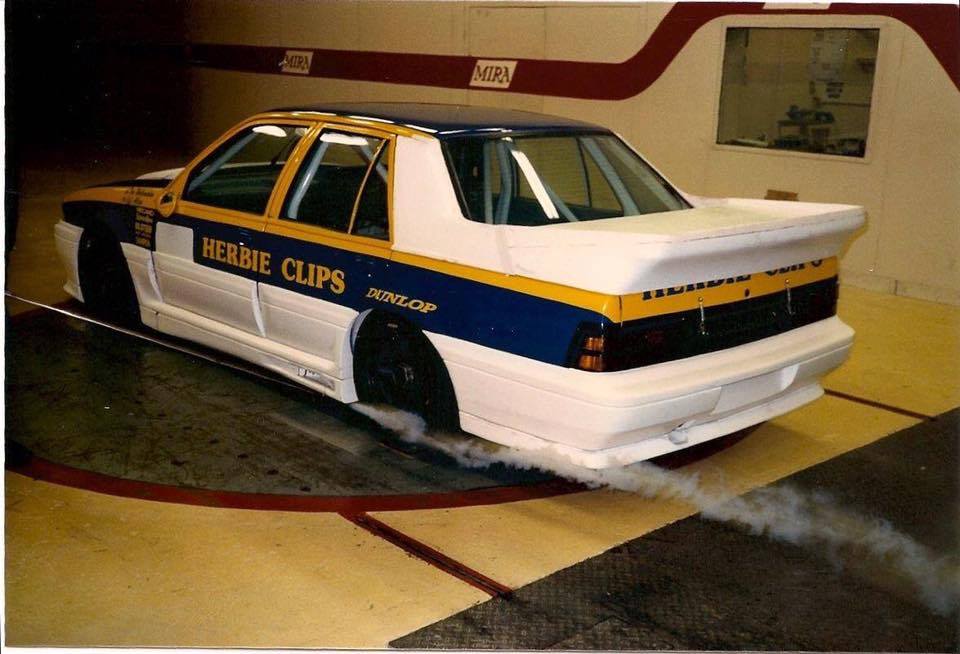
The field for the 1988 running of the TT was typically impressive: among the entrants in Class 1 were Tom Walkinshaw and Jeff Allam in the #46 Herbie Clips Holden, Tom's vaunted new fuel-injected evolution of Holden's VL Commodore SS Group A (we'll be getting to that). There was also Win Percy and Allan Grice in the works #23 Nissan Skyline HR31 GTS-R (that too). Most of Class 1 however was made up of Sierras, 17 in all, a veritable fleet of Fords. Most feared among them were of course the black Texaco cars built and run by Eggenberger Motorsport, three of them for Klaus Ludwig/Klaus Niedzwiedz (#1), Steve Soper/Pierre Dieudonné (#2), and Gianfranco Brancatelli/Bernd Schneider (#3). Eggenberger was Ford's works team in the ETCC, and they were here to ensure the drivers' title went to Dieudonné and not BMW's Roberto Ravaglia. With the Tourist Trophy the penultimate round of the championship, Dieudonné could clinch it here, as long as he won the race: in the smaller M3, Ravaglia merely had to win his class, and with BMW stage-managing the works Schnitzer and Bigazzi teams from behind the scenes, it seemed very likely he would. Tensions were high.

Source

It was not the ideal time for other Ford teams to stick their noses in, but that's what they did. Andy Rouse had entered what was basically his home event (for much the same reasons as Dick – recovering lost pride), and had brought along Frenchman Alain Ferté to co-drive his #33 Kaliber Sierra. His BTCC teammate Guy Edwards was sharing the #39 with Brit Pack F1 driver Jonathan Palmer, and both were a serious threat. This was Silverstone, after all: the BTCC had held four rounds here last year, and including the F1 support race, would hold another four in 1988; on top of that this was where many teams did all their testing, and now the TT race as well. The British drivers could all lap Silverstone in their sleep, and given this was the old Silverstone, all long straights and sweeping bends, a British driver in a Sierra was a pretty safe bet to win here today. In 1988, Silverstone was a Sierra circuit: everyone else was just driving on it.

Source

There was also the #4 AM Motorsport Sierra of Germany's Wolf Racing Team, to be driven by Harald Grohs and former Bathurst winner Armin Hahne, which really completed the trifecta: with Eggenberger, Rouse and Wolf, the Tourist Trophy entry list now counted Ford's works teams from the BTCC, ETCC and DTM alike.

Source

And to that they could now add the works team from Australia, too: Dick Johnson, and his Tasmanian teammate and co-driver John Bowe.
I had never seen so many rabbits. Maybe they were hares. What the hell did I know? I was used to kangaroos and wombats. Whatever they were, they bounced across the lush green grass, over the rolling hills and endless plains of the English Midlands, which led to one of the most famous motor racing tracks in the world.

The Silverstone Circuit was legendary. Stirling Moss, Jack Brabham, Juan Manuel Fangio, Jackie Stewart – they were all part of the magic.

I had conned my way there, intent on restoring Australian pride, and flogging these arrogant know-it-alls. It began when I phoned Ross Palmer.

Ross Palmer was launching his company in the U.S. and the U.K., and was about to hit the two whopping markets with a product called Redkote.

"What better way to launch yourself in the U.K. than have me go over with a car and give it to them?" I said.

"You reckon you can match it with the Europeans?" he replied.

"My oath. You know I can."

He agreed. Shell also offered to pay.

The race was for the Tourist Trophy at Silverstone, and took place on 4 September 1988.

With a decent budget, a dream and a truckload of Aussie fighting spirit, I loaded all my gear into two air-freight containers, grabbed my passport and headed straight into enemy territory.

I had never been to Silverstone and was astounded by the magnificent track when I arrived. Surrounded by rich verdant countryside, rabbits (or hares) roaming the plains and rain lashing the ground, I edged through the gates and was met by one of the most prestigious circuits in the world. Built on an old World War II airstrip, the track was long, fast, sweeping and technical. Being a naïve Aussie, I asked a local a dumb but important question.

"Clockwise, of course," he answered. "How could you not know that?"

I began testing on the Tuesday. After unloading my gear and piecing it all together, I took to the track – and made sure I went clockwise. I was cautious at first, learning the long straights and the hard braking points, and figuring out just how fast I could go into the sweepers. I soon had the tyres squealing and the brakes burning. After a few laps I felt I was doing okay, when I noticed a high-profile spy.

Sitting in an F1-like compound, full of computers and technology, Rudi Eggenberger’s team engineer was hunched over endless screens monitoring my every move. I had no idea why he was doing this until someone told me I was nudging the lap record on my very first fling.

I beamed.

Full of fire, and revenge firmly on my mind, I went out and ragged my Sierra. These guys I was up against knew Silverstone like I knew Lakeside, so they must’ve been embarrassed when they found out I was more than a second up on them. The entire European field shook their heads in disbelief.

I was on top of the world. To watch people like Rouse, the bloke who had dudded me, look panicked and scared, was just priceless. – Dick Johnson, The Autobiography
That's not the grin of a man halfway down the timesheets

On the fastest track of the year the #41 Redkote Steel Tubing Sierra absolutely smashed them; they took pole by nearly a second, then sat back and watched the others tear through dozens of sets of tyres trying to catch them up.
For the first time in this year's ETCC campaign, the entry was over-subscribed. There was no doubt from the outset that this would be the race of the year; the entry boasted the best of Group A cars from Europe, including the cream of the British championship cars, with the added interest of Dick Johnson's ATCC-winning car.

Johnson felt humiliated last year at Bathurst when the Eggenberger Sierras almost arrogantly swept the locals aside, while his cars were out virtually at the start. Pride dictated that he should try to recoup lost prestige, not only for himself and his team, but for Australian touring car racing in general. There was a point to make.

The tension began to mount mid-week when word started to filter through that Johnson had lapped under Rouse's existing 1m39.29s lap record. It climbed further when the Australian led the times in Friday's free test sessions. Notice had been served that this was no empty threat ... a mistake ruined the first run, but then the second set heads turning when a time of 1m35.49s was announced, at that time the best part of a second ahead of the opposition. Klaus Ludwig chimed in with a time of 1m36s dead, but it was too late and too slow. – Auto Action, 16 Sep 1988
There weren't many better places to start a race than from pole, and fastest time in the morning warm-up suggested the car was still up for it on race day.


The locals' last chance to discombobulate the Australians was with the unfamiliar rolling start, but when the Pace Car pulled into the pits Johnson gunned it and pulled away, like he'd been doing it all his life. The Redkote Sierra simply left them behind, zooming into an immediate and substantial lead – a full second by the end of lap 1. Johnson led easily from Steve Soper, Klaus Ludwig, Armin Hahne, Andy Rouse, BTCC regular Robb Gravett, Jonathan Palmer, and then Tom Walkinshaw in the Holden, the best-placed non-Sierra in the race. All of them realised, to their horror, that they were now in a race for 2nd.

The Poms do have a way with words, however, and after 10 laps the commentator in the video was moved to observe that Johnson, "hadn't managed to pull out more than a couple of seconds on Klaus Ludwig." Yes, what a poor showing, to be "only" two seconds ahead of the million-franc factory team on their home turf. Shame really. Well, if Johnson hadn't rammed the message down their throats yet, he was about to get another chance. Romeo Carnathias in the #6 Jolly Club Bergamo Sierra was abruptly seen in the gravel, having apparently suffered a steering failure. The RAC thought this warranted a full-course yellow and released the Pace Car, claiming Carnathias was in "a dangerous place." I wouldn't put it past the RAC to go all NASCAR on us and call a caution simply to bunch up the field again, especially with the Aussies walking all over them like this, but who knows? Maybe the #6 really was in a dangerous place.

Either way, the field was brought back together, and at the restart Johnson had to build his lead all over again – which he did, easily. In fact, this time he even set a new lap record, a time that nobody else would beat all day – 1:36.57, or 178.12km/h.
We went to Silverstone for the Tourist Trophy in 1988 – you have to remember that this was a world championship touring car race [sic] – and Dick came past on the first lap so far in the lead that we thought he must have jumped the start. I remember following one of the Eggenberger cars through one of the fast corners, Klaus Ludwig or someone – and they were like heroes – and I just drove past him and disappeared. It was awesome. Really awesome. – John Bowe
Unfortunately, having claimed pole and fastest lap, the DJR team would have to settle for two out of three: it was at the first scheduled stop that things started to go wrong. Johnson pitted around lap 38 as planned, letting Andy Rouse through into the lead, but the stop was slow with a fuel feed problem. John Bowe climbed in for his stint, but because of the refuelling problem he was slow away, and rejoined only 11th.

That seemingly burst the bubble, as for DJR things quickly went down the tubes. By lap 64, Bowe was back up to 4th place, but he and race leader Klaus Ludwig both pitted at the end of the lap. Ludwig's stop was smooth and untroubled, Klaus Niedzwiedz taking over without a fuss, but further down pit lane the Redkote car's bonnet was up and mechanics were pouring fresh water into its steaming reservoir. Johnson was strapped in and ready to go, but had to sit tight and wait for the mechanics to finish their tasks. It would later emerge that a water pump gasket of a kind you could buy in any Ford dealership in the U.K. – but not in Brisbane – had failed, killing what could have been a dream result. The car had to keep returning to the pits to top up its water, losing so much time that it finished the day only 21st – a long way from where its pace could've put it.

For want of a nail...

Although leaving with the silverware would've been the ideal finish to the weekend, Dick had to settle for impact alone, and that they still talk about today. After all, a broken water pump gasket said nothing about Dick's ability as a tuner, car builder or driver.
The only drama was they wouldn’t supply us with new water pumps and we unfortunately ended up with one that failed on us and started leaking and that was why it was overheating and hence the extra pit stops. But mate, they know damn well exactly what the deal was there. We were on pole position by a considerable margin and my favourite photo of all time is one of me coming down the Hangar Straight comfortably in the lead with the opposition all in the background. – Dick Johnson, AMC #77
So at the front, the race went on without the Aussies, and despite everything it was good one. Andy Rouse had started only 5th, but he'd risen steadily since then, dispatching Armin Hahne under brakes on the entry to Stowe, then resumed his usual battle with Steve Soper. This was yet another round of the ongoing row between these two (their scrap at Brands Hatch was, it must be said, magnificent), and although both had to be careful not to use up their cars in such a long race, the intensity never dipped. Rouse managed to get past Soper with the same move he'd pulled on Hahne, only for Soper to grab the restart with both hands and launch himself straight back up to 3rd. It was well and truly on between these two.

The Brands Hatch race. Don't think, just go and watch it.

Rouse eventually got the place back, and by the time the first round of stops loomed at one-third distance, Ludwig was 2nd, with Rouse 3rd, then Soper 4th, Gravett 5th, Brancatelli 6th in the extra Eggenberger car, Palmer 7th, Hahne 8th, and Win Percy 9th in the Nissan, the highest-placed non-Sierra at that stage. Walkinshaw's Holden was well off the place in 14th, which the formidable Scotsman dealt with by pitting for a change of tyres and a fresh load of fuel, and putting Jeff Allam in the driver's seat. Silverstone of all circuits should've played to the Commodore's brute power and uncompromising new aero package, while minimising the penalty of its weight and iffy brakes, so such a humbling performance was a bad sign for a new model as important as this.

An awesome photo of them building the thing, courtesy of Facebook page, "VL SS Group A SV - Walkinshaw."

The Nissan team was likewise in trouble: after 30 laps, Win Percy brought his Skyline into the pits, but stayed strapped in instead of hopping out: the car had a problem. It turned out the gearbox was stuck in 3rd, a crippling handicap on a circuit as fast as this, and not one that could be fixed in time to rejoin the race. The Nissan challenge had fizzled, and teammate Allan Grice never even got to drive.

Back at the front, Rouse kept the pressure on and soon put a move on the inside of Klaus Ludwig – again, at Stowe. The sharper, more hard-edged suspension tune needed for BTCC sprint races definitely gave Rouse the edge on handling, but would it come with a penalty for his tyre life? Only time would tell. In the meantime, he'd moved up to 2nd place just in time to make his scheduled stop and hand it over to co-driver Alain Ferté, who rejoined behind Soper, who'd now swept through into the lead.

Soper wasn't far from his own pit stop, however, and soon he brought it in to hand the #2 car over to Pierre Dieudonné. Soper was interviewed immediately after, where he was told, "Apparently there's a problem with the Australian car," which prompted the quote of the day: "Is there? Oh, I'm ever so upset!"

Soper/Dieudonné at the Donington 500, earlier in the year

He might've spoken too soon. Ferté was a good choice of co-driver, bringing Rouse's #33 Kaliber Sierra back to the pits without so much as a scratch on it. When it all shook out, Dieudonné was leading in the closing laps, but Rouse was on a mission to catch him and put the hammer down, sliding raucously out of his pit box and back onto the track. With 25 laps to go, Rouse was all over the back of the Eggenberger car and hounding him mercilessly, although he was wise enough to contain himself while they were still threading through the backmarkers. One of those was the Walkinshaw Commodore, in 10th – the Sierras had lapped every car up to P10!

With blue flags flying to another batch of backmarkers, Rouse took a punt and made his move on Dieudonné on the run from Copse up to Becketts. There was no sign his engine was about to pack it in, or that his tyres were wearing out, so there he stayed to the chequered flag, crossing the line for the 105th and final time to take the RAC Tourist Trophy for 1988. Whatever I might've said about the bastard, I never said he couldn't drive.

But here's the thing – if I'd been a Ford executive in the 1980s, I would've had a button installed in my desk in Cologne. I'd've watched the live feed of every touring car race from my office, and any time I saw Andy Rouse move ahead of my Eggenberger car, I'd've pressed the button and sent a remote signal to blow his engine sky-high. Rouse's victory had just deprived Ford of a coveted ETCC title: by moving ahead of the works team, Andy had taken away some crucial points for 1st place, and that effectively anointed Roberto Ravaglia European Touring Car Champion on the spot. Coming only a year after his shenanigans had arguably cost Ford the WTCC, it really is a wonder no-one tried to burn down his motorhome while he was asleep in it.

Yeah, I'd wear that face too, Pierre

But, if they'd done something like that to Andy, they would've done it twice over to Dick, who'd been the real threat to Eggenberger all week long. The whole experience was summed up by
the best moment in the video, exactly 13 minutes and 45 seconds in. As he cooled off after his first stint, a pitlane reporter came over to talk to the sweaty-faced Johnson, who gave one of the great interviews of all time.

"Oh, well the car's fine," he said, rattling off the usual racing driver stuff. "It’s just that we had a fair bit of trouble with slower traffic, and someone dropped a heap of oil before you come up under the bridge there. It was dripping all the way around on-line, which sort of made it pretty difficult for a couple of laps, but other than that it was fine."

The reporter nodded, then put in a stellar bid for the most condescending question ever asked: "Were you surprised to be so competitive over here?"

Dick was momentarily taken aback. Much as we might talk about "Mother England," it still takes you by surprise when they actually treat you like a child. But then the Poms never really adjusted to the loss of their Empire, and still expect you to call them nkosi or bwana if you address them in a funny accent.

"Uhh... yeah, okay," was all Dick said, smiling resignedly, a sinking "like that, is it?" sort of tone in his voice. But not knowing to quit while he was behind, the reporter then pressed on: "No, you’re obviously quite a match for the other Sierra Cosworths?" And having gathered himself by this time, Dick was able to give the answer his questioning deserved – the answer Australia can still give today, if we put our minds and backs into it.

"Mate, we convicts can do anything, I think."

Sunday, 13 May 2018

DJR3: New Frontiers in Crushing Dominance

It's not mere parochialism that has me dubbing Dick Johnson's Shell Sierras the fastest of them all (though of course that is a factor) – it's a measurable, scientific fact. It was an achievement goaded by the sting of his poor showing at Bathurst in '87, as he tells us: "The big European teams came out with all the factory backing and the big bucks. And they came out here and made us look stupid," said Dick. "We needed to improve, in a big way." And so they did, cherry-picking the choicest parts from Europe, the U.S. and our own local suppliers to create a stone-cold monster – DJR3.


But first, heads had to roll. Gregg Hansford's touring car career got a big jolt when Shell requested that another driver be found for the #18. The change was controversial, and there were reports Hansford didn't find out about his sacking until he read about it in a newspaper, but Dick categorically denies this.
I sacked Gregg at the Jack Newton Celebrity Pro-Am, a charity golf tournament [at Noosa] on the North Coast. It was an extremely awkward day. I hit woods and irons, fired balls into the sand, crippled by anxiety. He was with me the whole time, not a care in the world, and was really enjoying himself. I was a wreck because I knew what was coming. I meant to tell him on the course, but I couldn’t work up the courage so I waited until I had a stiff drink in my hand.

I grabbed a glass from the cupboard, threw in some ice and filled it to the brim before tipping my head back and downed the high-proof bourbon. I poured another and passed it to Gregg. I waited until he had a sip and then I gave him the bullet.

"What I have to say isn't real nice, mate," I blurted, the warm bourbon in my belly giving me courage.

"But I have to say it. I've been talking to the boys at the top, and we've come to the decision that we have to go in another direction. You won't be driving for us next year. I'm sorry."

Gregg went white. "What do you mean?" he said. "Are you serious?"

"Afraid so. It isn't totally my decision, but this is the way it has to go."

The poor bugger took it hard. He looked as though he was going to cry. I felt terrible. I had never sacked anyone in my life and to fire a bloke like Gregg was just heartbreaking. He was a good driver, and we had only given him a year to prove himself in what was ultimately a shit car.

I felt for him but I had no choice. The decision had been made. Shell was tipping in huge money and was very disappointed with the year we'd had. Gregg was an easy target and they told me he had to go. My hands were tied. – Dick Johnson, The Autobiography
Gregg as he spent the 1970s, in Kawasaki green. He chased Ron Toombs up and down Mount Panorama before he ever chased Peter Brock.

So leading up to Christmas '87, drivers still on the market had a sniff there might be a job opening at Dick Johnson Racing. Some took advantage better than others.
Not long after an envelope was lobbed over my way. Inside was a Christmas card, which was strange because I'd never received one addressed to the workshop before.

"Merry Christmas Dick," it said. "Heard you had a drive going? Would love to be involved. Best wishes, John Bowe."

I had a bit of a chuckle when I put the card down because John was pretty good when it came to playing the game. He was one of those blokes who was always hanging around the bigwigs, loitering with the journalists, and doing anything he could to further his name. He even had his own personal public relations agent, a bloke called David Segal, known as the "seagull." I would go as far as saying John Bowe was the best politician in motorsport. – Dick Johnson, The Autobiography
He wasn't too shabby a driver, either. Bowe was a two-time CAMS Gold Star winner (1984 and '85), and at one point had driven the only ground-effect Formula 5000 car ever built, the Elfin MR9.

Source

He'd also been Australian Sportscar Champion for 1986 in a frightening machine called the Veskanda C1, which still holds outright lap records at many tracks across Australia. Some said he could've taken over from Alan Jones as Australia's representative in Formula 1, but he'd elected to go tintop racing instead, and was best known as a former number two at Volvo and co-driver at Nissan. "I used to do a good Christmas card," Bowe laughed later. "In fact it kept me employed for 11 years!"
He probably didn't need to send me the card because he was already in my sights. John had been hanging around the Shell brass, never one to miss an opportunity. He told them how good he was and what he could do for the team. Even before we told Gregg he was no longer required, Shell had earmarked Bowe as their man.

I can remember sitting with him on the way to the first race of the year.

"No, you drive, mate," he said. "I have work to do."

He pulled out this gigantic machine, all black box and twisted cords.

"What's that?" I asked.

"A phone," he said, surprised. I didn't know what his Motorola MicroTAC mobile phone was.

He spoke on the damn thing all the way to the track, selling and buying cars. When he wasn't making calls, he had his head buried in the classified ads. He was every bit the used car salesman. Needless to say, a good one at that. – Dick Johnson, The Autobiography
Digression: since the Motorola MicroTAC wasn't released until 1989, and was quite compact by the standards of the day, Dick is probably remembering it wrong. From the description it sounds more like a Mobira Cityman 900 or similar, like the one Danny Glover used in Lethal Weapon.

The '80s really were glorious.

Anyway, with the other side of the garage settled, the next job was to sort out the car, starting with the ECU. The engine management system was the key to squeezing more power out of the humble Ford block, but they were dependent on chips supplied by Andy Rouse, half a world away.
We needed more horsepower but had no clue how to get it. We weren't able to program our computer (even the ex-Gibson employee wasn't up to speed with the equipment we had) and, like I said, we became dependent on Andy Rouse and his company in England.

So I called him up in desperation.

"Mate, we need more power," I said. "We're getting flogged."

"No worries," he said. "I'll send you the new customer chip. It'll do the job."

We sent Rouse $1,000 for the new chip, waiting anxiously for the parcel to arrive from England and thinking it was the solution to all our problems. We thought we could whack the little card into the engine and the car would be going two seconds quicker each lap. But we were wrong.

The chip did little. We didn't have the machinery to program the thing ourselves and could do nothing to adjust the engine. I called Rouse once more and forked out another $1,000, but again the new chip was no silver bullet.

The situation was a complete joke and we were being held to ransom because we operated under the Zytek engine management system, and the chips he sent us weren't specialised for this particular program, but simply upgrades he sent to everyone when he felt like making a buck. We tried to go around the problem by tricking the computer into making changes to other parts of the engine. It worked in theory, but in practice it was a disaster. We ended up blowing 37 turbos in the first year! – Dick Johnson, The Autobiography
Ideally DJR would've been mapping their own engines, but Rouse wouldn't allow that because the program was owned by him and built by Zytek. That might've been okay, except that Rouse had what you might call a British Empire moral conscience, and the computer chips he dispatched were an outright scam. He billed his customers thousands for chips that kept the horsepower well down and ensured they could never steal a win from his own Kaliber Ford team. Andy Rouse Racing wasn't a business, it was a racket.

His bank manager had the same smile.
I was at my wits' end and grabbed Jillie and my passport and jumped on the plane to the U.K. looking to start a fight.

"This is bullshit," I said, striding into Rouse's offices, trying hard to keep my cool. "I need to be able to have the machine in order to program the chips myself. I'm getting belted over there and this is the only way forward. I'm willing to pay you whatever you like so I can control things myself rather than rely on the customer chips you send out."

He shook his head.

"What do you mean no? I've spent a fortune on this!"

Rouse stayed silent and shook his head again.

I could feel my blood boiling.

"You are the biggest c*%t I have ever met in my life!" I screamed. "You can jam the whole deal right up your arse."

Jillie was there too and reckons that was the angriest she had ever seen me. I don't think I'd ever used the c-word in my life, and right there and then I blurted it out in front of my wife. I walked out of the office, feeling totally dejected, and with an icy breeze chilling me to my core, I looked to Jillie.

"We're stuffed," I said. "This could be the end because I really don't know where to go now."

Desperate, I called Doug Jacobi from Ford and told him of my seemingly hopeless situation.

"It's a long shot," Doug said. "But since you're there, why don't you pay John Griffiths a visit? He’s involved with the Sierra program for Ford."

So I followed Doug's advice and Griffiths ended up putting us in touch with the man who would become our saviour: Graham Dale-Jones. – Dick Johnson, The Autobiography
Dale-Jones had been contracted by Ford to work on the Group B rally programme, and the answer to Dick's woes lay in expertise and technology developed for the stillborn RS200 rally car. It was a Bosch 1.2 system that he would provide for a fee, then set up (and train them to use) free of charge. It wasn't as sophisticated as Rouse's Zytek system, but it would do the job.
He went to America to do the Pikes Peak Hillclimb with a DFV Cosworth there with two big 1.2 systems on it. They were only basically for a four-cylinder car. On the way back from America to England I convinced him to to come via Australia and that's how he taught us to do it and we eventually got things happening.

They were using a Bosch basic system, which was a lot different from what we had. He gave us a couple of lessons to Neal Lowe and myself and we started doing our own thing in Australia. – Dick Johnson, AMC #77
Within a year the Sierra was seeing up to 2.4 bar of boost in qualifying, and up to 2.0 in the races – well short of the 5.5 being achieved in Formula 1 at the time, but still impressive for a production block (at the time the average road car could barely handle 0.5). Claimed power outputs vary wildly, and given Dick drove the Sierra for six years and never stopped tinkering with it, probably varied quite a bit in practice too, but most estimates start at 450 kW, or 600hp. By comparison, Andy Rouse only found "about 520bhp for sprint racing": Eggenberger had no more, but made it last 500km instead of the 80 or so of the British series. There was just no comparison.

"That really unlocked the potential of the car," said Dick. "That's when we really started making inroads, because we had been restricted by not being able to make our own maps on the computer. It absolutely transformed power delivery."

Looks so innocuous on its own, doesn't it? (Source)

That much boost came at a price, however, and that price was catastrophic lag. In the '80s turbo lag wasn't measured in milliseconds, it was measured in seconds, and that required a unique driving style.
On the dyno we used to run the cars with absolutely no turbo hooked up at all and flat-out they'd honestly have 90 horsepower. Hook the turbo up, give it 2.4 bar boost and suddenly it’d have 680 horsepower. Many good drivers would jump into one of these things, and they wouldn't get around a lap before spinning it. They'd put their boot into it and it would go from nothing to 600-plus horsepower in a nanosecond and they'd be backwards somewhere. – Dick Johnson

I'd driven the Volvo and Nissan turbos in the two seasons before I joined DJR so I was familiar with the turbo style of driving, but I remember clearly the first time I ever drove a Sierra and being totally amazed by the lag. It had absolutely no boost below 4,500rpm, but when you hit that it was like being fired out of a cannon!

Basically it was the complete opposite to any other car. Let's take Turn 1 at Sandown, for example [a basic 90-degree left-hander]. You brake and go down through the gears and before you even really start to turn in you come off the brake and push the throttle to the floor. Then you coast into the apex and as you start to leave the corner the boost comes on in a rush, so you suddenly have another 400hp in a millisecond. So as the boost comes on you actually wind off the throttle rather than progressively put it on, as today's drivers do. If you didn't, the car would break into wheelspin and fire you in the opposite direction. – John Bowe

We now had the Bosch system and were growing more confident with our ability to control it with every passing day. But computer aside, there were still problems with the car. We were still blowing things left, right and centre. Components were breaking and we needed to improve them if we were to redeem ourselves. The biggest issue was the diff: we were using an extremely expensive Rudi Eggenberger model and it was rubbish. Apparently the best Ford bit in the world, it had a limited range of ratios and there was always something wrong with it. The piece of metal just couldn’t handle the power. – Dick Johnson, The Autobiography
In fact, even before the RS500 was homologated it had been clear that the existing 7.5-inch "Morris Minor rear end" couldn't withstand the massive torque of a race-tuned Cosworth. Rudi Eggenberger had responded with a diff made of what he called "panzer steel," which since "panzer" translates literally to "armoured," suggests some sort of expensive heat or chemical treatment. Either way, it still wasn’t up to the job.
So we decided to build our own. I spoke to master engineer Ron Harrop and came up with an idea.

"I reckon a nine-inch ring and pinion will do the job," he said. "It will be strong, and it'll give us flexibility with the ratios."

He built it and the diff was ironclad. Indestructible. But we still had to homologate it. We rang Ford and they agreed to help.

"Send it over and we'll get the job done," they said.

Ford did and the new diff was bulletproof. A godsend. – Dick Johnson, The Autobiography
The Ford 9-inch diff, originally from the F150 "pickup," had been standard fit on V8 Falcons from the Phase II (1970) through to the XC Cobra (1978). It was now technically out of production, but they had lived on in the XD and XE Falcon touring cars because they were cheap, you could order ratios from the U.S. for peanuts, and they were simply unbreakable. Dick probably had a couple sitting on a shelf at Acacia Ridge already. Since diffs were free under the rules, provided they could fit in the standard housing, the new homologation papers could only have been for the housing itself, cast by Harrop to fit in the normal position on the Sierra (although the unit used for the homologation photos was allegedly a fibreglass mockup). Since it was a spool diff that locked both wheels together, it wasn't quite as user-friendly as a proper LSD, but once the driver re-calibrated their brain the handling it offered was at least predictable.

After all the trouble with viscous LSDs, the answer came from Detroit muscle. (Source)

In fact, there were two different 9-inch diffs homologated that year, a British one made by FF Developments, and the Harrop-made "Dicky diff," as the British teams would come to call it. Confusion has led to claims Harrop's diff ended up on every racing Sierra in the world, but that wasn't quite true, as plenty of teams opted for the FF instead (although it proved almost as fragile as the original). But apparently they did end up fitted to Rudi Eggenberger's cars. Stop and bask in that for a moment.
With Ford's help we also homologated a Holinger 6-speed gearbox. The Getrag unit we were using was hopeless, the sort of thing you would find in a BMW road car. The Holinger was another giant leap forward and gave us reliability and added performance. – Dick Johnson, The Autobiography
After struggling along with the Mustang and American insularity, it was nice for Dick Johnson to have the factory behind him again – even if that factory was on the other side of the world.
John Griffiths, from Ford over in England, was pretty accommodating. They were very co-operative and he got to a point where we would ask for something and he could see what we were trying to do and pushed it through the FIA. We had tried to do a few things with the Mustang, with the Americans; to them, Group A was something they weren't interested in at all, but the Poms were still keen to see the Sierra become a winner. – Dick Johnson, AMC #77
With the driveline sorted Dick started sourcing brakes: ventilated discs all-round, 330mm rotors up front and 300 at the rear.
It stopped really well. It had six-pot callipers at the front and four at the back, but the stopping power was limited by the small tyre. The brakes were good, though. – Dick Johnson
In 1987 the Sierra had embarrassed Dick by dominating one week and then blowing up the next. But once he found the sweet spot between maximum power and reliability, he had what were quite simply the fastest Sierras in the world. "We really thought outside the square and pushed everything to the limit," said Dick. "We pushed the rulebook, but all the cars were legal at the end of the day. Once we got our point across, anyway…"
Ford had finally developed the car they had wanted. It looked as though it was going to be a real weapon, and we had the best of the best thanks to some Aussie ingenuity. It will come as no surprise that we went into the season full of hope, brimming with optimism. We had the cars, the drivers, the money and, most importantly, a point to prove. – Dick Johnson, The Autobiography


Unleash the Beast: ATCC '88
He certainly proved it. Dick took everything he'd learned in 1987 and poured it into a brand-new car for the '88 season, chassis DJR3. Bowe got Dick's old car from last year, DJR1, with the hapless Gregg Hansford's left-hand drive experimental, DJR2, kept as the team spare. With 450+ kilowatts DJR3 was in a class of its own, and Dick led the opening round at Melbourne's Calder Park, and then the second round at Tasmania's Symmons Plains, from lights to flag. He might've done the same at Winton Motor Raceway in rural Victoria, had a first-lap altercation with Larry Perkins' HSV Commodore not taken both of them out. In the boss's absence, Bowe proved his selection wise by stepping up and taking the win, giving DJR three wins from three.

Dick was back on form a fortnight later at WA's Wanneroo Park, where Allan Moffat's much-feared Eggenberger Sierra made its debut. It failed to impress, DNF-ing with a clutch failure, leaving Dick free to romp home to another win.

*Sad trombone*

But it was Round 5 at Adelaide International Raceway that really put the cherry on top of Johnson's season. With its long front straight AIR was all about horsepower, and a 1-2 for the Shell Sierras proved they had the legs on everybody – Bond, Longhurst, Miedecke, the lot. But poor Moffat, he had it the worst, not just beaten, but lapped – yes, he finished a full lap down, in an Eggenberger Sierra.
I can still remember the look on Allan Moffat’s face when I lapped him at Adelaide International Raceway. I was running first and Bowe second, the next challenger ten seconds behind. I came onto the straight and saw Moffat in front, almost a lap behind. He was driving a Sierra, an Eggenberger car he had paid more than $1 million for. Moffat was halfway down the straight when I turned the corner. With my foot flat to the floor, I passed him.

Whoosh!

My Sierra looked like an F-111, his like a Corolla. I could see the steam pouring from his ears, the anger consuming his face. Moffat had the shits and I was over the moon. – Dick Johnson, The Autobiography
Johnson was riding high as he headed to his home Queensland round, but at Lakeside – a track he all but owned – the DJR steamroller finally hit a snag. Although starting from pole, a long hold on the start line led to a slipping clutch and some creeping before the green. That earned him a 1-minute penalty for jumping the start, so although he still won on the road, once the penalty was applied he worked out as only a 2nd place. Despite a brief spin that cost him 10 seconds and left him crossing the line behind Johnson, Tony Longhurst was declared the winner, making him the only driver to break the DJR stranglehold on the championship.

Another 1-2 for Johnson and Bowe at Melbourne's Sandown Raceway set them up for a championship run, and although Dick developed a misfire at Sydney's Amaroo Park and dropped back behind his new teammate, they still finished 1st and 2nd to clinch it for DJR. A dominant drive at Oran Park a month later merely made it official, anointing Dick Johnson Australian Touring Car Champion for the fourth time in his remarkable career – the first Australian to win the title under Group A regulations.

Longhurst, the only other driver to win a championship round, seen here at Oran Park. (Source)

1988 was a year of crushing dominance in motorsport, and some might huff that 8 out of 9 ATCC rounds can't compare with, say, McLaren's 15 out of 16 in that year's F1 championship. But consider that no-one else in Formula 1 was driving what was (in theory) the same car – no other team had the McLaren MP4/4, and only one other team had the advantage of the Honda engine. Johnson's 1988 was different: like Michael Schumacher in 2002, Dick never finished lower than 2nd (as long as he finished at all), and he did it against a grid of other Sierras. In fact, of the top 45 finishing positions in the championship, Sierras had filled 30 of them; five out of nine rounds had seen Sierra drivers occupy all three steps on the podium. Formula Sierra was here, but one of them had proven more equal than all the others.

And yet DJR3 wasn't quite done. Before Dick could consider his revenge complete, he'd have to rub Andy Rouse's nose in it in his own backyard – in the U.K.